Quadratic Functions (Grade 12 NSC Matric Mathematics): Revision Notes
📚Revision Notes
Quadratic Functions
What is the inverse of a quadratic function?
The inverse function of a quadratic function is found by switching the roles of x and y variables. For quadratic functions of the form , the inverse creates a square root relationship.
When we find the inverse of a quadratic function, we get two possible branches (positive and negative), which means the inverse is typically not a function unless we restrict the domain.
Note
The key insight is that finding an inverse involves "switching and solving" - we interchange the variables and then solve for the new output variable.
Finding the inverse of y = ax²
To find the inverse of any quadratic function , follow this systematic process:
Step 1: Start with the original equation
- Let
Step 2: Interchange x and y
Step 3: Solve for y
The ± symbol indicates that there are two possible y-values for each x-value, creating both positive and negative branches.
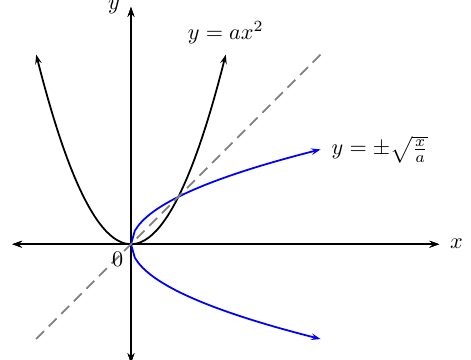
Note
The "switch and solve" method works for all inverse functions, not just quadratics. This systematic approach ensures you don't miss any steps in the process.
Domain and range relationships
One of the most important concepts with inverse functions is how domain and range switch roles:
Important
Critical Relationship:
- The domain of the original function becomes the range of the inverse function
- The range of the original function becomes the domain of the inverse function
This relationship holds for ALL inverse functions, not just quadratics.
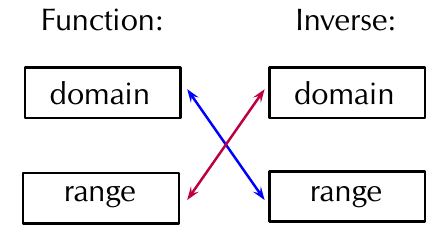
For a quadratic function where :
- Original function: Domain = all real numbers, Range =
- Inverse function: Domain = , Range = all real numbers
Why the inverse is not always a function
The vertical line test is crucial for determining whether a relation is a function. A relation is a function if every vertical line crosses the graph at most once.
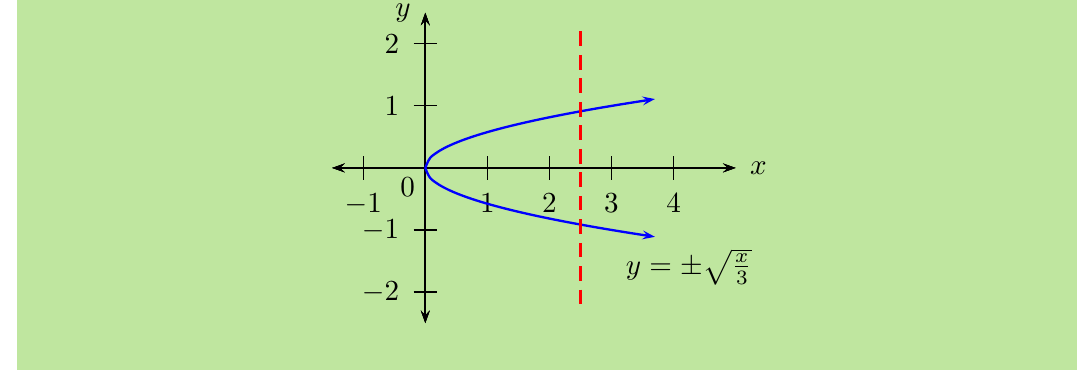
When we find the inverse of , we get , which creates two branches. This fails the vertical line test because vertical lines can intersect the graph at two points.
Important
Common Mistake Alert: Many students forget that the inverse of a quadratic function is NOT automatically a function. The ± in means you get two y-values for each x-value, violating the definition of a function.
Restricting the domain
To make the inverse of a quadratic function into a proper function, we must restrict the domain of the original function. There are two common approaches:
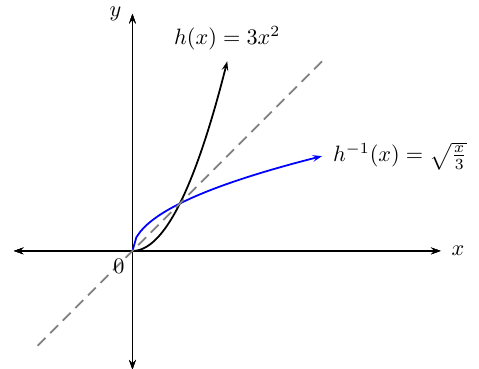
Option 1: Restrict to x ≥ 0
- Original function: for
- Inverse function: for
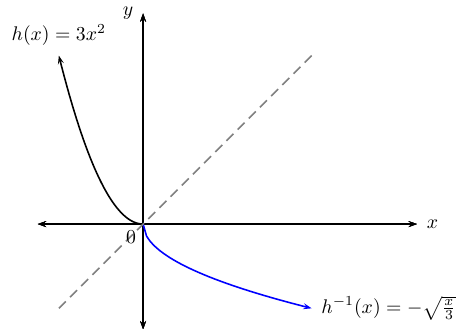
Option 2: Restrict to x ≤ 0
- Original function: for
- Inverse function: for
Note
The choice of domain restriction depends on the context of the problem. Both approaches are mathematically valid, but one may be more practical than the other depending on the situation.
Worked example 1: Finding the inverse of h(x) = 3x²
Example
Worked Example: Finding the inverse of h(x) = 3x²
Question: Determine the inverse of and sketch both graphs.
Solution:
Step 1: Find the inverse
- Let
- Interchange x and y:
- Solve for y:
- Therefore:
Step 2: Sketch the graphs The original function is an upward-opening parabola, and its inverse consists of two curved branches extending horizontally from the origin.
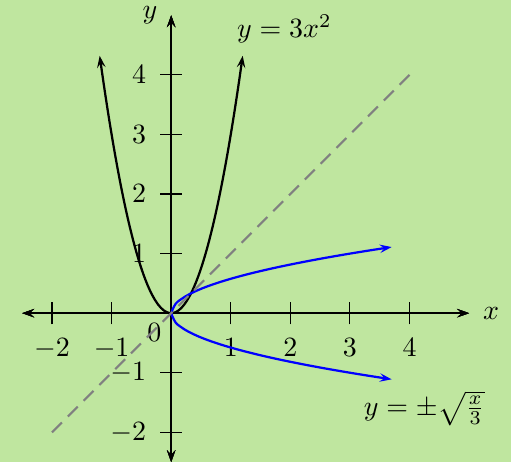
Notice that both functions intersect at the origin and are reflections of each other across the line .
Worked example 2: Domain restrictions with q(x) = 7x²
Example
Worked Example: Domain restrictions with q(x) = 7x²
Question: Determine the inverse of and restrict the domain so the inverse is a function.
Solution:
Step 1: Find the inverse
- Let
- Interchange:
- Solve:
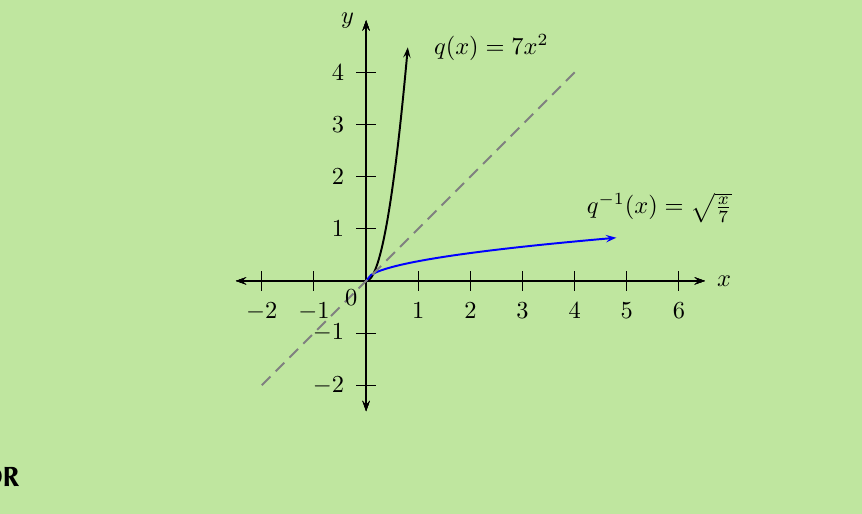
Step 2: Apply domain restriction If we restrict q to , then for .
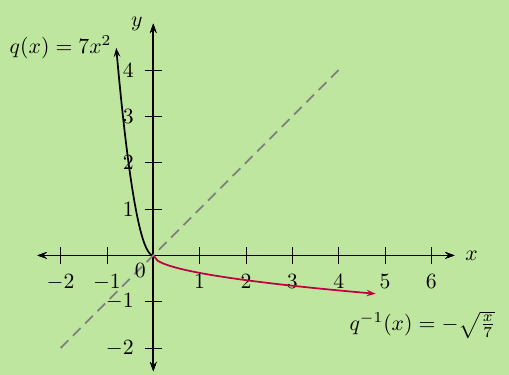
Alternatively, if we restrict q to , then for .
Worked example 3: Inverse of f(x) = -x²
Example
Worked Example: Inverse of f(x) = -x²
Question: Determine the inverse of .
Solution:
Step 1: Find the inverse
- Let
- Interchange:
- Solve:
- Therefore:
Note that is only defined when .
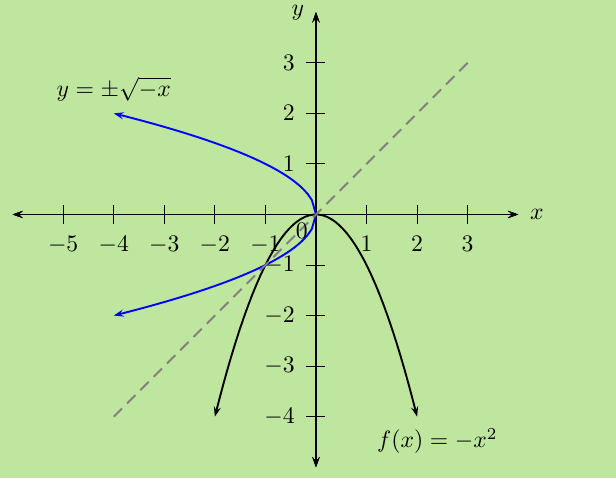
Step 2: Domain considerations For (a downward-opening parabola):
- If we restrict to : has domain and range
- If we restrict to : has domain and range
Worked example 4: Finding intersection points
Example
Worked Example: Finding intersection points
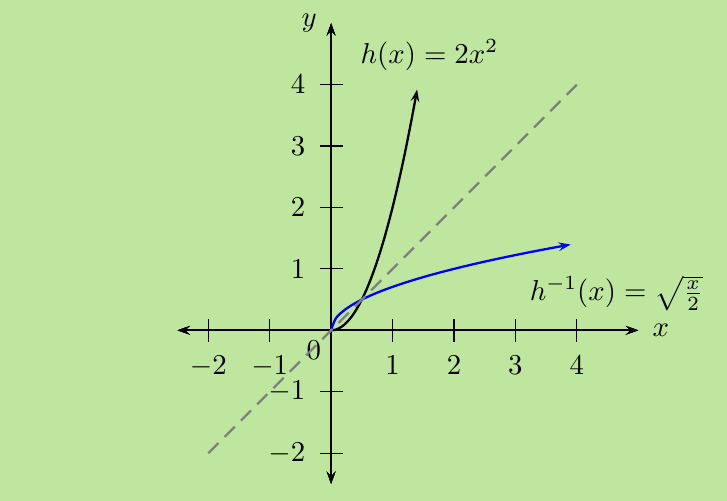
Question: Given for , find where h and intersect.
Solution:
Step 1: Find the inverse
- for
Step 2: Find intersection points Set :
Solving this equation:
Therefore or , giving intersection points at and .
Properties of quadratic function inverses
Increasing and decreasing behaviour:
- If the original quadratic function is increasing on its restricted domain, then its inverse is also increasing
- If the original quadratic function is decreasing on its restricted domain, then its inverse is also decreasing
Average gradient: The average gradient between two points can be calculated using:
For inverse functions, the average gradient between corresponding points on the function and its inverse are equal when calculated between the same intersection points.
Key graphical features
When sketching quadratic functions and their inverses:
- Both graphs pass through the origin (for )
- The graphs are reflections of each other across the line
- The line y = x acts as a line of symmetry between function and inverse
- Domain restrictions determine which branch of the inverse to use
- Intersection points occur where the function equals its inverse
Note
The line y = x is crucial when sketching inverse functions. Every point on the original function corresponds to the point on its inverse, making them reflections across this line.
Exam tips
Important
Essential Exam Strategies:
- Always check whether domain restrictions are specified in the question
- Remember that the inverse of gives , not just the positive branch
- Use the vertical line test to verify whether the inverse is a function
- When sketching, show the line to demonstrate the reflexion property
- Be careful with the domain and range - they switch between function and inverse
Summary
Summary
Key Points to Remember:
- The inverse of is , giving two branches
- Domain restrictions are essential to make the inverse a proper function
- Domain and range switch roles between a function and its inverse
- Graphs of inverse functions are reflections across the line
- Use the vertical line test to check if the inverse is a function
- The systematic "switch and solve" method works for finding any inverse function
- Both branches of the inverse are mathematically valid - the choice depends on domain restrictions