Revision (Grade 12 NSC Matric Mathematics): Revision Notes
📚Revision Notes
Revision
Introduction to function types
This revision covers the key characteristics and graphing techniques for three important function types that you need to master: linear functions, quadratic functions, and exponential functions. Each type has its own unique features and graphing methods that you'll use throughout your mathematics studies.
Linear functions
Definition and standard form
A linear function creates a straight line when graphed on a coordinate plane. The standard form of a linear function is:
Where:
- (or ) represents the gradient (slope) of the line
- (or ) represents the y-intercept (where the line crosses the y-axis)
Note
The terms "gradient" and "slope" mean the same thing - they describe how steep the line is and whether it's increasing or decreasing.
Key characteristics of linear functions
Note
Key Features of Linear Functions:
Linear functions have several important features:
- Domain: All real numbers
- Range: All real numbers
- Graph shape: Always a straight line
- Gradient: Constant throughout the entire line
- The function is either increasing (positive gradient) or decreasing (negative gradient)
Method for graphing linear functions
You can graph a linear function using the gradient-intercept method:
- Identify the y-intercept ( value) and plot this point on the y-axis
- Use the gradient ( value) to find another point by moving from the y-intercept
- Draw a straight line through these points
Alternatively, you can find both intercepts:
- y-intercept: Set and solve for
- x-intercept: Set and solve for
Example
Worked Example: Linear Function
Question: Draw a graph of and find the significant characteristics of this linear function.
Solution:
Step 1: Write the equation in standard form
Starting with:
Rearrange:
Divide by 2:
Therefore: and
Step 2: Draw the straight line graph
Using the gradient-intercept method:
- y-intercept:
- Gradient:
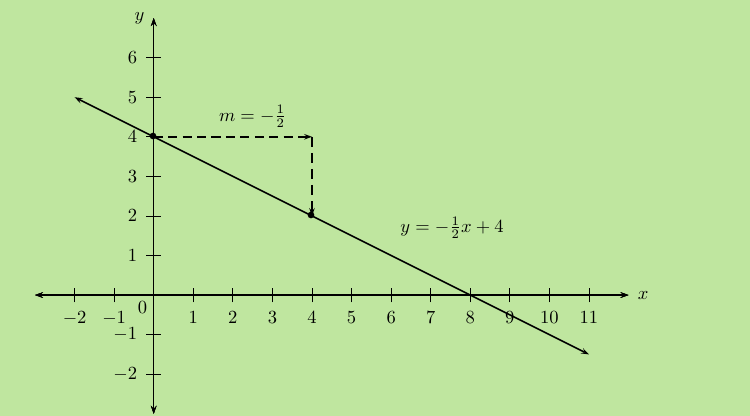
Alternative method - find both intercepts:
- For y-intercept, let : , giving point
- For x-intercept, let : , so , therefore , giving point
Step 3: State the key characteristics
- Gradient:
- Intercepts: and
- Domain:
- Range:
- Decreasing function: as x increases, y decreases
Quadratic functions
Definition and standard form
A quadratic function creates a curved graph called a parabola. The standard form of a quadratic function is:
Where:
- determines the direction and width of the parabola
- affects the position of the axis of symmetry
- represents the y-intercept
Important
Remember: If , the parabola "smiles" (opens upward). If , the parabola "frowns" (opens downward).
Key characteristics of quadratic functions
Note
Key Features of Quadratic Functions:
Quadratic functions have these important features:
- Graph shape: U-shaped curve (parabola)
- Turning point (vertex): The lowest or highest point of the parabola
- Axis of symmetry: Vertical line through the turning point, formula:
- Domain: All real numbers
- Range: Depends on the turning point value
- If : parabola "smiles" (opens upward)
- If : parabola "frowns" (opens downward)
Method for graphing quadratic functions
To graph a quadratic function:
- Find the y-intercept by setting
- Find the x-intercepts by setting and solving the equation
- Find the turning point using
- Plot these key points and draw the parabolic curve
Example
Worked Example: Quadratic Function
Question: Write the quadratic function in standard form. Draw a graph of the function and state the significant characteristics.
Solution:
Step 1: Write the equation in standard form
Starting with:
Rearrange:
Divide by 2:
Therefore: , ,
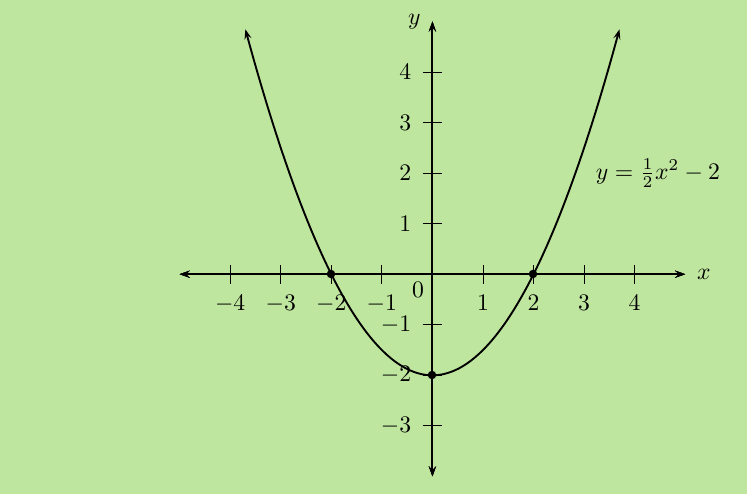
Step 2: Draw a graph of the parabola
Find key points:
- For y-intercept, let : , giving point
- For x-intercepts, let : , so , therefore , giving
- This gives us points and
Step 3: State the significant characteristics
- Shape: , therefore the graph is a "smile" (opens upward)
- Intercepts: , and
- Turning point:
- Axis of symmetry:
- Domain:
- Range:
- The function is decreasing for and increasing for
Exponential functions
Definition and standard form
An exponential function creates a curved graph that shows rapid growth or decay. The standard form of an exponential function is:
Where:
- is called the base of the exponential function
- If : the function shows exponential growth
- If : the function shows exponential decay
Important
All exponential functions pass through the point because for any positive base .
Key characteristics of exponential functions
Note
Key Features of Exponential Functions:
Exponential functions have these important features:
- Domain: All real numbers
- Range: All positive real numbers
- Horizontal asymptote: The line (x-axis)
- y-intercept: Always passes through the point
- No x-intercept: The graph never touches the x-axis
- The function is either always increasing or always decreasing
Method for graphing exponential functions
To graph an exponential function:
- Identify the y-intercept at
- Create a table of values for different x-values
- Plot the points and draw a smooth curve
- Remember the horizontal asymptote at
Example
Worked Example: Exponential Functions
Question: Draw the graphs of and on the same set of axes and compare the two functions.
Solution:
Step 1: Examine the functions and work out the information needed to draw the graphs
For :
- If : , but , so no solution (no x-intercept)
- If : , giving point
- Asymptotes: has a horizontal asymptote at (the x-axis)

For :
- If : , but , so no solution (no x-intercept)
- If : , giving point
- Asymptotes: also has a horizontal asymptote at

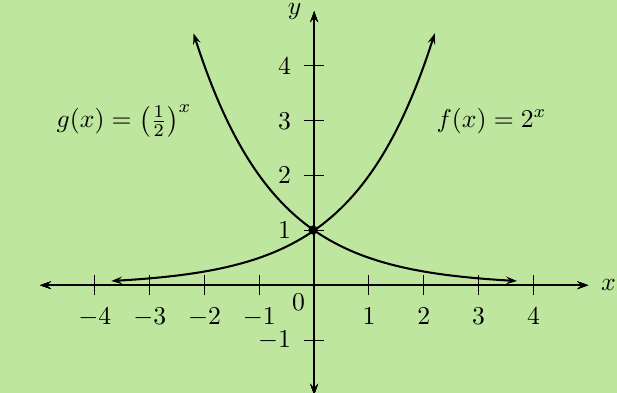
Step 2: Draw the graphs of the exponential functions
Step 3: State the significant characteristics
- Symmetry: and are symmetrical about the y-axis
- Domain of and :
- Range of and :
- Function decreases as increases and function increases as increases
- The two graphs intersect at the point
Summary
Key Points to Remember:
- Linear functions have the form and create straight line graphs with constant gradient
- Quadratic functions have the form and create parabolic curves with a turning point and axis of symmetry
- Exponential functions have the form and create curves with horizontal asymptotes, showing either growth () or decay ()
- All exponential functions pass through the point and have a horizontal asymptote at
- Always convert equations to standard form first before identifying key characteristics and graphing