Summary (Grade 12 NSC Matric Mathematics): Revision Notes
📚Revision Notes
Summary
What is a function?
A function is a special type of rule that creates a unique relationship between two sets of values. Think of it as a mathematical machine - for every input you put in, you get exactly one output.
Note
Think of a function like a vending machine: you press one button (input) and get exactly one specific item (output). You can't press button A and sometimes get a chocolate bar and sometimes get chips - that would break the function rule!
More formally, a function uniquely associates each element from one set (called set A) with exactly one element from another set (called set B).
Functions can be classified into different types based on how they map inputs to outputs. A one-to-one relation means each input corresponds to a unique output, whilst a many-to-one relation allows multiple inputs to produce the same output. However, for something to be a function, each input can only produce one output.
Testing if a relation is a function
Important
The vertical line test is your go-to method for determining whether a graph represents a function. Here's how it works: if you can draw any vertical line that crosses the graph more than once, then the relation is not a function. This happens because a vertical line represents one input value, and if it crosses the graph multiple times, that means one input is producing multiple outputs - which violates the definition of a function.
Understanding inverse functions
An inverse function, written as , essentially "undoes" what the original function does. If takes you from input to output, then takes you back from output to input.
Example
Finding the Inverse of a Function
To find the inverse of a function , follow these three steps:
Step 1: Replace every with and every with in the equation
Step 2: Make the subject of the new equation
Step 3: Express the result using inverse function notation
Note
When you graph a function and its inverse together, you'll notice they are reflections of each other about the line . This visual relationship helps you understand how inverse functions work - they're like mirror images across this diagonal line!
Domain and range relationships
Important
Domain and Range Swap Rule
There's an important relationship between a function and its inverse regarding domain and range. The domain of the original function becomes the range of the inverse function, and the range of the original function becomes the domain of the inverse function. This swap makes sense when you think about how inverse functions reverse the input-output relationship.
Special types of functions and their inverses
Straight line functions
Straight line functions have the form , where and are constants. Their inverse functions are also straight lines (with the important exception of vertical and horizontal lines, which don't have inverses that are functions).
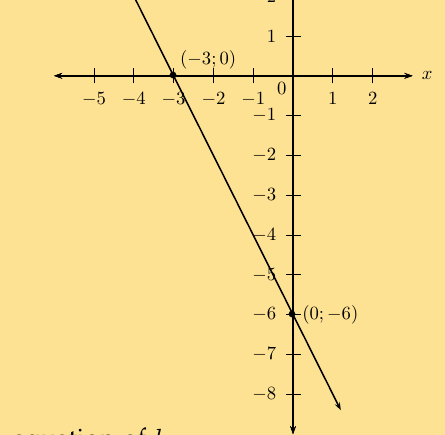
The graph above shows a straight line with x-intercept at (-3, 0) and y-intercept at (0, -6), demonstrating the linear relationship between x and y coordinates.
Quadratic functions
Quadratic functions follow the pattern . Interestingly, the inverse of a parabola is not actually a function because it fails the vertical line test. However, you can make it work by limiting the domain of the original parabola so that its inverse becomes a function.
Note
The reason quadratic functions fail the vertical line test for their inverses is because parabolas are symmetric - for most y-values, there are two corresponding x-values. By restricting the domain to only the left or right half of the parabola, we can create a function with a proper inverse.
Exponential functions
Exponential functions have the form where and . The inverse of an exponential function is a logarithmic function: .
Logarithmic functions and laws
The logarithmic function is closely related to exponential functions. The common logarithm uses base 10 and can be written as . When you see the log symbol without a base specified, it means base 10.
Example
Essential Logarithmic Laws
Here are the fundamental logarithmic laws you need to master:
- Power law: (where )
- Change of base: (where and )
- Product law: (where and )
- Quotient law: (where and )
These laws are extremely useful for simplifying complex logarithmic expressions and solving exponential equations.
Comparing function types
| Function Type | Formula | Inverse Formula | Has Inverse Function? |
|---|---|---|---|
| Straight line | Yes | ||
| Quadratic | No (unless domain restricted) | ||
| Exponential | Yes |
Understanding these patterns helps you quickly identify function types and predict their behaviour, which is especially useful in exam situations.
Summary
Key Points to Remember:
- A function must pass the vertical line test - one input gives exactly one output
- Inverse functions "undo" the original function and are reflections about
- Domain and range swap places between a function and its inverse
- Not all functions have inverses that are also functions (like unrestricted parabolas)
- Logarithmic laws follow predictable patterns that mirror the rules for exponents
- Each function type has distinctive characteristics that help with identification and problem-solving