Cubic Polynomials (Grade 12 NSC Matric Mathematics): Revision Notes
📚Revision Notes
Cubic Polynomials
Introduction to polynomial division
Before we explore cubic polynomials, we need to understand how division works with polynomials. Just like with ordinary numbers, we can divide one polynomial by another to get a quotient and remainder.
The division algorithm
When we divide integers, we follow a basic pattern. For example, when we divide 11 by 2, we get 5 with remainder 1.
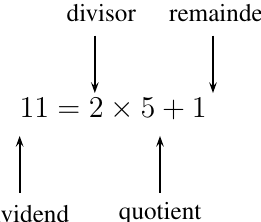
This can be written as:
Important
The Division Algorithm for Integers
In general terms, when we divide an integer by an integer , we get:
where:
- is the dividend (the number being divided)
- is the divisor (the number we're dividing by)
- is the quotient (the result)
- is the remainder (what's left over)
- and
Extension to polynomials
This same principle applies to polynomials. The division algorithm extends beautifully from integers to polynomial expressions.
Note
Polynomial Division Algorithm
When we divide a polynomial by a polynomial , we get:
where:
- is the dividend polynomial
- is the divisor polynomial
- is the quotient polynomial
- is the remainder polynomial
In words: the dividend equals the divisor multiplied by the quotient, plus the remainder.
What are cubic polynomials?
A cubic polynomial is a polynomial expression where the highest power of the variable is 3. This means the degree of the polynomial is 3.
General form
The general form of a cubic polynomial is:
where (if , it wouldn't be cubic anymore).
The term with is called the leading term, and '' is the leading coefficient.
Connection to previous learning
You may remember from Grade 10 how to factorise the sum and difference of cubes. These patterns become very useful when working with cubic polynomials.
Note
Sum and Difference of Cubes (Grade 10 Review)
- Sum of cubes:
- Difference of cubes:
These patterns are useful when working with cubic polynomials.
Methods for factoring cubic polynomials
There are three main methods we use to factorise cubic polynomials with one variable:
- Long division
- Synthetic division
- Inspection
We'll focus on the first two methods, as they provide systematic approaches to polynomial division.
Long division method
Long division with polynomials works similarly to long division with numbers. It's a step-by-step process that finds both the quotient and remainder systematically.
Example
Worked Example: Long Division
Question: Use long division to find the quotient and remainder when is divided by .
Solution:
Step 1: Write the division in standard form
We want:
So:
Step 2: Perform the long division
Make sure both polynomials are written in descending order of exponents. If any degree is missing, write it with coefficient 0.
|
___________
_______
_______
Step 3: Write the final answer
- Therefore:
Synthetic division method
Synthetic division is a simpler and more efficient method for dividing polynomials. It allows us to find the quotient and remainder by working with coefficients only, without needing to write out variables and exponents.
Note
Key Features of Synthetic Division
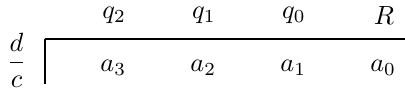
- The coefficients of the dividend are written below a horizontal line
- The coefficients of the quotient are written above the horizontal line
- We add coefficients instead of subtracting (unlike long division)
- We use the opposite sign of the constant term in the divisor
- The coefficient of in the divisor must be 1
Example
Worked Example: Synthetic Division
Question: Use synthetic division to find and when is divided by .
Solution:
Step 1: Set up the synthetic division
Since we're dividing by , we use in our calculation.
Step 2: Perform the synthetic division
↓ + + -
Working through:
Step 3: Write the final answer Since we divided a cubic by a linear expression, the quotient is quadratic:
- Therefore:
Example
Another Synthetic Division Example
Question: Find and when is divided by .
Solution:
Step 1: Prepare for synthetic division
First, we need the leading coefficient of the divisor to be 1:
So we divide by and use .
Step 2: Perform synthetic division
↓
Step 3: Account for the factor of 2 Since our original divisor was , our final answer is:
- Therefore:
Choosing between methods
Both long division and synthetic division give the same results, but synthetic division is generally faster and less prone to arithmetic errors.
Important
When to Use Each Method
Synthetic division only works when:
- The divisor is linear (degree 1)
- The coefficient of in the divisor is 1 (or can be made 1 by factoring)
For more complex divisors, long division is necessary.
Summary
Key Points to Remember:
- A cubic polynomial has degree 3, with general form where
- The division algorithm for polynomials states that
- Long division works for any polynomial division but can be lengthy
- Synthetic division is faster but only works for linear divisors with leading coefficient 1
- Both methods will give you the same quotient and remainder when applied correctly