Arithmetic Sequences (Grade 12 NSC Matric Mathematics): Revision Notes
📚Revision Notes
Arithmetic Sequences
What is an arithmetic sequence?
An arithmetic sequence is a special type of number pattern where each term is found by adding the same constant value to the previous term. This constant value is called the common difference.
Note
Definition: An arithmetic sequence is an ordered set of numbers where consecutive terms are calculated by adding a constant value to the previous term.
For example, consider the sequence: 3, 0, -3, -6, -9, ...
In this sequence, we add -3 to each term to get the next term. The common difference (d) is -3.
The key components of an arithmetic sequence are:
- a = the first term
- d = the common difference (the value added each time)
- n = the position of a term in the sequence
- Tn = the value of the nth term
The general term formula
To find any term in an arithmetic sequence without listing all previous terms, we use the general term formula.
Starting with the first term a, we can build the sequence:
Notice the pattern: each term equals the first term plus the common difference multiplied by .
Important
General Term Formula:
Where:
- is the nth term
- is the first term
- is the position of the term
- is the common difference
How to test for arithmetic sequences
To determine if a sequence is arithmetic, check whether the difference between consecutive terms is constant:
Test:
Note
If all these differences are equal, the sequence is arithmetic. If not, it's not an arithmetic sequence.
Arithmetic mean
The arithmetic mean between two numbers is the average of those numbers. When you place the arithmetic mean between two numbers, you create an arithmetic sequence of three terms.
Formula: Arithmetic mean =
For example, the arithmetic mean between 7 and 17 is: Arithmetic mean =
So 7, 12, 17 forms an arithmetic sequence with .
Graphical representation of arithmetic sequences
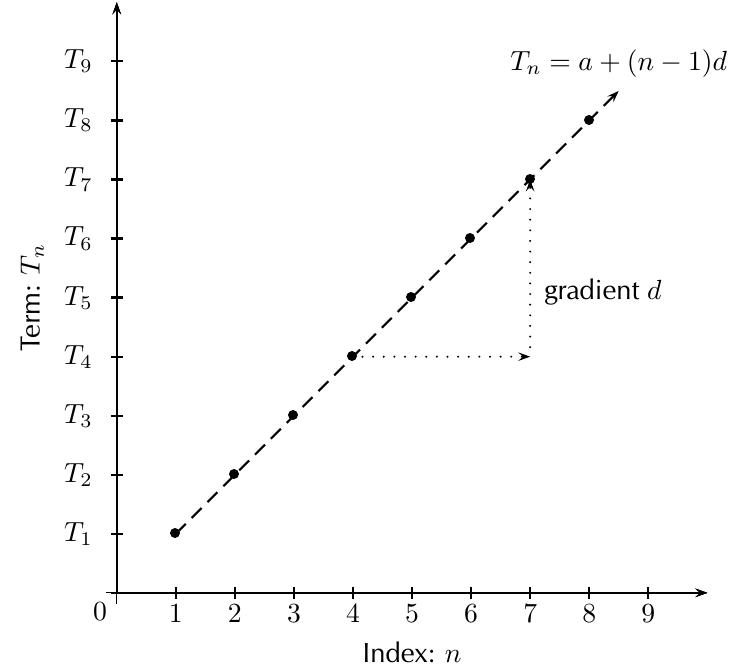
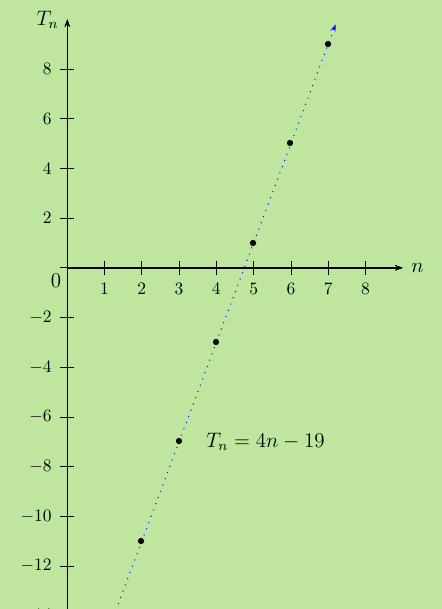
When you plot the terms of an arithmetic sequence on a coordinate graph, they form a straight line. This is why arithmetic sequences are also called linear sequences.
Note
The graph shows that:
- The points lie on a straight line
- The gradient of the line equals the common difference (d)
- The general formula has the same form as
This linear relationship makes arithmetic sequences easy to recognise when graphed.
Worked example
Example
Worked Example: Analysing an Arithmetic Sequence
Question: Given the sequence -15, -11, -7, ..., 173
- Is this an arithmetic sequence?
- Find the formula for the general term
- Determine the number of terms in the sequence
Solution:
Step 1: Check for common difference
Since the difference is constant, this is an arithmetic sequence with .
Step 2: Find the general term formula
Using where and :
Step 3: Find the number of terms
The last term is 173, so:
Therefore, there are 48 terms in the sequence.
Key characteristics of arithmetic sequences
Understanding these key properties helps identify and work with arithmetic sequences:
- Constant difference: The difference between consecutive terms is always the same
- Linear growth: Terms increase or decrease at a steady rate
- Straight line graph: When plotted, the points form a straight line
- General formula: Always in the form
- Predictable pattern: Any term can be calculated without finding all previous terms
Summary
Key Points to Remember:
- An arithmetic sequence has a constant difference between consecutive terms
- The general term formula is , where is the first term and is the common difference
- To test if a sequence is arithmetic, check that all consecutive differences are equal
- Arithmetic sequences form straight lines when graphed, making them linear sequences
- The arithmetic mean of two numbers creates the middle term of a three-term arithmetic sequence