Geometric Sequences (Grade 12 NSC Matric Mathematics): Revision Notes
📚Revision Notes
Geometric Sequences
What is a geometric sequence?
A geometric sequence is a special type of sequence where each term is found by multiplying the previous term by the same fixed number. This fixed number is called the constant ratio, represented by the letter r.
In simpler terms, if you know one term in a geometric sequence, you can find the next term by multiplying it by r, and the term after that by multiplying by r again, and so on.
Note
Key characteristics of geometric sequences:
- Each term = previous term × constant ratio (r)
- The ratio between consecutive terms is always the same
- The sequence grows (or shrinks) by multiplication, not addition
Understanding geometric sequences is essential for many mathematical applications, from calculating compound interest to modelling population growth patterns.
Understanding the constant ratio (r)
The constant ratio (r) is the value you multiply each term by to get the next term. To find the constant ratio, divide any term by the term before it.
Formula for constant ratio:
Where:
- = first term
- = second term
- = nth term
- = term before the nth term
The beauty of geometric sequences lies in this consistency - no matter which consecutive terms you choose, the ratio will always be the same.
Real-world example: Disease spread pattern
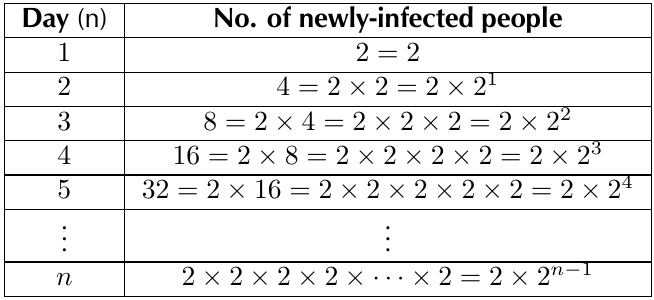
Let's look at how a disease might spread to understand geometric sequences better. Imagine each infected person spreads the disease to exactly 2 other people each day.

This creates a pattern where the number of newly infected people doubles each day:
Example
Worked Example: Analysing Disease Spread Pattern
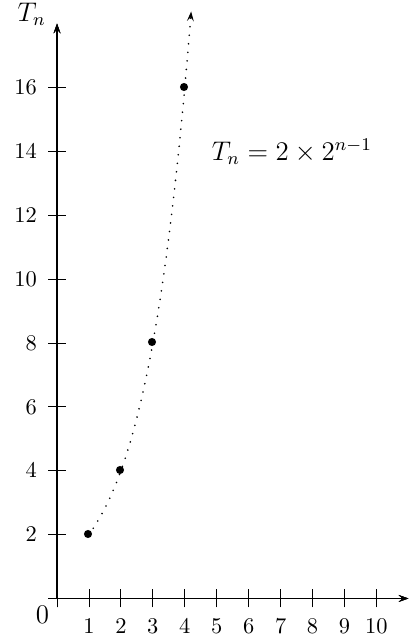
The sequence of newly infected people is: 2, 4, 8, 16, 32, ...
Let's verify this is geometric by checking the ratios:
Since all ratios equal 2, we confirm this is a geometric sequence with constant ratio r = 2.
This pattern demonstrates how geometric sequences can model exponential growth in real-world situations.
General term formula
For any geometric sequence, we can find a formula to calculate the nth term directly without having to work out all the terms before it.
Important
The general term formula is:
Where:
- = the nth term (the term you want to find)
- = the first term of the sequence
- = the constant ratio
- = the position number of the term
Why is the power (n-1)?
Let's examine the pattern step by step:
- 1st term:
- 2nd term:
- 3rd term:
- nth term:
The power starts at 0 for the first term, which is why we use for the nth term.
How to test if a sequence is geometric
To check whether a sequence is geometric, follow this systematic approach:
Note
Testing Process:
- Calculate the ratio between consecutive terms
- Check if all ratios are equal
The test formula is:
If all ratios are the same, the sequence is geometric. If any ratio is different, it's not geometric.
This verification step is crucial before applying geometric sequence formulas to ensure accuracy in your calculations.
Worked example: Disease spread calculations
Example
Worked Example: Disease Spread Calculations
Question: Using the flu epidemic example where :
- Calculate how many newly-infected people there are on the tenth day
- On which day will 16,384 people be newly-infected?
Solution:
Step 1: Write down known values
- (first term)
- (constant ratio)
Step 2: Calculate
On the tenth day, there are 1024 newly-infected people.
Step 3: Find when
Since :
There are 16,384 newly-infected people on the 14th day.
Geometric mean
The geometric mean between two numbers is a value that, when placed between them, creates a geometric sequence.
For a geometric sequence a, x, b:
Example
Worked Example: Finding Geometric Mean
Find the geometric mean between 5 and 20.
Step 1: Set up the equation
For the sequence 5, x, 20 to be geometric:
Step 2: Solve for x
Step 3: Check both solutions
- Using : Sequence is 5, 10, 20 with ratio
- Using : Sequence is 5, -10, 20 with ratio
Both are valid geometric sequences.
Note
Notice that geometric means can produce two different sequences - one with a positive ratio and one with a negative ratio. Both are mathematically correct.
Common exam tips
Summary
Key Points to Remember:
- Always check that ratios are constant before using geometric sequence formulas
- The general term formula uses as the power, not
- Geometric means can be positive or negative
- When solving for , use the fact that if , then (same base rule)
- Show all working steps clearly in calculations
Important
Common mistakes to avoid:
- Using instead of in the general term formula
- Forgetting to consider both positive and negative geometric means
- Not checking if the sequence is actually geometric before applying formulas
- Confusing arithmetic sequences (which add a constant) with geometric sequences (which multiply by a constant)
Remember!
Summary
Essential Geometric Sequence Concepts:
- Geometric sequences multiply by a constant ratio to get from one term to the next
- Constant ratio (must be the same for all consecutive terms)
- General term formula is where is the first term
- Test for geometric sequence by checking if all consecutive ratios are equal
- Geometric mean between and is , giving two possible sequences