Infinite Series (Grade 12 NSC Matric Mathematics): Revision Notes
📚Revision Notes
Infinite Series
What is an infinite series?
An infinite series is the sum of an unlimited number of terms in a sequence. Unlike finite series where we only add the first n terms, infinite series continue indefinitely. The key question becomes: what happens when we add infinitely many terms together?
Note
Surprisingly, even when adding infinitely many numbers, the answer isn't always infinity. Sometimes these infinite sums approach a specific finite value, which opens up fascinating mathematical possibilities.
Understanding convergence through investigation
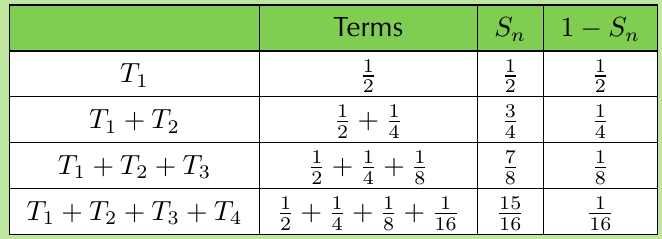
When we examine what happens as we add more and more terms to a series, we can observe an important pattern. Let's consider the geometric series with first term and common ratio .
Example
Investigation: Partial Sums of a Geometric Series
As we add successive terms, we notice that:
- The partial sum gets larger:
- The amount by which increases gets smaller:
- The partial sum appears to be approaching the value 1
This behaviour suggests that even though we're adding infinitely many terms, the sum approaches a finite limit.
Convergence and divergence
Key definitions
Understanding whether a series converges or diverges is fundamental to working with infinite series. The following definitions help us classify the behaviour of infinite series:
Important
Convergent series: If the sum of a series gets closer and closer to a certain value as we increase the number of terms, we say the series converges. There is a limit to the sum of a converging series.
Divergent series: If a series does not converge, we say it diverges. The sum of an infinite series usually tends to infinity, but there are special cases where it does not.
Notation: We express the sum of an infinite number of terms as:
Infinite geometric series
Test for convergence
For geometric series, there's a simple test to determine convergence or divergence based on the common ratio:
Important
Test for convergence:
- If , then the infinite geometric series converges
- If or , then the infinite geometric series diverges
This test is crucial because it tells us immediately whether an infinite geometric series will have a finite sum or not.
Sum to infinity formula
When a geometric series converges (when ), we can calculate its exact sum using a specific formula:
Note
Sum to infinity formula:
Where:
- is the first term of the series
- is the common ratio
Understanding why the formula works
The derivation of this formula comes from examining the behaviour of partial sums as approaches infinity. As approaches infinity in a convergent geometric series, approaches 0. This means:
- The formula becomes
- The series reaches its limiting value
Worked examples
The following examples demonstrate how to apply the concepts of convergence and sum to infinity in different contexts:
Example
Worked Example 1: Finding sum to infinity
Question: Find the sum to infinity of the series
Solution:
Step 1: Identify the first term and common ratio
Step 2: Check convergence
Since , the series converges.
Step 3: Apply the formula
Therefore, the sum approaches 27 as we add infinitely many terms.
Example
Worked Example 2: Converting recurring decimals
Question: Convert to a fraction using infinite series.
Solution:
Step 1: Express as a series
Step 2: Identify the geometric series
- First term:
- Common ratio:
Step 3: Check convergence and apply formula
Since , the series converges.
Therefore, .
Example
Worked Example 3: Finding unknown values
Question: If , find the possible values of and .
Solution:
Step 1: Apply the sum formula
Therefore:
Step 2: Apply convergence condition
For convergence:
Substituting :
This gives us:
Simplifying:
Step 3: State the answer
For the series to converge: and .
Summary
Key Points to Remember:
- Infinite series can have finite sums when they converge to a specific limit
- Convergence test: A geometric series converges if and only if
- Sum to infinity formula: for convergent geometric series
- Divergent series have no finite limit and usually tend to infinity
- Recurring decimals can be converted to fractions using infinite geometric series
Note
Exam Tips:
- Always check the convergence condition first before applying the sum to infinity formula
- Arithmetic series never converge - they always tend to positive or negative infinity
- When converting recurring decimals, identify the repeating pattern as a geometric series
- Remember that is the key condition for geometric series convergence
- Practice identifying the first term and common ratio accurately