Equation of a Circle: Centre at (a;b) (Grade 12 NSC Matric Mathematics): Revision Notes
📚Revision Notes
Equation of a Circle: Centre at (a;b)
What is the equation of a circle with centre at (a;b)?
When a circle is not centred at the origin, we need to adjust our equation to account for the shifted centre position. Understanding this concept is fundamental to solving many coordinate geometry problems involving circles.
Note
Definition: A circle is the set of all points that are equidistant from a fixed point called the centre. The distance from the centre to any point on the circle is called the radius.
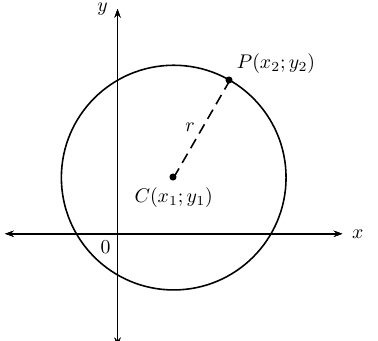
Deriving the general equation
To find the equation of a circle with centre at point C(a; b), we use the distance formula. Consider any point P(x; y) on the circumference of the circle.
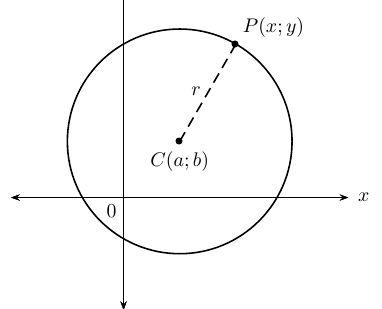
The distance from the centre C(a; b) to any point P(x; y) on the circle equals the radius r:
Distance formula:
Since this distance equals the radius:
Squaring both sides to eliminate the square root:
Therefore, the standard form of a circle equation is:
Important
Key Formula:
Where:
- (a; b) is the centre of the circle
- r is the radius
- (x; y) represents any point on the circle
Special case: Circle centred at the origin
When the centre is at the origin (0; 0), the equation becomes:
This simplifies to:
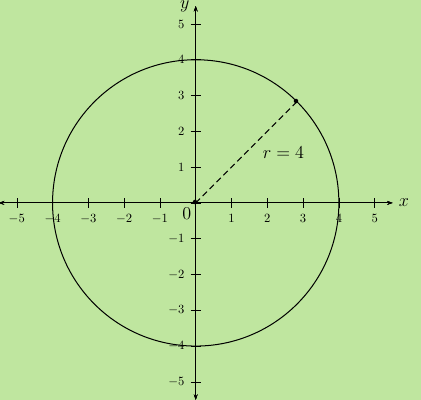
Worked example 1: Finding the equation from centre and point
Example
Worked Example: Finding the equation from centre and point
Question: F(6; -4) is a point on the circle with centre C(3; -4). Find the equation of the circle.
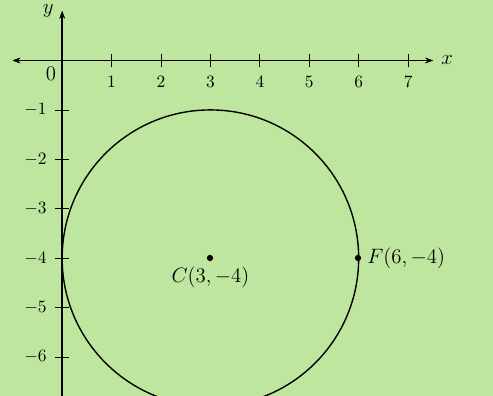
Solution:
Step 1: Write the general equation
Step 2: Substitute the centre coordinates (3; -4)
Step 3: Find the radius using point F(6; -4)
Substitute F(6; -4) into the equation:
Step 4: Write the final equation
Worked example 2: Converting from general form to standard form
Example
Worked Example: Converting from general form to standard form
Question: Find the centre and radius of the circle:
Solution:
Step 1: Make coefficients of and equal to 1
Divide everything by 3:
Step 2: Complete the square for x terms
Take half of the x coefficient:
Step 3: Complete the square for y terms
Take half of the y coefficient:
Answer: Centre is (-1; 2) and radius is 4 units.
Worked example 3: Circle transformations
Example
Worked Example: Circle transformations
Question: A circle has equation . If it is shifted 2 units down and 1 unit right, write the equation of the shifted circle.
Solution:
Step 1: Identify the original circle
Centre: (0; 0), Radius: 4
Step 2: Apply the transformations
- Vertical shift: 2 units down means replace y with (y + 2)
- Horizontal shift: 1 unit right means replace x with (x - 1)
Step 3: Write the new equation
The new centre is (1; -2) with radius 4 units.
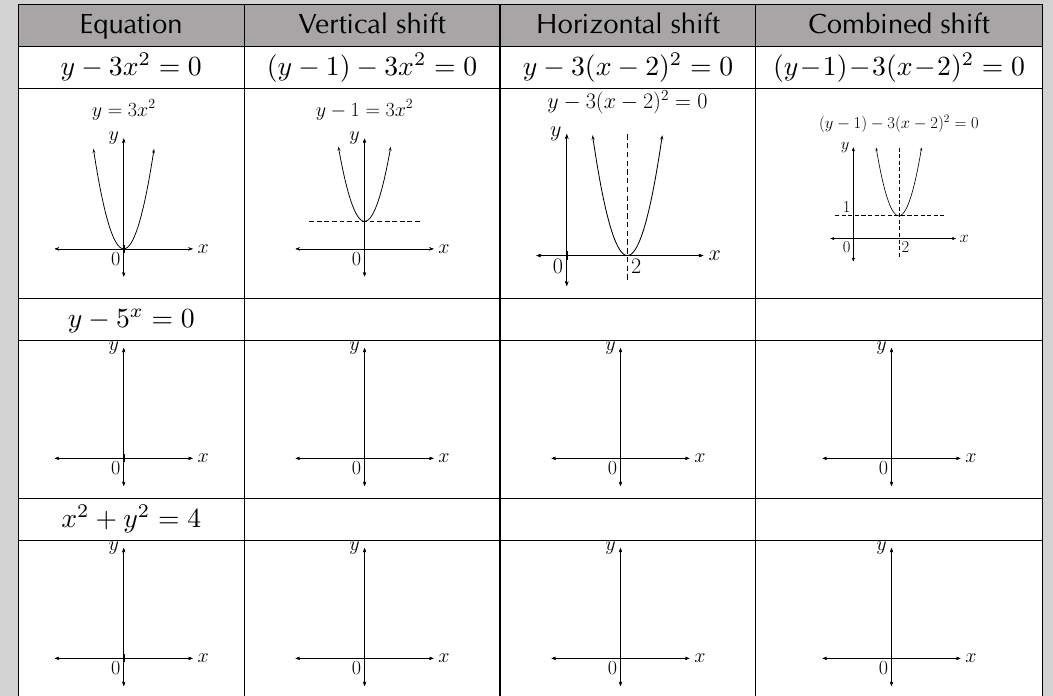
Circle transformations summary
Note
Key transformation rules:
- Horizontal shift h units right: replace x with (x - h)
- Vertical shift k units up: replace y with (y - k)
- Combined shifts: has centre (h; k)
Worked example 4: Advanced problem with geometric constraints
Example
Worked Example: Advanced problem with geometric constraints
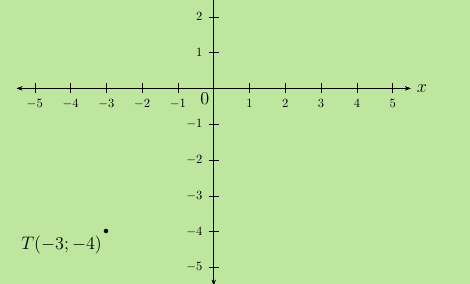
Question: Given points S(-3; 4) and T(-3; -4), find the equation of a circle where these points are endpoints of a diameter.
Solution:
Step 1: Find the centre (midpoint of diameter)
Centre =
Centre =
Step 2: Calculate the radius
Radius = distance from centre to either point
Step 3: Write the equation
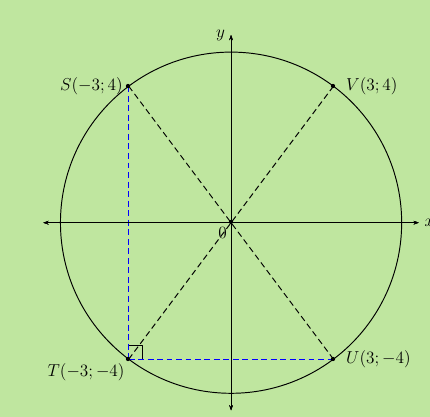
Important property: Any angle subtended by a diameter at the circumference is 90°.
Circle relationships
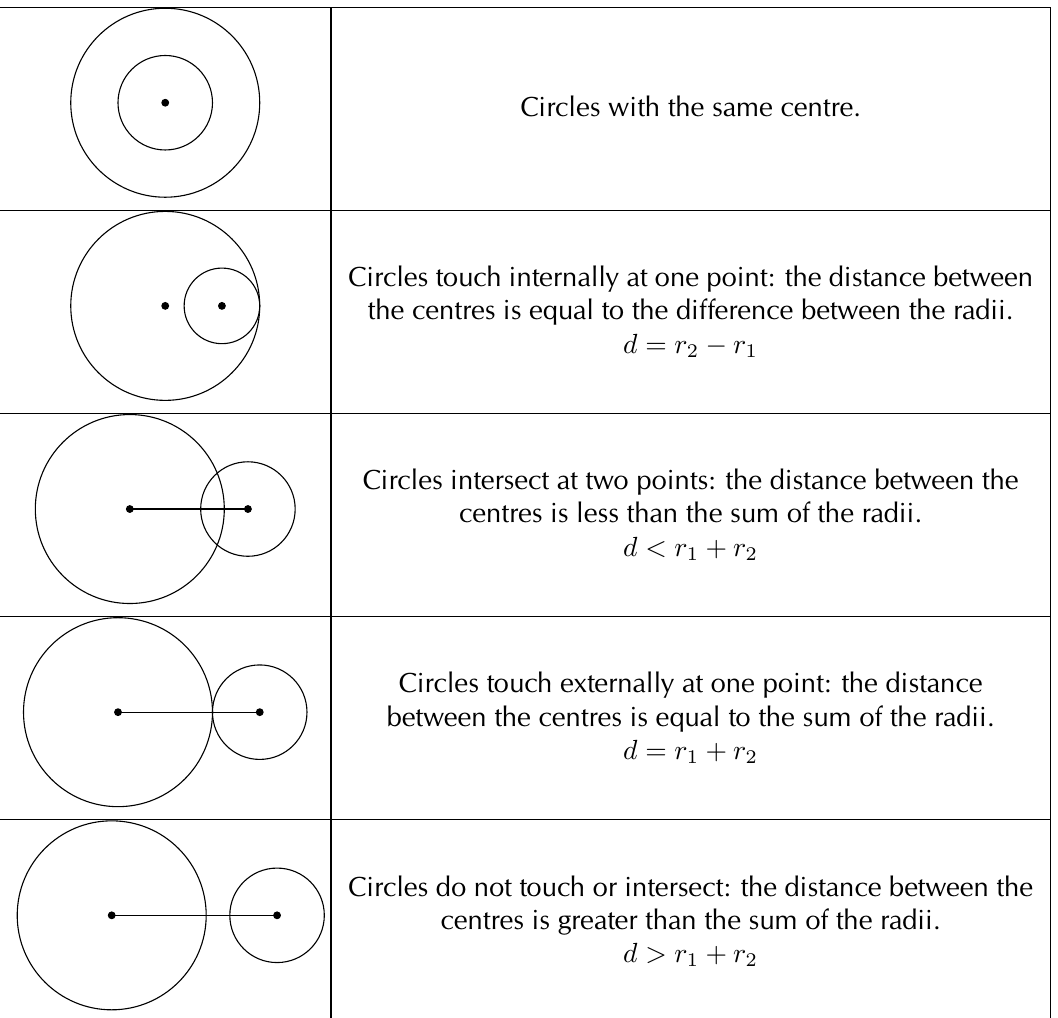
Understanding how circles interact is important for solving complex problems:
Note
Key relationships (where d = distance between centres, and = radii):
- Concentric circles: Same centre, different radii
- Internal tangent: (circles touch internally)
- Intersecting: (circles cross at two points)
- External tangent: (circles touch externally)
- Separate: (circles don't touch)
Important exam tips
- Always sketch the circle first to visualise the problem
- Remember that (a; b) in the equation means the centre is at (a; b)
- When completing the square, add and subtract the same value
- Check your answer by substituting a known point back into the equation
- For transformations, be careful with positive and negative signs
Important
Common exam mistakes to avoid
- Confusing the signs: means centre has x-coordinate +a
- Forgetting to square both sides when using the distance formula
- Mixing up horizontal and vertical shifts in transformations
- Not simplifying the radius when is given as a perfect square
Summary
Key Points to Remember:
- Circle equation with centre (a; b):
- Distance from centre to any point on circle equals radius: Use this to find
- Completing the square: Take half the coefficient, square it, then add and subtract
- Transformations: Horizontal shift h units right → replace x with (x - h); Vertical shift k units up → replace y with (y - k)
- Always sketch the circle to check your solution makes geometric sense