Revision (Grade 12 NSC Matric Mathematics): Revision Notes
📚Revision Notes
Revision
Essential formulas for straight lines
Understanding the fundamental formulas is crucial for solving analytical geometry problems. These formulas form the foundation for all straight line calculations.
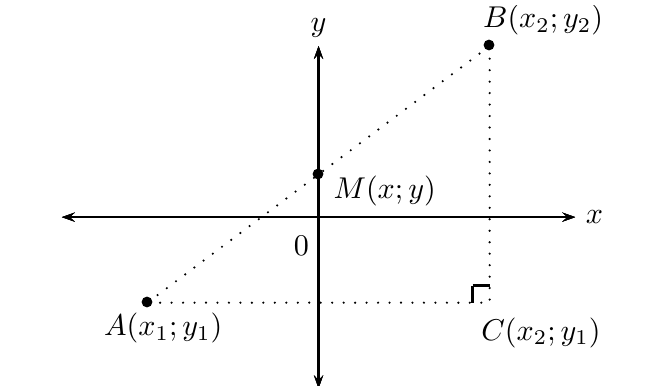
Distance formula
The distance formula calculates the length between any two points on a coordinate plane. For points A(x₁; y₁) and B(x₂; y₂):
Note
This formula comes from the Pythagorean theorem, where we create a right triangle using the horizontal and vertical distances between the points.
Gradient formula
The gradient (or slope) measures how steep a line is. It represents the rate of change between two points:
The gradient tells us:
- How much y increases for every unit increase in x
- Whether the line slopes upward (positive gradient) or downward (negative gradient)
Note
Remember the phrase "rise over run" - the gradient is the vertical change divided by the horizontal change.
Midpoint formula
The midpoint is the exact centre point between two given points:
This formula simply averages the x-coordinates and y-coordinates separately.
Forms of straight line equations
There are three main forms of straight line equations, each useful in different situations.
Two-point form
When you know two specific points on the line, use:
This form directly uses the coordinates of both points to establish the line's equation.
Gradient-point form
When you know the gradient and one point on the line:
Note
This is often the most convenient form when you already know the slope of the line.
Gradient-intercept form
When you know the gradient and y-intercept:
where:
- is the gradient
- is the y-intercept (where the line crosses the y-axis)
Special cases: horizontal and vertical lines
Some lines have special properties that make their equations simpler.
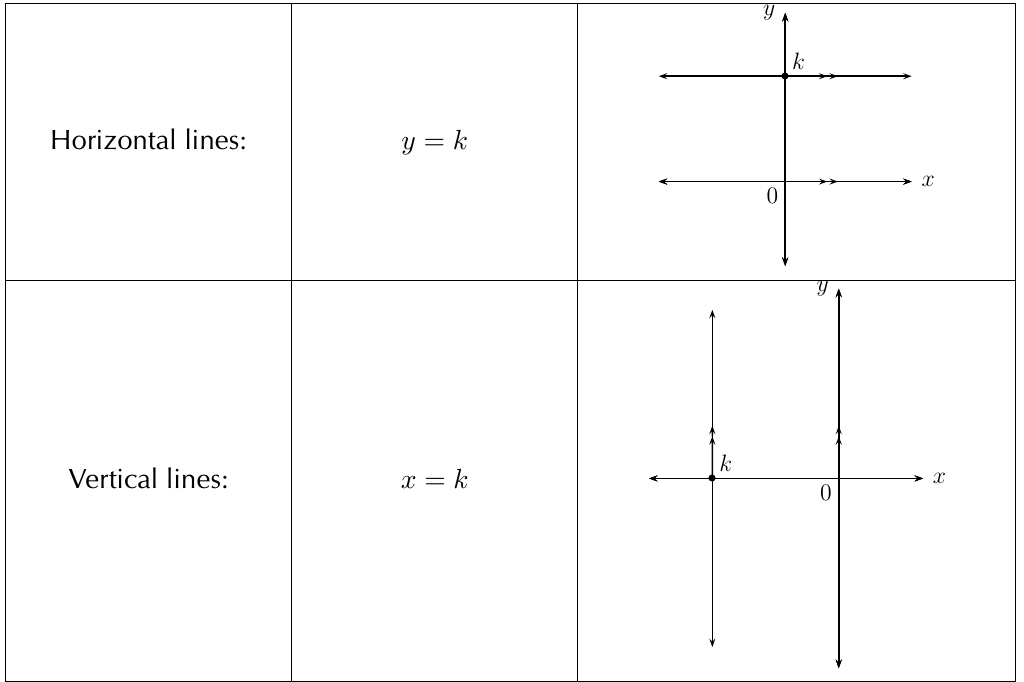
Horizontal lines
Horizontal lines have zero gradient and are parallel to the x-axis. Their equation is:
where is a constant representing the y-coordinate of every point on the line.
Vertical lines
Vertical lines have undefined gradient and are parallel to the y-axis. Their equation is:
where is a constant representing the x-coordinate of every point on the line.
Important
Vertical lines cannot be written in the form because their gradient is undefined.
Worked example: quadrilateral properties
Example
Worked Example: Analysing Quadrilateral PQRS
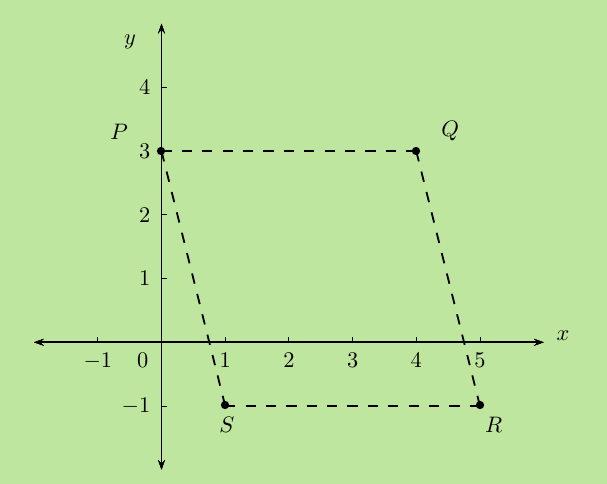
Given quadrilateral PQRS with vertices P(0; 3), Q(4; 3), R(5; -1), and S(1; -1).
Step 1: Find equations of lines PS and QR
For line PS using two-point form:
- P(0; 3) and S(1; -1)
For line QR using gradient-intercept form:
- Q(4; 3) and R(5; -1)
- Gradient:
- Using point Q(4; 3):
Step 2: Verify parallel lines
Both PS and QR have gradient = -4, so PS || QR.
Step 3: Calculate lengths
Using the distance formula:
- units
- units
Since PS || QR and PS = QR, quadrilateral PQRS is a parallelogram.
Inclination of a line
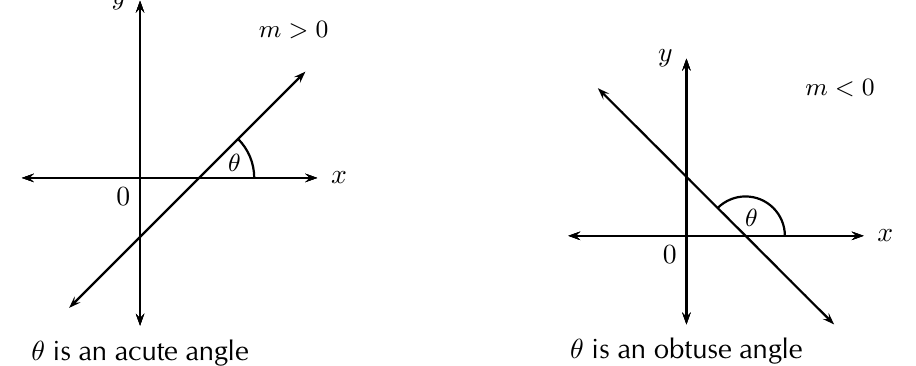
The angle of inclination is the angle θ that a line makes with the positive x-axis, measured anticlockwise.
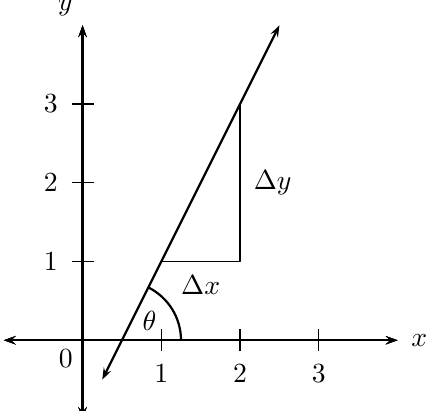
Key relationship
This connects the gradient of a line directly to its angle of inclination.
Lines with positive gradients
When , the line slopes upward from left to right, and θ is an acute angle (0° < θ < 90°).
Example: For
Lines with negative gradients
When , the line slopes downward from left to right, and θ is an obtuse angle (90° < θ < 180°).
Important
For negative gradients, we calculate the reference angle first, then add 180° to get the obtuse angle.
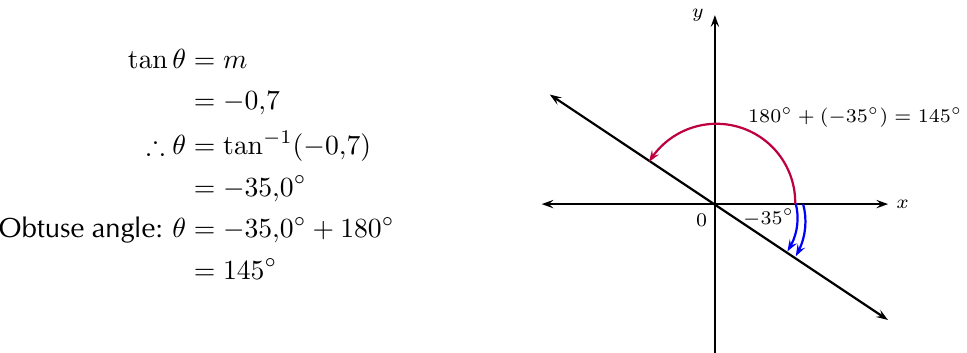
Example: For
- Reference angle =
- Obtuse angle =
Worked example: finding inclination angles
Example
Worked Example: Finding Angles Between Lines
Determine the acute angle between line PQ passing through P(-2; 0) and Q(3; 1), and the line .
Step 1: Find gradient of line PQ
Step 2: Find angle of inclination for PQ
Step 3: Find angle of inclination for
From the equation,
Since the gradient is negative, this gives an obtuse angle:
Reference angle =
Step 4: Calculate the acute angle between the lines
Parallel and perpendicular lines
Understanding the relationship between gradients helps identify parallel and perpendicular lines.
Parallel lines
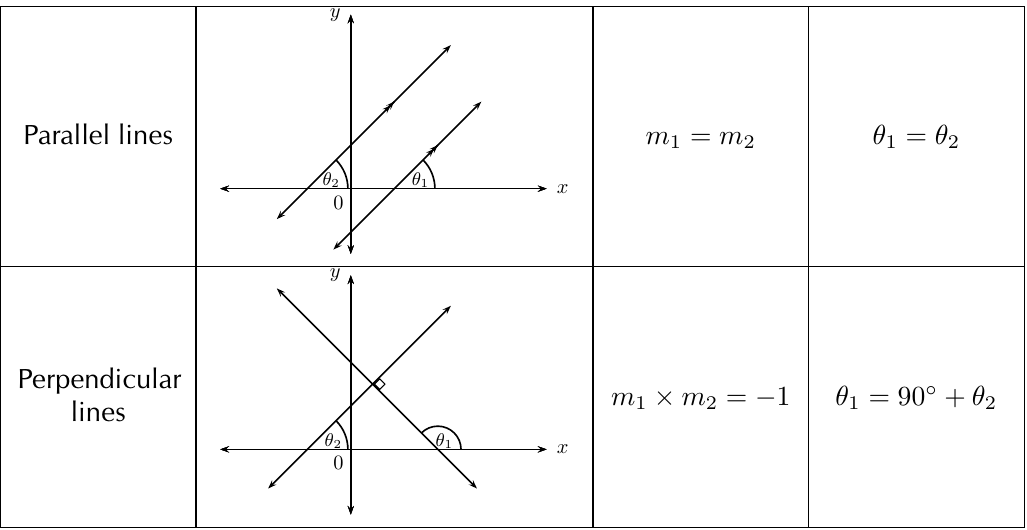
Parallel lines have identical gradients and will never intersect.
Condition:
The lines also have equal angles of inclination:
Perpendicular lines
Perpendicular lines intersect at right angles (90°).
Condition:
The angles of inclination are related by:
Important
If one line has gradient , then a perpendicular line has gradient .
Worked example: parallel and perpendicular lines
Example
Worked Example: Finding Parallel and Perpendicular Lines
Given line AB with angle of inclination 153.4°, find equations for:
- Line CD parallel to AB through C(2; -3)
- Line EF perpendicular to AB through origin
Step 1: Find gradient of AB
Step 2: Equation of parallel line CD
Since CD || AB:
Using point C(2; -3):
Step 3: Equation of perpendicular line EF
Since EF ⊥ AB:
Through origin (0; 0):
Step 4: Verify angle of inclination for EF
Method 1:
Method 2: , so ✓
Summary
Key Points to Remember:
- Distance formula: - essential for finding lengths
- Three equation forms: Use two-point form when given coordinates, gradient-point form when given slope and a point, gradient-intercept form when given slope and y-intercept
- Parallel lines: Same gradient (), never intersect
- Perpendicular lines: Product of gradients equals -1 (), intersect at 90°
- Negative gradients: Add 180° to reference angle to get the obtuse angle of inclination