Euclidean Geometry (Grade 12 NSC Matric Mathematics): Revision Notes
📚Revision Notes
Triangles
Introduction to proportionality of triangles
Understanding the relationship between triangle areas and their dimensions is fundamental in Euclidean geometry. When we study triangles, we often need to compare their areas and understand how changing certain properties affects these relationships. This forms the basis for several important theorems that help us solve complex geometric problems.
The key to understanding triangle proportionality lies in recognising how area, base, and height interact with each other. Remember that the area of any triangle is calculated using the formula:
Note
Area Formula for Triangles:
This fundamental formula is the foundation for all triangle proportionality relationships.
This simple formula leads to powerful relationships when we compare different triangles.
Triangles with equal heights
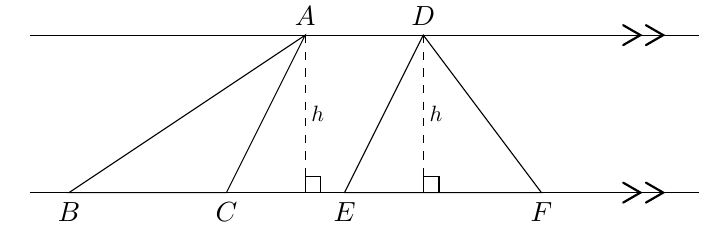
When two triangles share the same height, there's a beautiful relationship between their areas and their bases.
Important
Key Principle: Triangles with equal heights have areas which are proportional to their bases.
Let's understand this step by step:
- If triangle ABC and triangle DEF both have the same height
- Area of triangle ABC =
- Area of triangle DEF =
- Therefore:
This means the ratio of the areas equals the ratio of the bases when triangles have the same height.
Triangles with equal bases and heights
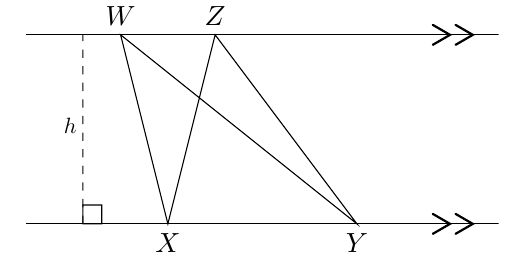
When triangles not only share the same base but also have the same height, something special happens.
Important
Key Principle: Triangles with equal bases and between the same parallel lines are equal in area.
This occurs because:
- Both triangles share base XY
- Both triangles have vertices that lie on a line parallel to the base
- This ensures both triangles have the same height
- Therefore:
Triangles with equal areas
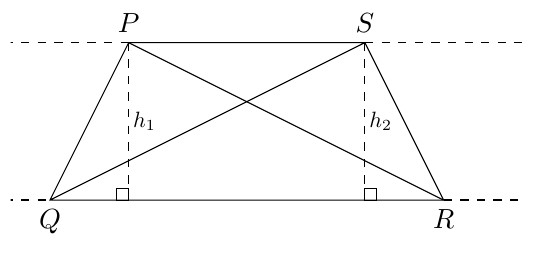
Here's a fascinating reverse relationship - when triangles have equal areas and share the same base, we can deduce something about their heights.
Important
Key Principle: Triangles on the same side of the same base and equal in area, lie between parallel lines.
The reasoning works as follows:
- If Area PQR = Area SQR and both share base QR
- Then
- This means
- Therefore, line PS must be parallel to QR
Note
This reverse relationship is particularly useful when solving problems where we know areas are equal and need to prove that certain lines are parallel.
The proportion theorem
This is one of the most important theorems in triangle geometry and forms the foundation for understanding similar triangles.
Important
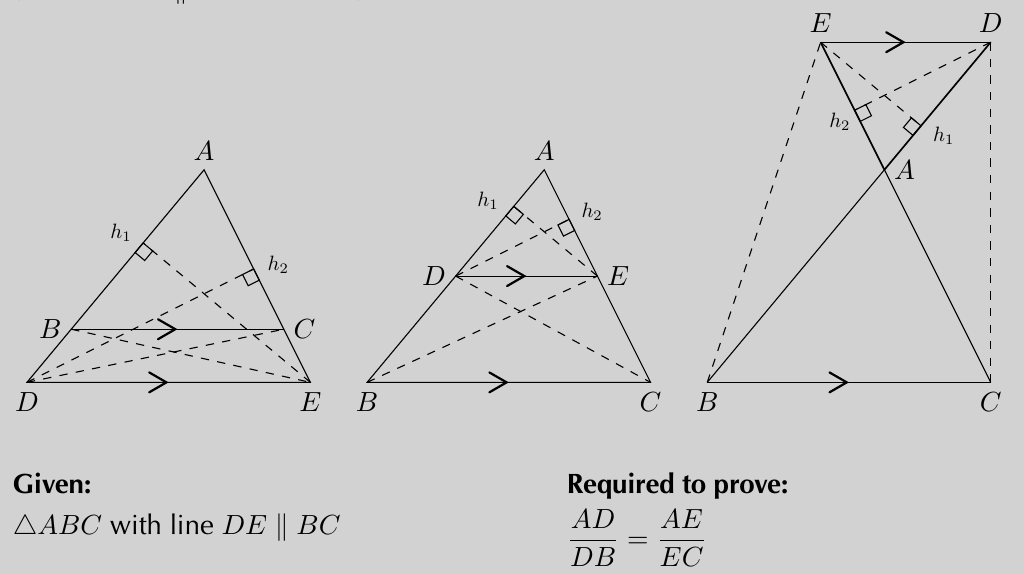
Statement: A line drawn parallel to one side of a triangle divides the other two sides of the triangle in the same proportion.
Given: Triangle ABC with line DE parallel to BC
To prove:
Proof outline
The proof uses the area relationships we've already learned:
- Draw heights from E perpendicular to AD, and from D perpendicular to AE
- Use area relationships: Since triangles ADE and BDE share the same height from E, their areas are proportional to their bases AD and BD
- Similarly: Triangles ADE and CED have areas proportional to AE and EC
- Key insight: Triangles BDE and CED have equal areas because they share the same base DE and lie between parallel lines
- Conclude: This equality of areas leads to the proportional relationship
Example
Worked Example: Proportion Theorem
Question: In triangle TQP, SR is parallel to QP. SQ = 12 cm, RP = 15 cm. If TR = , TP = , and TS = , determine the values of and .
Solution:
Step 1: Use the proportion theorem for segment TP Since SR || QP, we have:
- RP =
- From the given information:
- Therefore: cm
- And: TR = cm
Step 2: Apply proportionality for segment TQ Since the line is parallel to one side of the triangle:
- Therefore: cm
The mid-point theorem
This is a special case of the proportion theorem that occurs when we're dealing with midpoints.
Important
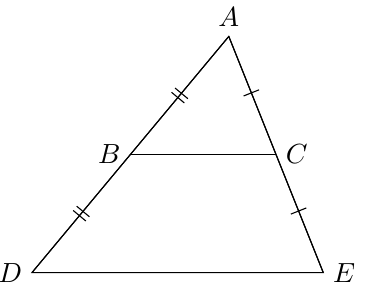
Statement: The line joining the mid-points of two sides of a triangle is parallel to the third side and equal to half the length of the third side.
Mathematical expression: If AB = BD and AC = CE, then:
- BC is parallel to DE
We can also express this using ratios:
Converse of the mid-point theorem
Note
Statement: The line drawn from the mid-point of one side of a triangle parallel to another side, bisects the third side of the triangle.
Mathematical expression: If AB = BD and BC || DE, then AC = CE.
Example
Worked Example: Proportionality of Triangles
Question: Given parallelogram PQRS with QR produced to T. RS = 45 cm, QR = 30 cm and cm.
- Calculate H
- If TR : TQ = 1 : 4, show that
Solution:
Step 1: Find H using the parallelogram area formula
- Area PQRS = cm²
- Area PQRS =
- Therefore: cm
Step 2: Use proportionality to prove the area ratio Given TR : TQ = 1 : 4:
- , so
- Therefore:
Since triangles STR and PRQ have equal heights (PS || QT):
Summary
Key Points to Remember:
-
Same height triangles: Areas are proportional to their bases - if heights are equal, compare the bases to find area ratios
-
Same base triangles: When triangles share a base and lie between parallel lines, they have equal areas
-
Proportion theorem: A line parallel to one side of a triangle creates proportional segments on the other two sides - this is fundamental for solving many geometry problems
-
Mid-point theorem: The line joining midpoints of two triangle sides is parallel to the third side and half its length - remember this special case for quick problem solving
-
Area relationships: Use the formula strategically to establish relationships between different triangles in complex figures