Pythagorean Theorem (Grade 12 NSC Matric Mathematics): Revision Notes
📚Revision Notes
Pythagorean Theorem
Introduction
The Pythagorean theorem is one of the most important and widely used theorems in geometry. Many different methods of proving this theorem have been developed over the years, with the similarity of triangles providing one of the most elegant approaches to understanding this fundamental relationship.
Note
The Pythagorean theorem appears in virtually every area of mathematics and has practical applications in fields ranging from construction and engineering to computer graphics and navigation systems.
Theorem statement
Pythagorean theorem: The square on the hypotenuse of a right-angled triangle is equal to the sum of the squares on the other two sides.
Mathematical formula
For a right-angled triangle with sides of length and , and hypotenuse of length :
Where:
- c is the length of the hypotenuse (the longest side opposite the right angle)
- a and b are the lengths of the other two sides (called legs)
Important
The hypotenuse is always the longest side in a right triangle and is always opposite the right angle. This is crucial to remember when applying the theorem.
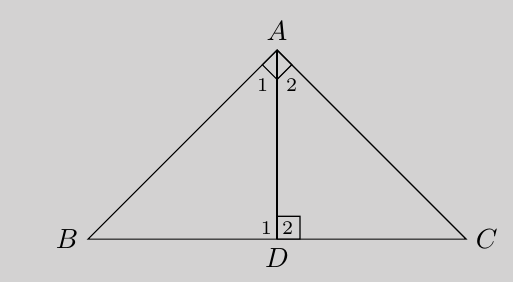
Proof of the Pythagorean theorem
The proof uses the construction of an altitude from the right angle to the hypotenuse, creating similar triangles that allow us to establish the theorem algebraically.
Given: Triangle ABC with
Required to prove:
Construction: Draw
Step-by-step proof
-
Identify the angles: Since AD is perpendicular to BC, we have:
- (angles of triangle CAD)
- (given that )
- Therefore:
-
Establish similar relationships: Similarly:
- (angles of triangle ABD)
- Therefore:
Note
The key insight here is that the altitude to the hypotenuse creates angles that are equal to the original acute angles of the triangle. This is what allows us to establish the similarity relationships.
-
Identify similar triangles: Since all angles are equal:
- (construction)
- Therefore: (AAA similarity)
-
Apply proportionality: From the similar triangles:
- , which gives us: AB² = BD × BC
- Similarly: , which gives us: AC² = CB × DC
-
Complete the proof:
Therefore:
Important
This proof demonstrates that the Pythagorean relationship emerges naturally from the properties of similar triangles. The altitude construction is the key that unlocks this relationship.
Converse theorem
The converse of the Pythagorean theorem is equally important for identifying right-angled triangles.
Converse theorem: If the square of one side of a triangle is equal to the sum of the squares of the other two sides of the triangle, then the angle included by these two sides is a right angle.
Mathematical statement: If , then the triangle is right-angled at the vertex opposite side .
Important
The converse is particularly useful in real-world applications where you need to determine if something is perfectly square or perpendicular, such as in construction or engineering.
Worked example
Example
Worked Example: Finding Unknown Sides
Question: In triangle PQR, and . If cm and cm, determine PR and QR (correct to the nearest integer).
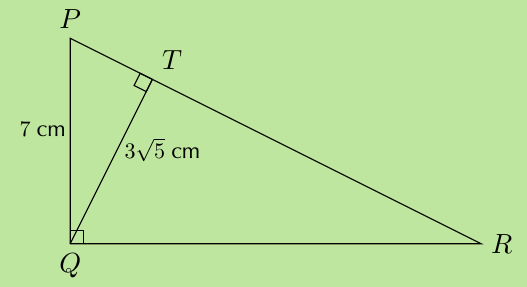
Solution:
Step 1: Use the Pythagorean theorem to determine PT
In triangle PTQ:
(Pythagoras)
Therefore: cm
Step 2: Use proportionality to determine PR and QR
Since and :
- Triangle triangle triangle (right-angled triangles)
From similarity:
Therefore:
And: cm (to nearest integer)
Step 3: Calculate QR using Pythagoras
In triangle PQR:
(Pythagoras)
Therefore: cm
Final answer: PR = 25 cm and QR = 24 cm
Special relationships in right triangles
When an altitude is drawn from the right angle to the hypotenuse in a right triangle, several important relationships emerge:
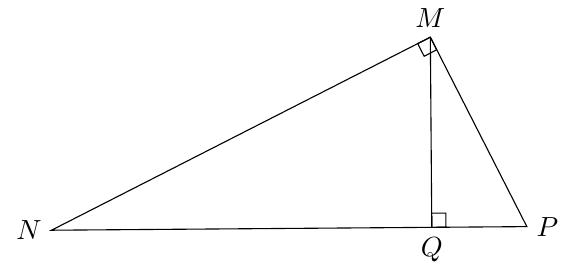
For any right-angled triangle MNP, if MQ is drawn perpendicular to NP:
Note
These relationships are particularly useful when solving problems involving the altitude to the hypotenuse. They provide alternative methods for finding unknown lengths when direct application of the Pythagorean theorem isn't immediately obvious.
Remember!
Summary
Key Points to Remember:
- The Pythagorean theorem only applies to right-angled triangles
- The hypotenuse is always the longest side and is opposite the right angle
- The formula is c² = a² + b² where c is the hypotenuse
- The converse helps us identify right triangles: if , then the triangle has a right angle
- When solving problems, always identify which side is the hypotenuse before applying the theorem
- The altitude to the hypotenuse creates similar triangles with useful proportional relationships