Revision (Grade 12 NSC Matric Mathematics): Revision Notes
📚Revision Notes
Revision
Types of triangles
Understanding triangle classification is fundamental to solving geometry problems. Triangles can be classified in two ways: by their side lengths and by their angle measures.
Classification by sides
Equilateral triangles have all three sides equal in length. All three angles are also equal, each measuring 60°. These triangles have three lines of symmetry and rotational symmetry.
Isosceles triangles have exactly two sides of equal length. The angles opposite these equal sides (called base angles) are also equal. This creates a line of symmetry through the vertex angle and the midpoint of the base.
Scalene triangles have all three sides of different lengths. This means all three angles are also different from each other. These triangles have no special symmetry properties.

Note
Remember that equilateral triangles are a special case of isosceles triangles, since they have at least two equal sides. However, they have additional properties due to all three sides being equal.
Classification by angles
Acute-angled triangles have all three interior angles less than 90°. The triangle appears "sharp" with no obtuse angles.
Right-angled triangles contain exactly one 90° angle. The side opposite the right angle is called the hypotenuse and is the longest side.
Obtuse-angled triangles have one interior angle greater than 90°. This creates a triangle that appears "flat" on one side.
Important
A triangle can only have one right angle or one obtuse angle. It's impossible for a triangle to have two or more right angles or obtuse angles, as the angles must sum to 180°.
Congruent triangles
Congruent triangles are triangles that are identical in size and shape. When two triangles are congruent, all corresponding sides are equal and all corresponding angles are equal.
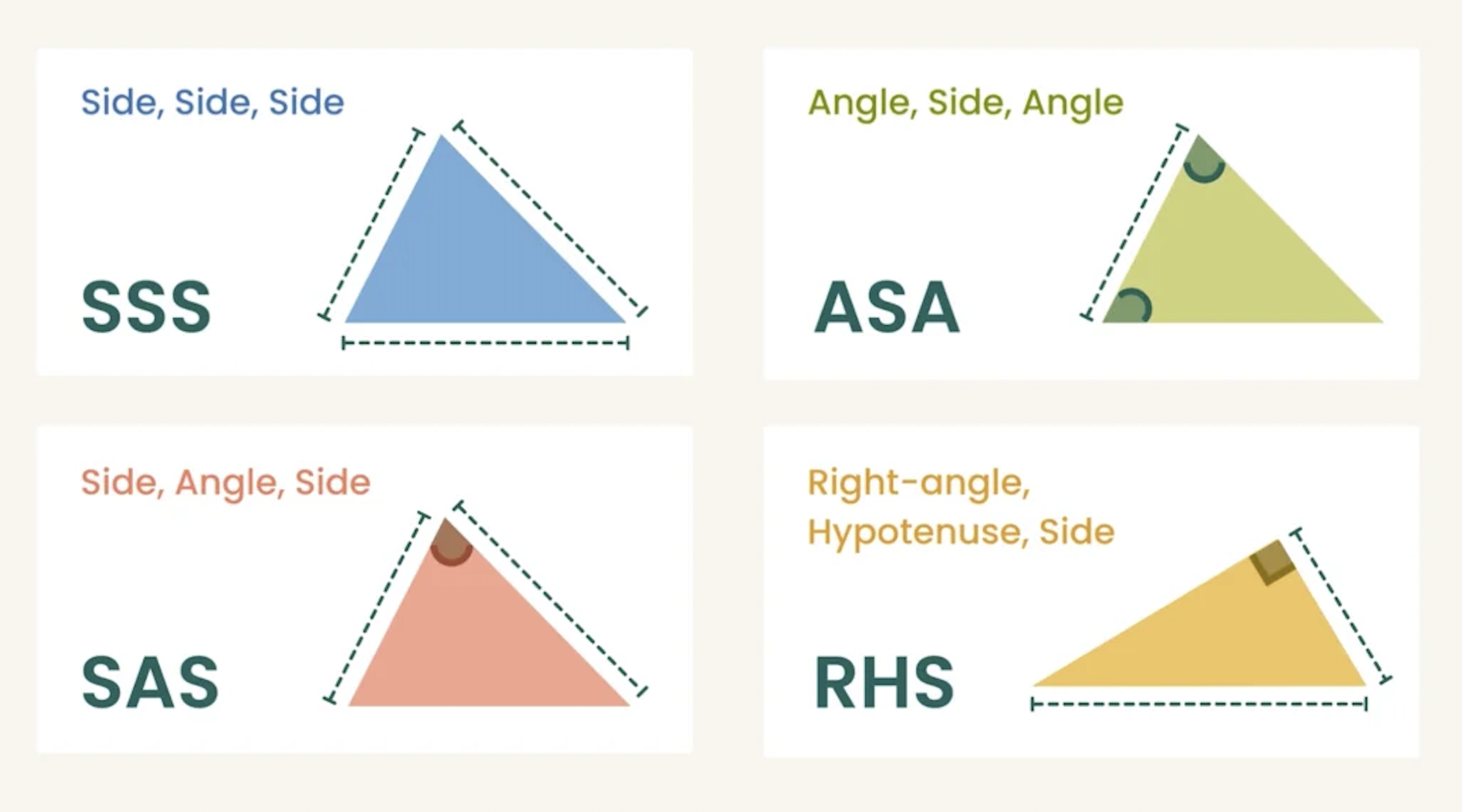
There are four conditions that prove triangle congruence:
SSS (Side, Side, Side)
When all three corresponding sides of two triangles are equal, the triangles are congruent. This is often the easiest condition to identify from given information.
SAS (Side, Angle, Side)
When two corresponding sides and the included angle (the angle between those sides) are equal, the triangles are congruent. The angle must be between the two equal sides.
Important
For SAS congruence, the angle must be the included angle - the angle between the two given sides. If the angle is not between the two sides, you cannot use SAS.
AAS (Angle, Angle, Side)
When two corresponding angles and any corresponding side are equal, the triangles are congruent. This works because if two angles are equal, the third angle must also be equal (angles in a triangle sum to 180°).
RHS (Right angle, Hypotenuse, Side)
This condition applies only to right-angled triangles. When the hypotenuse and one other side are equal in two right-angled triangles, the triangles are congruent.
Example
Worked Example: Identifying Congruence
Given: Triangle ABC and Triangle DEF where AB = DE = 5cm, BC = EF = 7cm, and angle ABC = angle DEF = 60°
Step 1: Identify what information we have
- Two sides and an included angle
Step 2: Determine the congruence condition
- This matches SAS (Side, Angle, Side)
Step 3: Conclusion
- Triangle ABC ≅ Triangle DEF by SAS
Similar triangles
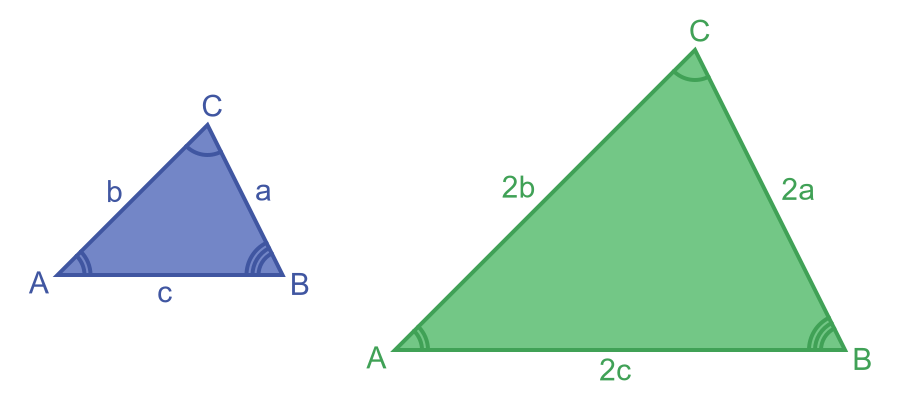
Similar triangles have the same shape but not necessarily the same size. Their corresponding angles are equal, and their corresponding sides are in the same ratio.
There are two main conditions for proving similarity:
AAA (Angle, Angle, Angle)
When all three corresponding angles of two triangles are equal, the triangles are similar. In practice, you only need to prove two angles are equal (since the third will automatically be equal).
SSS (Sides in proportion)
When the ratios of all three pairs of corresponding sides are equal, the triangles are similar. This is expressed as:
Note
Similar triangles maintain the same shape but can be different sizes. The ratio between corresponding sides is called the scale factor or ratio of similarity.
Circle geometry
Circle geometry involves understanding the relationships between various parts of a circle including the centre, radius, chords, and arcs.
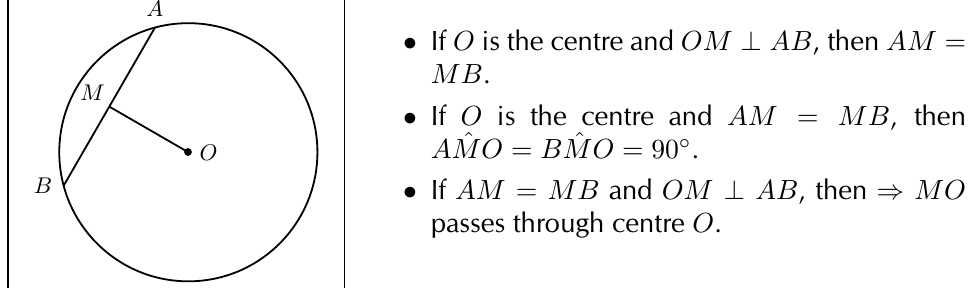
Perpendicular bisector theorem
When a line from the centre of a circle is drawn perpendicular to a chord, it bisects that chord. Conversely, if a line from the centre bisects a chord, then it is perpendicular to that chord.
Central and inscribed angles
The relationship between central angles (angles at the centre) and inscribed angles (angles on the circumference) is crucial. An inscribed angle is half the size of the central angle that subtends the same arc.
Important
Key Circle Theorem: An inscribed angle is always half the central angle that subtends the same arc.
If the central angle = 80°, then the inscribed angle = 40°
Equal arcs and angles
Angles at the circumference that are subtended by equal arcs are themselves equal. This property is frequently used in circle geometry proofs.
Cyclic quadrilaterals
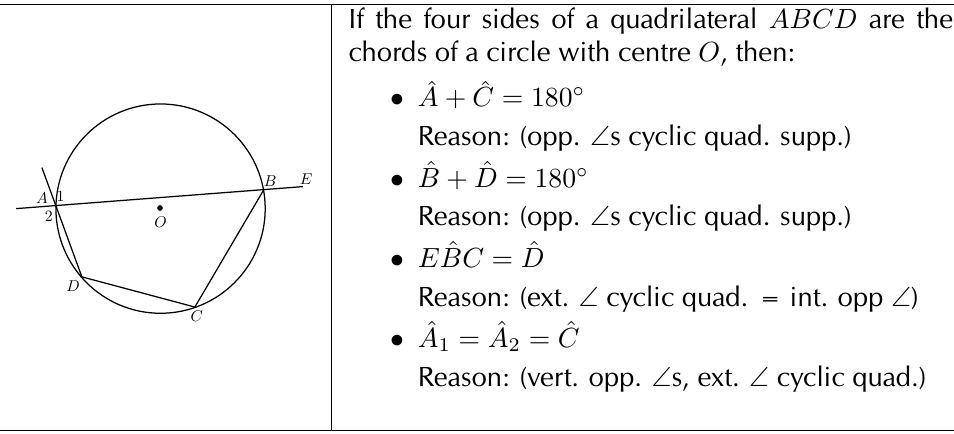
A cyclic quadrilateral is a four-sided polygon where all vertices lie on the circumference of a circle.
Properties of cyclic quadrilaterals
The most important property is that opposite angles are supplementary (they add up to 180°). If ABCD is a cyclic quadrilateral, then:
- Angle A + Angle C = 180°
- Angle B + Angle D = 180°
Important
Remember: In a cyclic quadrilateral, opposite angles are supplementary (add to 180°), not equal. This is different from properties of parallelograms where opposite angles are equal.
Proving a quadrilateral is cyclic
There are several ways to prove that a quadrilateral is cyclic:
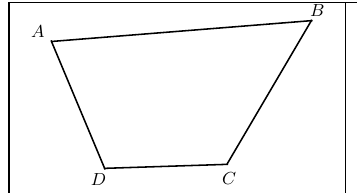

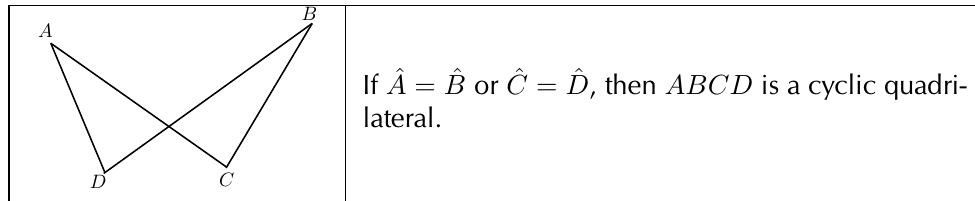
- Opposite angles supplementary: If opposite angles add up to 180°, then the quadrilateral is cyclic.
- Equal angles in same segment: If angles subtended by the same chord are equal, then the quadrilateral is cyclic.
- Exterior angle equals interior opposite angle: If an exterior angle equals the interior opposite angle, then the quadrilateral is cyclic.
Tangents to a circle
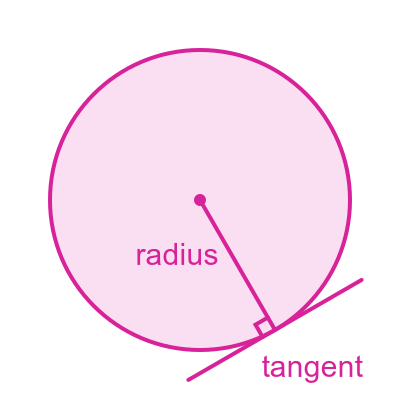
A tangent is a straight line that touches a circle at exactly one point, called the point of contact or point of tangency.
Properties of tangents
Tangent perpendicular to radius: A tangent to a circle is always perpendicular to the radius drawn to the point of contact. This is a fundamental property used in many proofs.
Equal tangents from external point: When two tangents are drawn to a circle from the same external point, these tangent segments are equal in length.
Note
The property of equal tangents from an external point is very useful for calculating unknown lengths in circle problems. If you know one tangent length, you automatically know the other.
Tangent-chord angle theorem
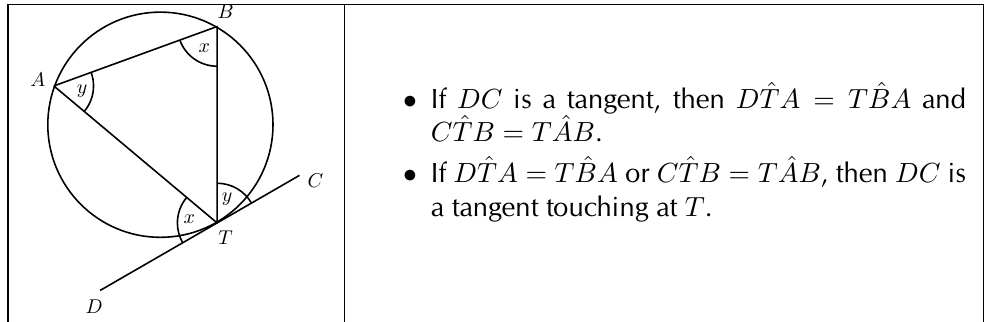
This important theorem states that the angle between a tangent and a chord drawn from the point of contact equals the angle in the alternate segment. This relationship is often called the alternate segment theorem.
The mid-point theorem
The mid-point theorem is a fundamental property of triangles that relates to parallel lines and proportional segments.
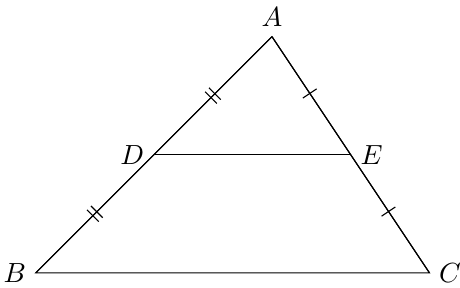
Statement of the theorem
The line segment joining the midpoints of two sides of a triangle is parallel to the third side and equal to half its length.
If D and E are midpoints of sides AB and AC respectively in triangle ABC, then:
- DE is parallel to BC
- DE = ½BC
Example
Worked Example: Applying the Mid-point Theorem
Given: In triangle PQR, M is the midpoint of PQ and N is the midpoint of PR. If QR = 12cm, find the length of MN.
Step 1: Identify the theorem
- M and N are midpoints of two sides of the triangle
Step 2: Apply the mid-point theorem
- MN is parallel to QR and MN = ½QR
Step 3: Calculate
- MN = ½ × 12 = 6cm
Applications
This theorem is frequently used to:
- Prove lines are parallel
- Calculate unknown lengths
- Establish proportional relationships in triangles
- Solve problems involving similar triangles
Common Exam Questions
Common question types include:
- Calculating angles using circle theorems
- Finding lengths using perpendicular bisector properties
- Proving geometric relationships using congruence and similarity
- Applying the mid-point theorem to find unknown measurements
Exam tips
Note
Essential Exam Strategies:
- Always state the theorem or property you're using
- Draw clear diagrams and label all given information
- Show all working steps clearly
- Give reasons for each statement in proofs
- Check that your answers make geometric sense
Summary
Key Points to Remember:
-
Triangle congruence requires proving SSS, SAS, AAS, or RHS conditions are met.
-
Cyclic quadrilaterals have opposite angles that are supplementary (add to 180°).
-
Tangents to circles are always perpendicular to the radius at the point of contact, and tangents from the same external point are equal.
-
The mid-point theorem states that the line joining midpoints of two sides is parallel to the third side and half its length.
-
Circle geometry relies on understanding the relationships between central angles, inscribed angles, chords, and arcs.