Similarity (Grade 12 NSC Matric Mathematics): Revision Notes
📚Revision Notes
Similarity
What is similarity?
Similar polygons are shapes that have exactly the same form but differ in size. Think of similarity as one shape being an enlarged or reduced version of another. When two polygons are similar, one is simply a scaled version of the other.
Note
It's important to note that congruent polygons are also similar. This is because congruent shapes have identical form and size, differing only in their position or orientation on the page.
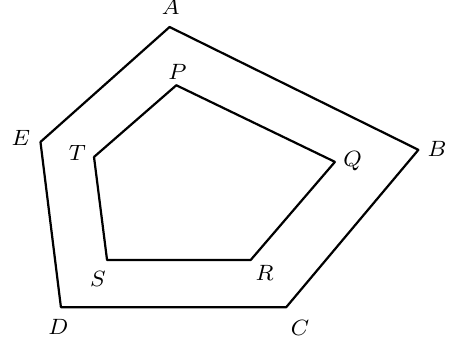
Conditions for similar polygons
For two polygons with the same number of sides to be similar, both of the following conditions must be true:
Important
Two Essential Conditions for Polygon Similarity:
- All pairs of corresponding angles are equal
- All pairs of corresponding sides are in the same proportion
These conditions work together - you cannot have similarity with only one condition satisfied. Both angle equality and proportional sides are essential requirements.
Important note about the conditions
- Both conditions must be true for two polygons to be similar
- If we know two polygons are similar, then we automatically know that both conditions are satisfied
Example
Worked Example: Finding Unknown Values in Similar Polygons
Question: Polygons PQTU and PRSU are similar. Determine the value of x.
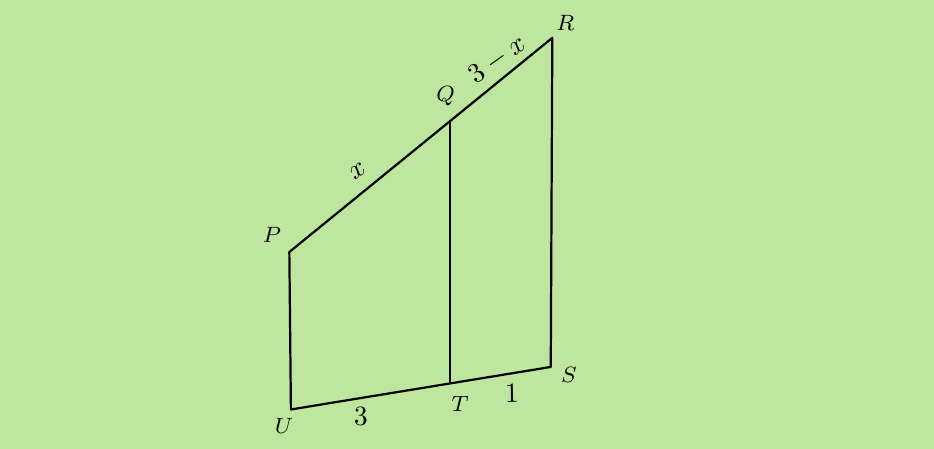
Solution:
Since the polygons are similar, corresponding sides are proportional:
Substituting the known values:
Similarity of triangles
Triangle similarity follows a special rule that makes it easier to prove than polygon similarity.
Important
Key Principle for Triangles: To prove two triangles are similar, we need only show that one of the similarity conditions is true. If one condition holds for triangles, the other condition automatically becomes true as well.
This is different from general polygons, where both conditions must be proven independently.
Triangle similarity theorems
Theorem 1: Equiangular triangles are similar
Statement: If two triangles have all corresponding angles equal, then the triangles are similar.
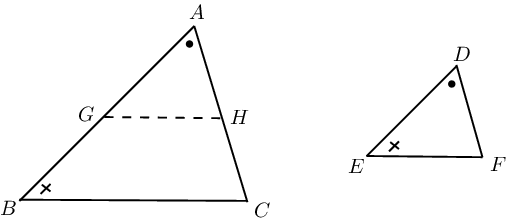
Given: Triangle ABC and triangle DEF with ∠A = ∠D, ∠B = ∠E, ∠C = ∠F
To prove:
Proof method: The proof uses construction techniques, creating parallel lines and using proportional segments to establish that equal angles lead to proportional sides.
Why equiangular triangles are similar
Note
The key insight comes from the triangle angle sum property. Since the interior angles of any triangle sum to 180°, if we know that two pairs of corresponding angles are equal, the third pair must also be equal.
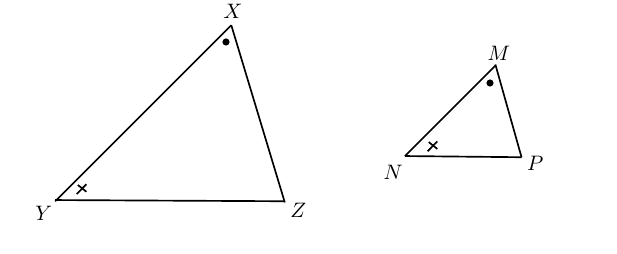
For triangles XYZ and MNP:
If and , then
Therefore: (equiangular triangles)
Worked example: Proving triangle similarity
Example
Worked Example: Proving Triangle Similarity Using Angles
Question: Prove that triangle XYZ is similar to triangle SRT.
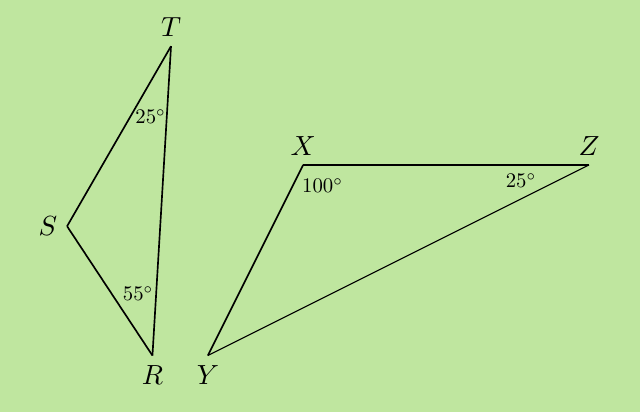
Step 1: Calculate unknown angles
In △XYZ:
In △SRT:
Step 2: Prove similarity
In △XYZ and △SRT:
- (proved in step 1)
- (given)
∴ (AAA - Angle-Angle-Angle similarity)
Theorem 2: Triangles with sides in proportion are similar
Statement: If the corresponding sides of two triangles are in proportion, then the triangles are similar.
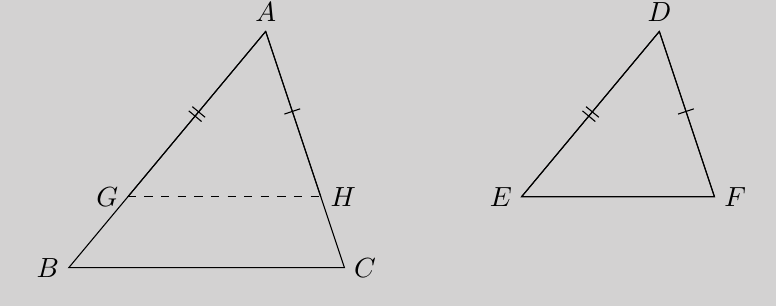
Given: △ABC and △DEF with
To prove: ∠A = ∠D, ∠B = ∠E, ∠C = ∠F
The proof demonstrates that proportional sides automatically create equal corresponding angles.
Proving triangles with proportional sides are similar
Note
To prove that triangles have sides in proportion, we must show that all three pairs of corresponding sides have the same ratio.
Worked example: Testing triangle similarity
Example
Worked Example: Testing Triangle Similarity with Side Ratios
Question 1: Is △ABC ||| △ZYX? Show calculations.
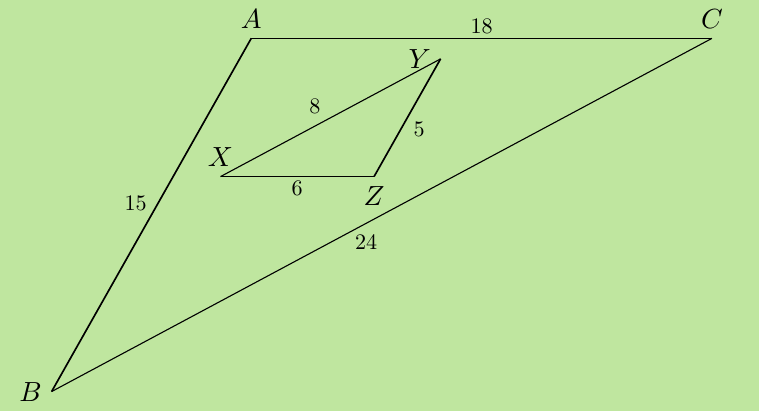
Solution:
Step 1: Identify corresponding sides For similar triangles, we need to check if sides are proportional:
In △ABC and △ZYX:
∴ (SSS - all sides in same proportion)
Question 2: Consider △PQR and △RPS. Show calculations.
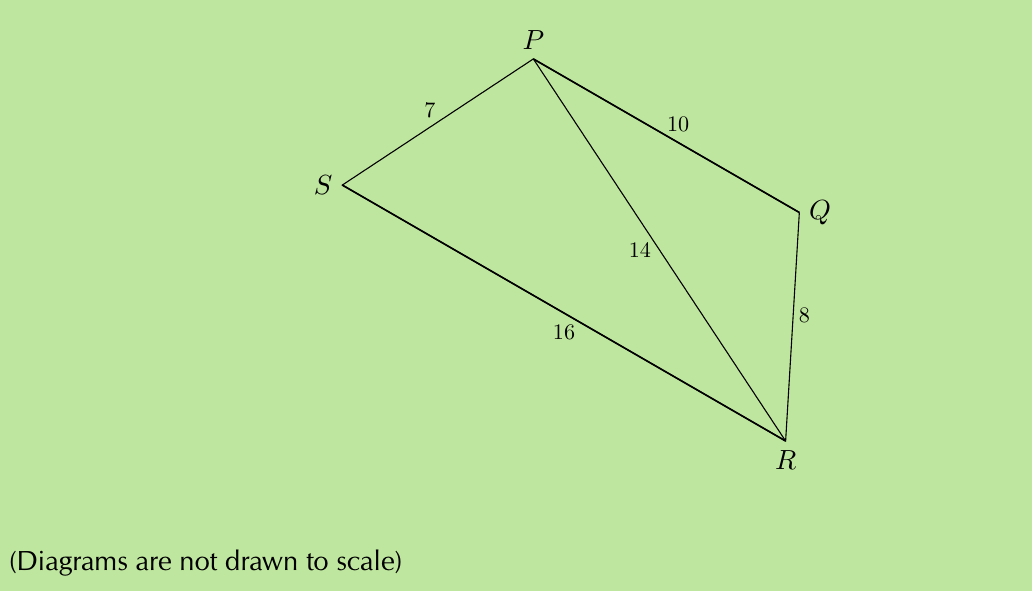
Solution:
Step 1: Check proportionality
In △PQR and △RPS:
Since the ratios are not equal, △PQR is not similar to △RPS.
Theorem 3: SAS similarity for triangles
Statement: If two sides of one triangle are in proportion to two sides of another triangle and the included angles are equal, then the triangles are similar.
This theorem allows us to prove similarity using only two proportional sides plus one equal angle (the angle between those sides).
Worked example: Using proportional relationships
Example
Worked Example: Proving Proportional Relationships
Question: PQSR is a trapezium with PQ || RS. Prove that PT · RT = ST · QT.
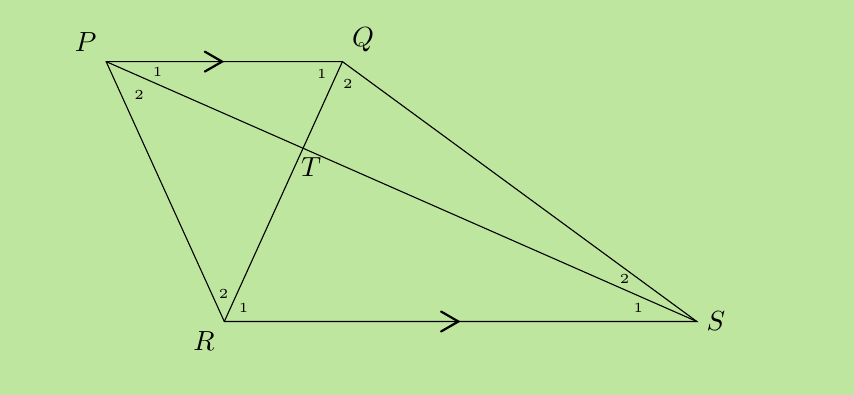
Solution:
Step 1: Identify triangles We need to prove the relationship
Step 2: Prove triangles are equiangular In △PTQ and △STR:
- (alternate angles, PQ || RS)
- (alternate angles, PQ || RS)
∴ (AAA)
Step 3: Use proportionality (similar triangles) ∴
Important notation and conventions
Symbols
- ≡ represents congruency
- ||| represents similarity
Labelling similar triangles
Note
When writing similar triangles, be careful about the order of vertices. The order indicates which sides correspond to each other.
For example: If △PQR ||| △BAC, then:
The position of letters shows the correspondence between vertices and sides.
Common exam tips
Important
Common Mistakes to Avoid:
- Always check all three ratios when proving triangles are similar using side proportions
- Use the triangle angle sum (180°) to find missing angles
- Identify corresponding parts carefully - incorrect correspondence is a common error
- Show all calculation steps clearly in your working
- State the similarity theorem you're using (AAA, SSS, or SAS)
Summary
Key Points to Remember:
- Similar polygons have the same shape but different sizes - one is a scaled version of the other
- Two conditions must be satisfied for polygon similarity: equal corresponding angles AND proportional corresponding sides
- For triangles only: proving one condition automatically proves the other condition
- Three main similarity theorems: AAA (equiangular), SSS (proportional sides), and SAS (two proportional sides with equal included angle)
- Always check your correspondence - make sure you're comparing the correct sides and angles when proving similarity