Summary (Grade 12 NSC Matric Mathematics): Revision Notes
📚Revision Notes
Summary
What is a ratio?
A ratio describes the relationship between two quantities that have the same units. You can write a ratio in three different ways:
Note
Three ways to express ratios:
- x : y
- x/y
- x to y
Important
When working with ratios, remember that both quantities must have the same units for the comparison to make sense.
Understanding proportions
Proportions occur when two or more ratios are equal to each other. If , then we say that m and n are in the same proportion as p and q.
This concept is fundamental in Euclidean geometry because it helps us understand relationships between different parts of geometric figures.
Basic polygon properties
A polygon is a plane, closed shape consisting of three or more line segments. These shapes form the foundation for many geometric calculations and proofs.
Triangle area relationships
Understanding how triangle areas relate to their dimensions is crucial for solving geometric problems:
- Triangles with equal heights have areas that are proportional to their bases
- Triangles with equal bases and between the same parallel lines are equal in area
- Triangles on the same side of the same base and equal in area lie between parallel lines
Note
These properties help you solve area problems and understand geometric relationships by connecting area calculations to proportional reasoning.
Parallel lines and proportional division
When you draw a line parallel to one side of a triangle, it creates important proportional relationships:
Important
The Proportion Theorem states: A line drawn parallel to one side of a triangle divides the other two sides of the triangle in the same proportion.
For a triangle with a line parallel to one side, you get these equal ratios:
Important
Converse of the Proportion Theorem: If a line divides two sides of a triangle in the same proportion, then the line is parallel to the third side.
The mid-point theorem
This is a special case of the proportion theorem that's very useful in exams:
Important
Mid-point Theorem: The line joining the mid-points of two sides of a triangle is parallel to the third side and equal to half the length of the third side.
If and , then and
Important
Converse of the Mid-point Theorem: The line drawn from the mid-point of one side of a triangle parallel to another side, bisects the third side of the triangle.
If and , then
Similar polygons
Similar polygons are the same shape but differ in size. One polygon is an enlargement of the other.
Note
Conditions for Polygon Similarity
Two polygons with the same number of sides are similar when:
- All pairs of corresponding angles are equal, and
- All pairs of corresponding sides are in the same proportion
Triangle similarity
For triangles specifically, we have simplified conditions:
- If two triangles are equiangular, then the triangles are similar
- Triangles with sides in proportion are equiangular and therefore similar
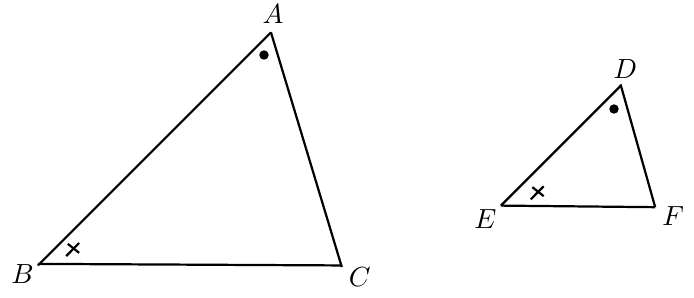
This means you can identify similar triangles by checking either their angles or their side ratios.
Pythagoras' theorem
One of the most important theorems in geometry:
Important
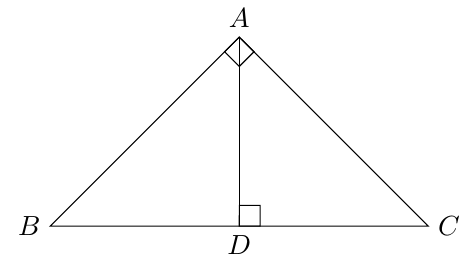
Pythagoras' Theorem: The square on the hypotenuse of a right-angled triangle is equal to the sum of the squares on the other two sides.
For a right-angled triangle:
Important
Converse of Pythagoras' Theorem: If the square of one side of a triangle is equal to the sum of the squares of the other two sides of the triangle, then the angle included by these two sides is a right angle.
Note
This converse is particularly useful for proving that a triangle contains a right angle when you know the side lengths.
Remember!
Summary
Key Points to Remember:
- Ratios compare quantities with the same units and can be written as x, x/y, or x to y
- Proportions occur when ratios are equal, creating important relationships in triangles
- A line parallel to one side of a triangle divides the other sides proportionally
- The mid-point theorem creates parallel lines that are half the length of the third side
- Similar polygons have equal corresponding angles and proportional corresponding sides
- Pythagoras' theorem relates the sides of right-angled triangles through squares
- Always check both the theorem and its converse as both are useful in geometric proofs