Revision (Grade 12 NSC Matric Mathematics): Revision Notes
📚Revision Notes
Revision
Fundamental trigonometric ratios
Trigonometric ratios are mathematical relationships that connect the angles of a triangle to the lengths of its sides. These ratios form the foundation of trigonometry and are essential for solving problems involving angles and distances.
In a right-angled triangle, we define three primary trigonometric ratios using the relationship between sides relative to a specific angle.
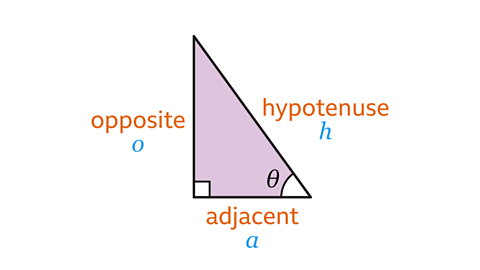
For any angle in a right triangle:
- Sine (sin) =
- Cosine (cos) =
- Tangent (tan) =
Note
These ratios remain constant for any given angle, regardless of the triangle's size. This fundamental property makes trigonometry a powerful tool for solving real-world problems involving angles and distances.
Coordinate plane trigonometry
When we extend trigonometric concepts to the coordinate plane, we can define these ratios for any angle, not just those in right triangles.
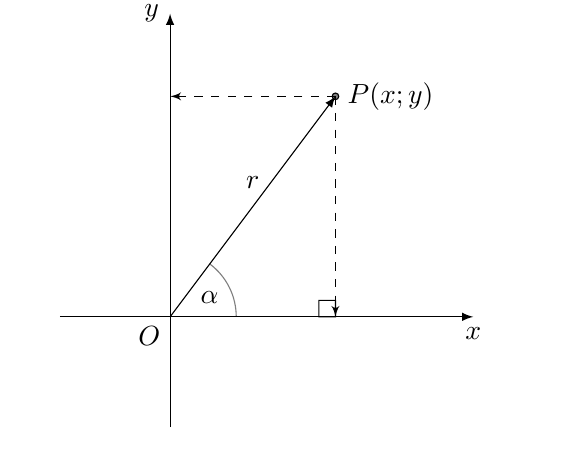
For a point P(x,y) at distance r from the origin, forming angle α with the positive x-axis:
Note
This coordinate approach allows us to work with angles greater than 90° and negative angles, extending trigonometry beyond the limitations of right triangles.
Signs of trigonometric functions - CAST diagram
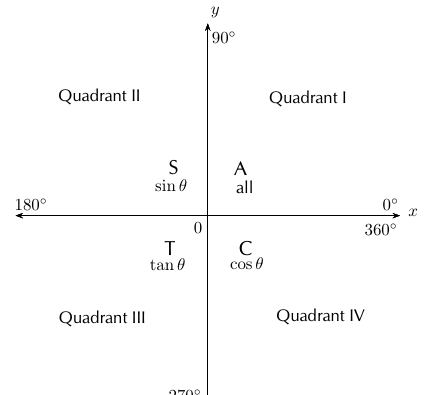
The CAST diagram shows which trigonometric functions are positive in each quadrant of the coordinate plane. This is crucial for determining the correct signs when working with angles in different quadrants.
Important
Memory aid: "All Students Take Calculus"
- Quadrant I (0° to 90°): All functions are positive
- Quadrant II (90° to 180°): Sine is positive
- Quadrant III (180° to 270°): Tangent is positive
- Quadrant IV (270° to 360°): Cosine is positive
The sign of a trigonometric function depends on the signs of x and y coordinates in each quadrant.
Reduction formulae and co-functions
Reduction formulae allow us to express trigonometric functions of any angle in terms of an acute angle (between 0° and 90°). This is essential for simplifying complex trigonometric expressions.
Key reduction rules:
First quadrant (0° to 90°):
- All functions remain positive
Second quadrant (90° to 180°):
- Only sine is positive
Third quadrant (180° to 270°):
- Only tangent is positive
Fourth quadrant (270° to 360°):
- Only cosine is positive
Co-function relationships:
Co-functions are complementary trigonometric functions that relate angles summing to 90°:
Note
These relationships show the complementary nature of sine and cosine functions.
Negative angles
Trigonometric functions of negative angles follow specific patterns that are important to remember:
- (sine is an odd function)
- (cosine is an even function)
- (tangent is an odd function)
These relationships help us evaluate trigonometric functions for negative angle measures.
Special angle triangles
Special triangles provide exact values for trigonometric functions at commonly used angles. These values are essential for solving problems without a calculator.
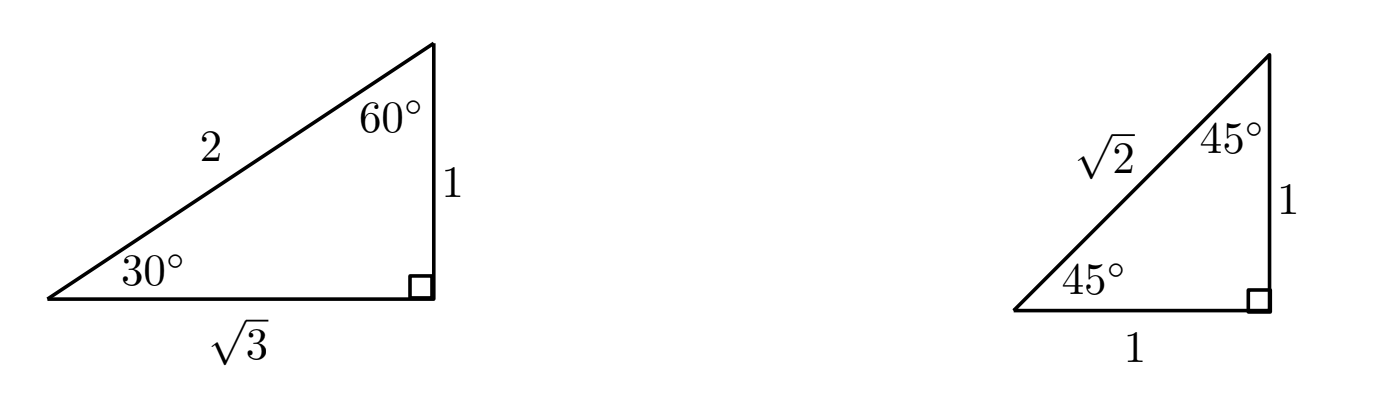
The 30°-60°-90° triangle has sides in the ratio The 45°-45°-90° triangle has sides in the ratio
Important
Special angle values must be memorised:
- 0°: , ,
- 30°: , ,
- 45°: , ,
- 60°: , ,
- 90°: , , undefined
These exact values are fundamental for evaluating trigonometric expressions accurately.
Fundamental trigonometric identities
Trigonometric identities are equations that are true for all valid values of the variable. They are powerful tools for simplifying expressions and solving equations.
Quotient identity:
This shows the relationship between the three basic trigonometric functions.
Pythagorean identity:
Note
This fundamental identity leads to several useful variations:
The ± sign depends on the quadrant in which the angle lies.
Worked examples
Example
Worked Example 1: Evaluating trigonometric expressions
Question: Determine the value of
Step 1: Use reduction formulae to express each term using acute angles
Step 2: Substitute special angle values
- , so
- , so
Step 3: Calculate the expression
Example
Worked Example 2: Proving trigonometric identities
Question: Prove that
Step 1: Simplify the left-hand side
Step 2: Express in terms of sine and cosine
Step 3: This equals the right-hand side, so the identity is proven.
Restrictions: The identity is undefined when , which occurs at and .
Example
Worked Example 3: Using reduction formulae
Question: Simplify
Step 1: Apply reduction formulae
Step 2: Calculate
Exam tips and common traps
Understanding these key strategies will help you avoid common pitfalls and approach trigonometry problems with confidence:
- Always check which quadrant your angle is in to determine the correct sign
- Remember that is undefined when (at 90° and 270°)
- When proving identities, work with one side at a time - never cross-multiply
- Always state restrictions where trigonometric functions are undefined
- Use exact values from special triangles rather than decimal approximations
Important
Common mistake to avoid: Writing trigonometric ratios without angles (e.g., has no meaning - you must specify the angle)
Memory aid: Use CAST ("All Students Take Calculus") for quadrant signs
Summary
Key Points to Remember:
- Trigonometric ratios are defined as opposite/hypotenuse, adjacent/hypotenuse, and opposite/adjacent in right triangles
- CAST diagram determines which functions are positive: All (I), Sine (II), Tangent (III), Cosine (IV)
- Reduction formulae convert any angle to an equivalent acute angle expression
- Special angles (30°, 45°, 60°) have exact trigonometric values that must be memorised
- Fundamental identity: is the foundation for many algebraic manipulations