Summary (Grade 12 NSC Matric Mathematics): Revision Notes
📚Revision Notes
Summary
Fundamental identities
Trigonometry is built on several core relationships that connect the basic trigonometric functions. Understanding these fundamental identities is essential for solving complex trigonometric problems.
The Pythagorean identities form the foundation of trigonometric relationships. The most important identity states that the sum of the squares of sine and cosine for any angle equals one: . This relationship comes directly from the Pythagorean theorem applied to the unit circle.
Note
The Pythagorean identity is derived from the unit circle where the radius equals 1. Since any point on the circle satisfies , and while , we get the fundamental relationship .
From this fundamental relationship, we can derive two additional forms:
- (useful when you know sine and need cosine)
- (useful when you know cosine and need sine)
The ratio identities show how tangent relates to sine and cosine. These relationships are:
- (tangent equals sine divided by cosine)
- (the reciprocal relationship)
These identities allow you to convert between different trigonometric functions and are particularly useful in simplifying complex expressions.
Special angle values
Certain angles appear frequently in trigonometry problems, and knowing their exact values is crucial for efficient problem-solving.
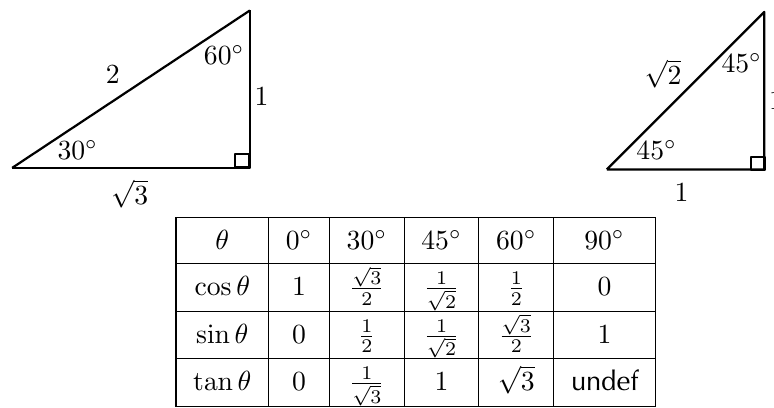
Two special right triangles provide the foundation for these values:
The 30-60-90 triangle has sides in the ratio . In this triangle:
- The side opposite to 30° has length 1
- The side opposite to 60° has length
- The hypotenuse has length 2
The 45-45-90 triangle has sides in the ratio . In this triangle:
- Both legs have length 1
- The hypotenuse has length
Note
These special triangles can be constructed easily: the 45-45-90 triangle is half of a square, while the 30-60-90 triangle is half of an equilateral triangle.
These triangles give us the exact trigonometric values for the standard angles:
For 0°: , ,
For 30°: , ,
For 45°: , ,
For 60°: , ,
For 90°: , , = undefined
These values are essential for solving trigonometric equations without a calculator.
Quadrant analysis and reduction formulae
Understanding how trigonometric functions behave in different quadrants is crucial for solving problems involving angles greater than 90°.
Important
The CAST Diagram
The CAST diagram is a memory tool that shows which trigonometric functions are positive in each quadrant:
- Cosine: positive in quadrant 4
- All functions: positive in quadrant 1
- Sine: positive in quadrant 2
- Tangent: positive in quadrant 3
Remember: "Cast All Spells Tonight" going counter-clockwise from quadrant 4.
Each quadrant has specific reduction formulae that help you find the trigonometric values of any angle:
First Quadrant (0° to 90°):
Second Quadrant (90° to 180°):
Third Quadrant (180° to 270°):
Fourth Quadrant (270° to 360°):
Additionally, the co-function relationships are:
Function properties
Trigonometric functions have specific behaviours that make calculations more predictable and help in solving equations.
Negative angle identities show how functions respond to negative inputs:
- (sine is an odd function)
- (cosine is an even function)
- (tangent is an odd function)
Note
Odd functions satisfy , while even functions satisfy . This means sine and tangent graphs are symmetric about the origin, while cosine is symmetric about the y-axis.
Periodicity identities describe how trigonometric functions repeat their values:
- (sine repeats every 360°)
- (cosine repeats every 360°)
- (tangent repeats every 180°)
Cofunction identities relate trigonometric functions at complementary angles:
These properties are essential for simplifying expressions and solving trigonometric equations efficiently.
Triangle trigonometry
When working with triangles that are not right-angled, specific rules help us find unknown sides and angles.
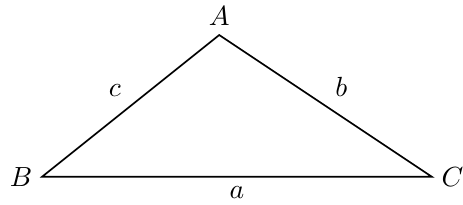
Consider a triangle with vertices A, B, and C, where:
- Side is opposite angle
- Side is opposite angle
- Side is opposite angle
Note
Standard triangle labelling uses lowercase letters for sides and uppercase letters for the opposite angles. This convention makes it easier to apply the various triangle rules consistently.
Area rule gives us three ways to calculate a triangle's area using trigonometry:
These formulae are particularly useful when you know two sides and the included angle.
Sine rule establishes proportional relationships in any triangle:
This can also be written as:
The sine rule is most useful when you know two angles and one side, or two sides and an angle opposite one of them.
Important
When to Use Which Rule
- Area rule: Use when you have two sides and the included angle
- Sine rule: Use when you have two angles and one side, or two sides and a non-included angle
- Cosine rule: Use when you have three sides, or two sides and the included angle
Cosine rule extends the Pythagorean theorem to non-right triangles:
The cosine rule is essential when you know three sides and need to find an angle, or when you know two sides and the included angle.
Advanced identities
Complex trigonometric problems often require compound angle and double angle identities.
Compound angle identities help us find trigonometric values for sums and differences of angles:
For sine:
For cosine:
Note
These compound angle identities can be remembered using the pattern: for sine addition, the signs match (+ +, - -), while for cosine addition, the signs alternate (- +, + +).
Double angle identities are special cases where :
For sine:
For cosine (multiple forms):
For tangent:
These identities are crucial for solving complex trigonometric equations and simplifying expressions involving multiple angles.
Summary
Key Points to Remember:
-
Master the fundamental identities - Pythagorean () and ratio () identities form the foundation for all trigonometry work
-
Learn special angle values - Memorise exact values for 0°, 30°, 45°, 60°, and 90° to solve problems without a calculator efficiently
-
Use CAST for quadrants - Remember that Cosine is positive in quadrant 4, All functions in quadrant 1, Sine in quadrant 2, and Tangent in quadrant 3, along with their corresponding reduction formulae
-
Apply triangle rules appropriately - Use the area rule when you have two sides and included angle, sine rule for two angles and one side, and cosine rule for three sides or two sides and included angle
-
Recognise when to use advanced identities - Compound angle identities help with sums/differences of angles, while double angle identities simplify expressions with angles like