Convergent and Divergent Evolution (HSC SSCE Biology): Revision Notes
📚Revision Notes
Convergent and Divergent Evolution
Introduction to evolutionary patterns
When Charles Darwin and Alfred Russel Wallace studied living organisms, they noticed that many species shared similar structural features. They realised these similarities could be explained in two different ways, depending on how closely the organisms were related. This observation led to our understanding of two important evolutionary patterns: divergent evolution and convergent evolution.
Note
Darwin and Wallace's key insight was recognising that similarities between organisms can arise through two completely different processes. This realisation was crucial for understanding how natural selection shapes the diversity of life on Earth.
These two patterns help us understand how natural selection shapes life on Earth. They explain why some closely related species look very different from each other, whilst some distantly related species look remarkably similar.
Understanding divergent evolution
Divergent evolution occurs when closely related species that share a recent common ancestor become increasingly different from each other over time. This happens when populations of the same ancestral species move into different environments or habitats.
When organisms enter new environments, they face different challenges and selective pressures. Natural selection then favours different characteristics in each population. Over many generations, these populations accumulate different adaptations, causing them to diverge (become different) from their common ancestor and from each other.
How divergent evolution works
The process follows these steps:
- A population of organisms shares a common ancestor
- Groups from this population migrate to different habitats
- Each new environment presents unique selective pressures
- Natural selection favours different traits in each population
- Over time, the populations become increasingly different from each other
- Eventually, they may become distinct species
Important
Key Concept: The crucial factor in divergent evolution is that closely related organisms face different environmental pressures, which leads them to evolve in different directions from their shared ancestor.
Examples of divergent evolution
Example
Worked Example: Darwin's Finches
Darwin's finches provide a classic example of divergent evolution:
Starting point: A single ancestral finch species arrived on the Galápagos Islands
Different environments: Each island offered different food sources (insects, seeds of various sizes, nectar)
Result: Different selection pressures on various islands favoured different beak types
- Islands with large, hard seeds → finches with strong, thick beaks
- Islands with insects → finches with thin, pointed beaks
- Islands with flowers → finches with long, curved beaks
This demonstrates how one ancestor species can give rise to many different descendant species when populations face different environmental challenges.
Horse evolution also demonstrates divergent evolution. The variety of horse species we see in the fossil record arose from common ancestors but diverged as they adapted to different environments and lifestyles.
Understanding convergent evolution
Convergent evolution occurs when distantly related species (which diverged from a common ancestor long ago) evolve to become similar to each other. This happens when unrelated organisms face similar environmental challenges and selective pressures.
When different species live in similar habitats, natural selection often favours similar adaptations. Even though these organisms have very different evolutionary histories, they may develop comparable features that help them survive in similar conditions.
Note
Think of convergent evolution as "similar problems, similar solutions" – when different organisms face the same environmental challenges, natural selection often produces similar solutions, even in species that aren't closely related.
How convergent evolution works
The process follows these steps:
- Different species with distant common ancestors live in similar environments
- Similar selective pressures act on both species
- Natural selection favours similar adaptations in each species
- Over time, the species develop analogous structures or features
- The organisms become more similar despite being distantly related
Examples of convergent evolution
Marsupials and placental mammals provide excellent examples of convergent evolution. Although these two groups are extremely distantly related (as shown by their very different reproductive systems), pairs of species show remarkable similarities.
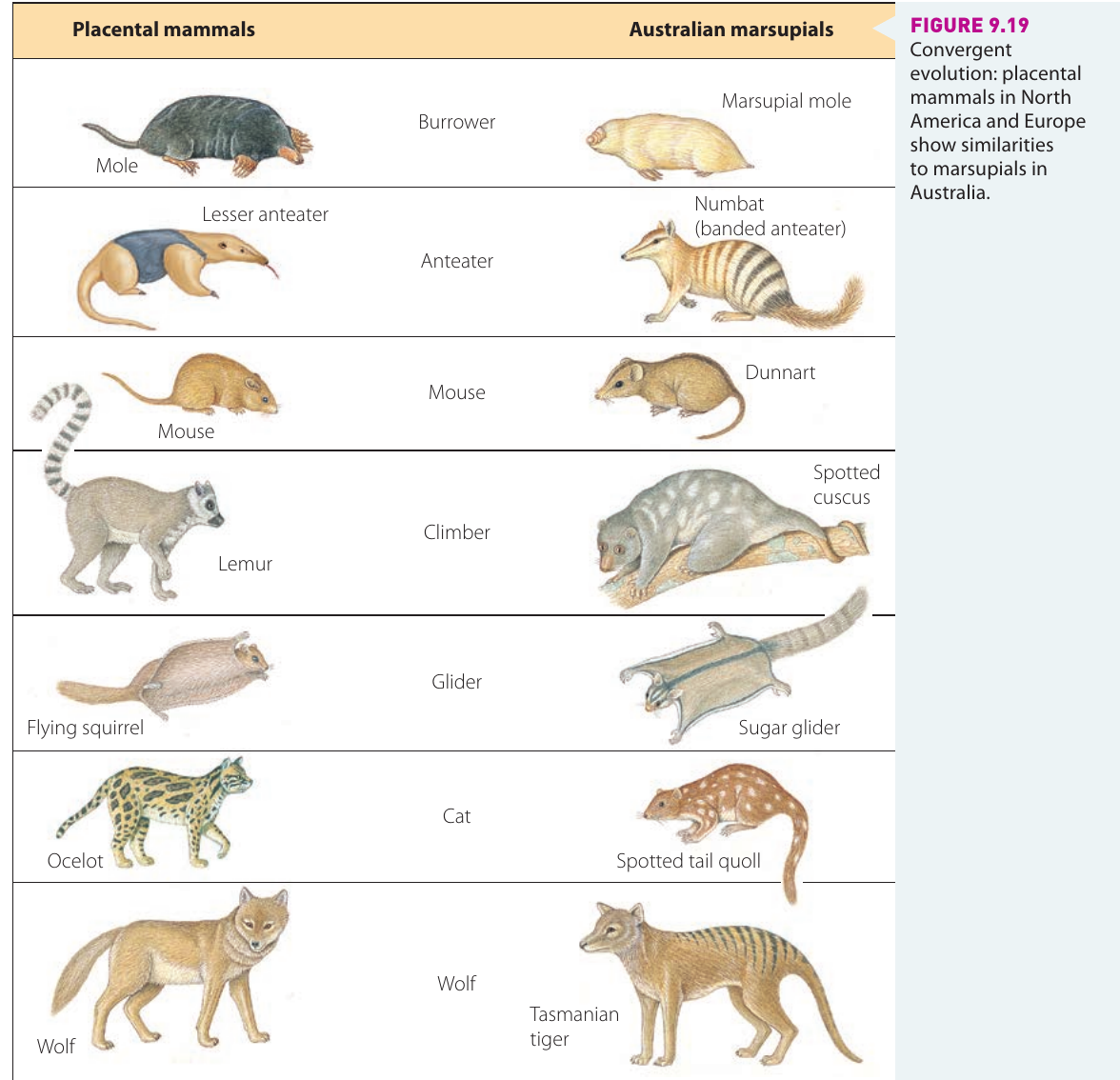
As shown in the figure above, Australian marsupials have evolved to fill similar ecological roles (niches) as placental mammals in other parts of the world:
- The marsupial mole burrows underground like the placental mole
- The numbat feeds on insects like the lesser anteater
- The dunnart occupies a similar niche to mice
- The spotted cuscus climbs trees like lemurs
- The sugar glider glides through forests like flying squirrels
- The spotted tail quoll hunts like the ocelot
- The Tasmanian tiger hunted in packs like wolves
Important
These pairs evolved similar body plans because they faced similar environmental challenges, not because they share recent common ancestry. This is the defining characteristic of convergent evolution.
Aquatic animals demonstrate convergent evolution through their streamlined body shapes. Sharks (fish), dolphins and whales (mammals), and penguins (birds) have all evolved similar fin and flipper structures. Despite being from completely different groups, they developed comparable features for swimming efficiently.
Example
Worked Example: Venom Evolution
Venom production provides clear evidence of convergent evolution:
Observation: Both reptiles (such as snakes) and the platypus produce venom
Genetic analysis: Scientists discovered that both groups have a mutation to the same gene (the β-defensin gene)
Key finding: The actual mutations are different in each group
Conclusion: The venom evolved separately and independently in each group through convergent evolution, rather than being inherited from a common ancestor. This demonstrates how similar selective pressures (the advantage of venom for defence or hunting) can lead to similar adaptations in unrelated species.
How natural selection drives both patterns
The Darwin-Wallace theory of evolution by natural selection explains both convergent and divergent evolution through the same fundamental mechanism.
When organisms enter a changed or new environment, they experience pressure to survive. The environment acts as a selective force, favouring individuals with certain traits that increase their chance of survival. These favourable traits are called adaptations.
Important
Understanding Natural Selection:
When resources become limited:
- Individuals with beneficial adaptations are more likely to survive
- These individuals reproduce and pass their advantageous traits to offspring
- Over generations, these traits become more common in the population
This same process can produce different outcomes depending on the circumstances.
The key principle is that the environment determines which traits are advantageous. This explains both patterns:
- Convergent evolution: Different organisms subjected to similar selective pressures become more similar
- Divergent evolution: Similar organisms subjected to different selective pressures become more different
A modern example: underground mosquitoes
A recent example of microevolution has been observed in underground railway stations in London and parts of Russia. Scientists discovered a species of underground mosquito that evolved from the surface-dwelling species Culex pipiens.
These underground mosquitoes are now found in ten Russian cities. Researchers investigated whether their evolution represented convergent or divergent evolution. They wanted to know: did underground mosquitoes in different cities evolve independently (convergent evolution), or did they all descend from a single population that evolved underground and then spread (divergent evolution)?
Example
Investigation: Underground Mosquito Evolution
Research question: Did underground mosquitoes in different cities evolve independently or from a common underground ancestor?
Method: Scientists conducted genetic analysis and compared traits across populations in different cities
Results: The genetic evidence showed that underground mosquitoes in different cities were more closely related to each other than to their surface-dwelling ancestors
Conclusion: The underground mosquitoes showed divergent evolution. The populations in different cities descended from related underground populations rather than evolving independently. This provided strong evidence supporting the divergent evolution hypothesis.
Adaptive radiation
Adaptive radiation is a special type of divergent evolution. It describes the evolutionary pattern where multiple species evolve from a single common ancestor as they spread into new environments.
Note
Understanding the Term:
The term "adaptive radiation" has two meaningful parts:
- Radiation refers to organisms spreading out into different areas (like rays spreading out from a central point)
- Adaptive indicates that changes favour survival in new environmental niches
Together, they describe how one ancestral species can give rise to many specialised descendant species.
During adaptive radiation:
- Organisms migrate from their original habitat into new environments
- They encounter different niches (specific roles or positions in the ecosystem)
- Natural selection favours different adaptations in each new niche
- Multiple new species evolve, each adapted to its particular environment
This process explains how a single ancestral species can give rise to many different descendant species, each specialised for different ways of life. Darwin's finches are an excellent example of adaptive radiation, where one ancestral finch species radiated across the Galápagos Islands and evolved into multiple species, each adapted to different food sources and habitats.
Summary
Key Points to Remember:
-
Divergent evolution occurs when closely related species become different as they adapt to different environments and face different selective pressures
-
Convergent evolution occurs when distantly related species become similar as they adapt to similar environments and face similar selective pressures
-
Natural selection drives both patterns by favouring adaptations that increase survival and reproduction in specific environments
-
Australian marsupials and placental mammals demonstrate convergent evolution, developing similar body plans for similar ecological roles despite being distantly related
-
Adaptive radiation is a type of divergent evolution where one ancestral species gives rise to many different species as populations spread into new environments
-
Remember the simple rule: Similar pressures create similar traits (convergent), whilst different pressures create different traits (divergent)