Gradualism vs Punctuated Equilibrium (HSC SSCE Biology): Revision Notes
📚Revision Notes
Gradualism vs Punctuated Equilibrium
Introduction to evolutionary patterns
Gradualism and punctuated equilibrium are two different patterns of evolutionary change that can occur in species. Scientists have discovered that a single species can display either one or both of these patterns during its evolutionary history. Some researchers suggest that the time scale of evolution may determine which pattern occurs, with species evolving over longer periods tending to show gradualism. Importantly, both models are considered valid scientific explanations for macroevolution (large-scale evolutionary changes).
Note
The time scale of evolutionary change may be a key factor in determining which pattern a species displays. Species that evolve over longer geological periods tend to show gradualistic patterns, while those experiencing rapid environmental changes may exhibit punctuated equilibrium.
Gradualism
What is gradualism?
Gradualism is the evolutionary pattern originally proposed by Charles Darwin. It describes how populations change slowly over time as small variations in characteristics accumulate due to different selection pressures acting on the population.
The key idea behind gradualism is that evolutionary change happens continuously and steadily. According to this model, we should expect to find intermediate or transitional forms in the fossil record - organisms that show the gradual progression from one species to another.
Note
Transitional forms, sometimes called "missing links," are fossils that show characteristics intermediate between ancestral and descendant species. Finding these forms in the fossil record would support the gradualism model by demonstrating the step-by-step progression of evolutionary change.
Evidence for gradualism
Trilobites, a group of ancient marine invertebrates, provide strong fossil evidence supporting gradualism. Their fossil record shows a pattern of slow, continuous change over extended periods of geological time.
Punctuated equilibrium
What is punctuated equilibrium?
The theory of punctuated equilibrium presents a different view of how evolution proceeds. It proposes that evolutionary change occurs in rapid bursts of activity, followed by long periods where populations remain stable with little or no change. This theory has gained significant attention over the past 50 years and, like all good science, has prompted scientists to re-examine existing evidence in new ways.
Historical development
Stephen Jay Gould and Niles Eldridge developed the theory of punctuated equilibrium in the 1970s, basing their ideas on careful examination of fossil evidence. They made an important observation: if evolution truly occurs gradually as Darwin suggested, we should find abundant fossil remains showing these ongoing incremental changes. However, when they examined the fossil record, they found something quite different.
Note
Gould and Eldridge's critical insight came from recognizing that the gaps in the fossil record might not be due to incomplete preservation, but rather could reflect the actual pattern of evolutionary change - long periods of stability interrupted by brief periods of rapid change.
Evidence for punctuated equilibrium
The fossil record reveals many examples where species remain virtually unchanged for millions of years. For instance:
- Soft-bodied organisms dominated the seas for hundreds of millions of years, then in just a few million years (a relatively short time geologically), they disappeared and were replaced by organisms with shells and skeletons
- Horseshoe crabs have remained almost unchanged for 445 million years, showing remarkable stability
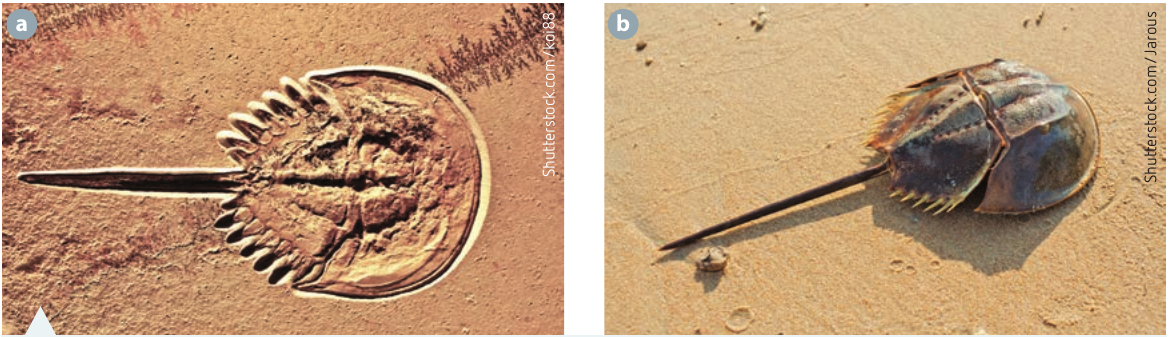
Supporters of punctuated equilibrium make an additional argument: if evolution occurred gradually all the time, we should observe much greater diversity among living organisms than actually exists. The incompleteness of the fossil record makes it challenging to determine definitively the rate of evolutionary change.
Important
Common Misconception About Fossil Record Gaps
The incomplete fossil record can be interpreted in two ways:
- Gradualism perspective: Gaps exist because fossilization conditions weren't always favorable, and we simply haven't found all the transitional forms yet
- Punctuated equilibrium perspective: Gaps exist because evolutionary change happened so rapidly (in geological terms) that few or no intermediate forms were preserved
Both interpretations are scientifically valid, and the truth likely varies depending on the species and circumstances.
Important clarification
Important
It's crucial to understand that punctuated equilibrium does not challenge the fundamental Darwin-Wallace theory that evolution occurs through natural selection. Rather, it questions the rate and pattern of change - whether evolution happens in quick bursts or gradually over extended periods.
Both gradualism and punctuated equilibrium accept that natural selection is the mechanism driving evolutionary change. They differ only in describing how quickly and consistently that change occurs.
The process of punctuated equilibrium
Punctuated equilibrium typically follows this sequence of events:
- Stasis phase: A population exists in a stable environment with no significant changes. The fossil record shows little to no evolutionary change during this time.
- Isolation event: Part of the population becomes separated from the main group due to environmental changes, such as tectonic activity or sea level changes.
- Rapid evolution: The small, isolated population experiences strong selection pressure from the sudden change in environmental conditions.
- Absence of transitional fossils: Because the population is small and change occurs rapidly, there are typically no fossils representing intermediate forms.
- Potential competition: If environmental conditions change again and populations reunite, competition may occur between the different populations.
- Return to stability: Larger populations in stable environments are less likely to experience significant evolutionary changes.
Comparing the two models
Recent research suggests that both gradualism and punctuated equilibrium are valid patterns that can occur within the same species at different times. Both models help us understand the rate of speciation - how new and distinct species form.
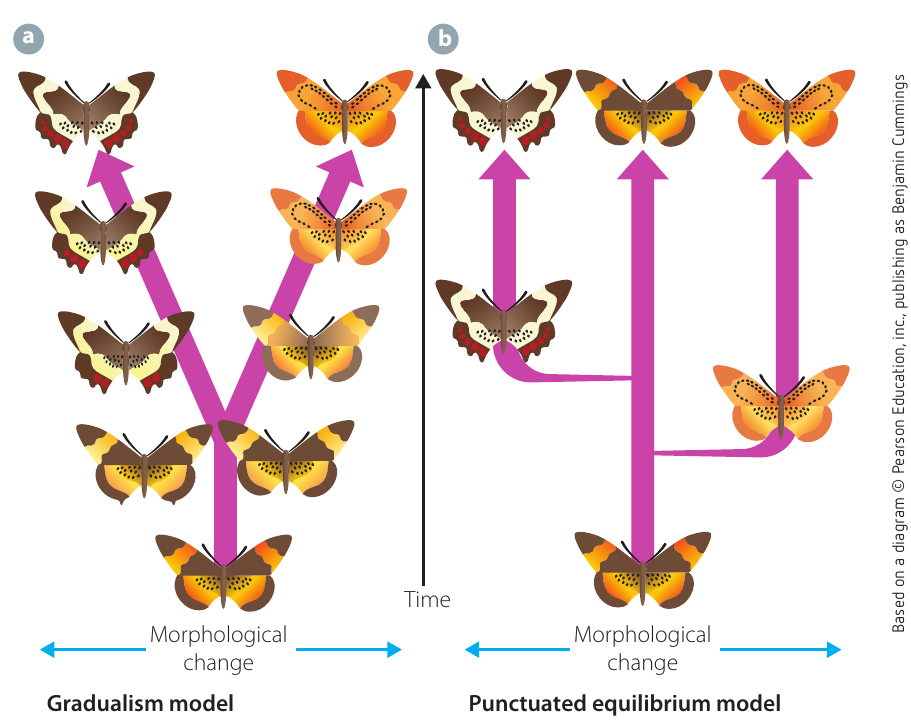
Example
Worked Example: Understanding the Butterfly Evolution Models
The butterfly example illustrates the key differences between these models:
Gradualism model: The butterfly evolves from a common ancestor through continuous selection pressure for wing colour. Gradual evolution occurs as small variations in individuals help them survive and reproduce, passing these advantageous traits to offspring. Over extended time periods, the entire population changes through these selection pressures.
Punctuated equilibrium model: Long periods pass without change (stasis). When helpful mutations occur in individuals, they get passed to offspring. The proportion of the population carrying the mutation can change rapidly, causing the species to transform quickly over a short geological period.
Key observation: Notice how in the gradualism model, changes accumulate steadily over time, while in the punctuated equilibrium model, the population remains unchanged for long periods before sudden shifts occur.
Key differences between gradualism and punctuated equilibrium
| Feature | Gradualism | Punctuated Equilibrium |
|---|---|---|
| Rate of change | Slow, constant, and consistent evolutionary change | Very little change for extended periods, interrupted by sudden rapid changes |
| Time scale | Occurs over long geological periods | Happens rapidly in geological time, but little change between speciation events |
| Pattern of speciation | A single species may evolve separately due to isolation | Speciation is branched with multiple outcomes, not linear |
| Frequency of change | Evolutionary change occurs continuously and doesn't always result in new species | Large, widespread species change slowly; new species can appear suddenly |
| Fossil record interpretation | Incomplete fossil record results from breaks in fossil formation; missing links could be found with more complete rock sequences or better fossilisation conditions | Fossil record is incomplete because speciation happened too quickly for fossil formation |
| Natural selection's role | Changes species features by removing less fit organisms from the gene pool over time | Very little change during stasis periods, punctuated by periods of sudden change |
Summary
Key Points to Remember:
-
Gradualism describes evolution as a slow, continuous process where populations gradually change as small variations accumulate over time due to different selection pressures
-
Punctuated equilibrium describes evolution as occurring in rapid bursts of change, followed by long periods of stability (stasis) within populations
-
Both patterns are scientifically valid and can occur in the same species at different times
-
The fossil record provides evidence for both patterns - trilobites show gradualism, while horseshoe crabs demonstrate punctuated equilibrium with 445 million years of stability
-
Neither theory challenges Darwin's fundamental principlethat evolution occurs through natural selection - they differ only in describing the rate and pattern of evolutionary change