Biochemical Processes in Cells (HSC SSCE Biology): Revision Notes
📚Revision Notes
Biochemical Processes in Cells
Introduction
Living cells carry out complex chemical reactions to maintain life. Eukaryotic cells contain many membrane-bound organelles, each housing specific enzymes that catalyse particular biochemical processes. These reactions within cells require energy, which is provided in the form of ATP (adenosine triphosphate).
The two major biochemical processes that occur in living cells are:
- Photosynthesis - occurs in plant cells
- Cellular respiration - occurs in all living cells
Note
For example, lysosomes use strong digestive enzymes in an acidic environment to break down compounds brought into the cell. The lysosome membrane prevents these powerful enzymes from damaging other parts of the cell, demonstrating how organelles create specialized environments for specific biochemical processes.
Energy transfer between reactions
The role of glucose and energy
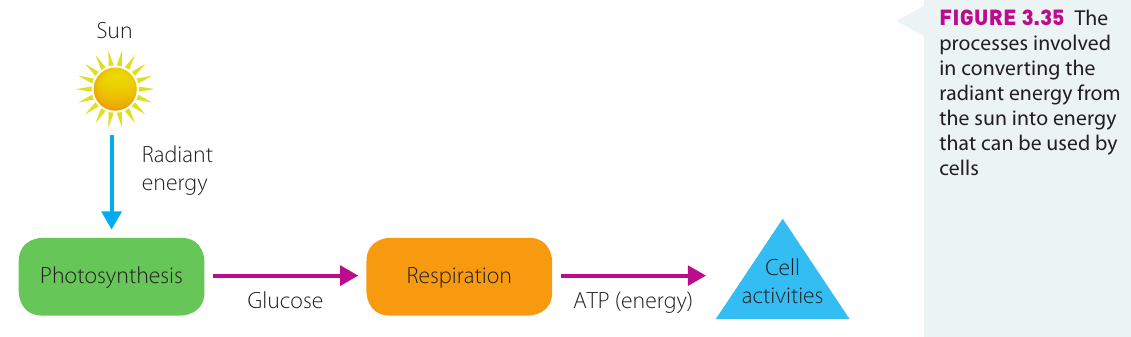
Energy provision is essential for all life processes to occur. All cells use glucose as their primary energy source to drive the thousands of chemical reactions happening constantly within them. When glucose breaks down through aerobic cellular respiration, it releases a large amount of stored energy.
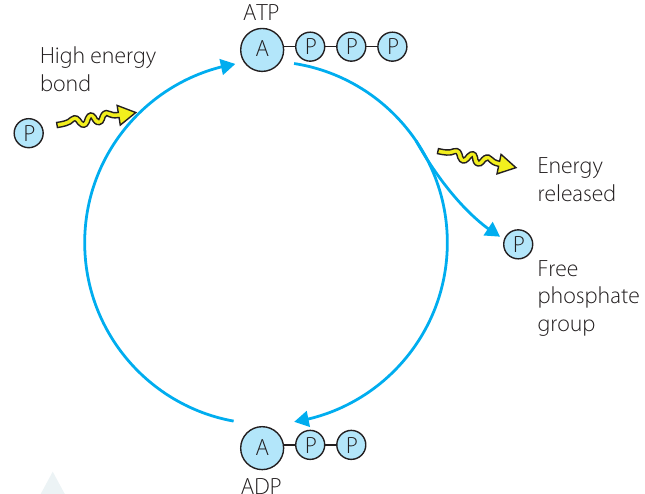
This released energy is captured and stored in small packets within many high-energy molecules called adenosine triphosphate (ATP). Cells access the energy in ATP to power all cellular functions. ATP is a small, mobile molecule that can deliver energy wherever it is needed in the cell.
ATP structure and the ATP-ADP cycle
ATP is composed of:
- Adenosine - a complex molecule consisting of adenine attached to a ribose sugar group
- Three phosphate groups - hence the name adenosine tri-phosphate
Note
The bond attaching the third phosphate group is a high-energy bond. When the cell requires energy, this bond breaks and releases its stored energy. This produces ADP (adenosine diphosphate) and a free phosphate group ().
To store energy produced by the cell, a free phosphate group attaches to ADP through a high-energy bond, reforming ATP. This creates a continuous cycle of energy storage and release between ADP, free phosphate groups, and ATP.
Important
The ATP-ADP Cycle:
The energy storage and release cycle can be summarised as:
- Energy release:
- Energy storage:
This cycle is fundamental to all cellular processes and is often called the energy currency of the cell.
Photosynthesis
What is photosynthesis?
Photosynthesis is the process by which plants use light energy (usually from the sun) to produce food. During this process:
- Light energy is trapped by chlorophyll (contained in the chloroplast)
- This energy breaks apart water () and carbon dioxide () molecules
- The atoms are rebuilt into oxygen (), energy-storing glucose molecules (), and water
Photosynthesis equations
Photosynthesis can be summarised by the word equation:
The balanced chemical equation is:
The two stages of photosynthesis
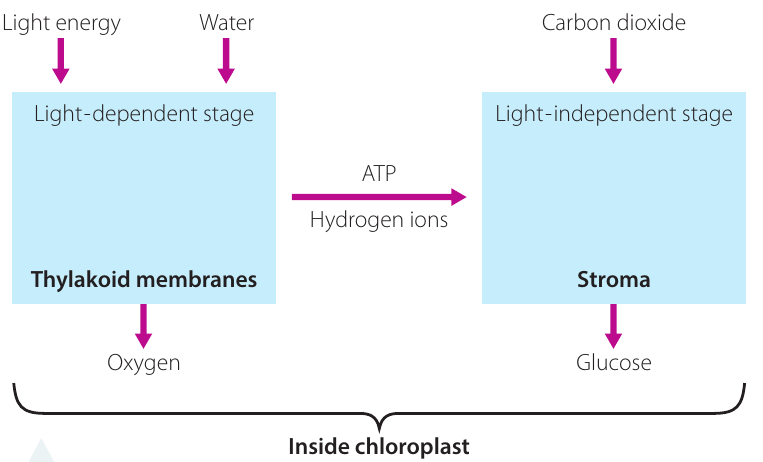
While the general equation summarises photosynthesis, the actual process consists of two stages, each involving many chemical reactions. These reactions occur in the chloroplasts of green plant cells and in some photosynthetic bacteria.
Phase 1: the light-dependent stage
The light-dependent stage (also called photolysis, meaning "light-splitting") occurs in the grana of chloroplasts. Here's what happens:
- Chlorophyll in the thylakoid membranes absorbs light energy
- This energy splits water () molecules into:
- Hydrogen ions ()
- Oxygen ()
- The oxygen is released into the atmosphere
- The hydrogen ions are carried to the next phase
- ATP is also formed at this stage
Important
Key point: This stage requires light and produces oxygen as a by-product. Without light, this stage cannot proceed, which is why photosynthesis only occurs during daylight hours.
Phase 2: the light-independent stage
The light-independent stage (also called carbon fixation) occurs in the stroma of chloroplasts. Here's what happens:
- Carbon dioxide () combines with the hydrogen ions produced in the light-dependent stage
- This forms glucose ()
- The ATP formed in the light-dependent stage provides the energy for this reaction
- No light is required in this stage (hence "light-independent")
Uses of glucose from photosynthesis
Glucose produced by photosynthesis can be converted by plants into:
- Complex carbohydrates
- Lipids
- Proteins
Note
These end-products are stored by plants and serve as the source of organic nutrients for:
- The plants themselves
- Consumer organisms that eat the plants
This makes photosynthesis the foundation of most food chains on Earth, as it converts light energy into chemical energy that can be used by other organisms.
Cellular respiration
Overview of cellular respiration
All organisms break down glucose to release energy for cellular metabolism. Glucose can be broken down in two ways:
- Aerobic cellular respiration - in the presence of oxygen
- Anaerobic cellular respiration - in the absence of oxygen
These processes produce different products and release different amounts of energy.
Anaerobic cellular respiration
Many organisms (such as some bacteria and archaea) live in oxygen-poor environments. Sometimes cells (like muscle cells) cannot obtain enough oxygen but still need to release energy through anaerobic pathways in the cytosol. Two common biochemical pathways enable energy production without oxygen:
Alcoholic fermentation
Example
Example: Alcoholic Fermentation
In alcoholic fermentation, yeast, many bacteria, and plants (or parts of plants) carry out anaerobic respiration. This process:
- Breaks down glucose in the absence of oxygen
- Forms ethanol (an alcohol) and carbon dioxide
- Produces two molecules of ATP
Word equation: glucose → ethanol + carbon dioxide + adenosine triphosphate
Chemical equation:
Human applications: Humans use this process to produce beer, wine, and bread.
Lactic acid fermentation
Example
Example: Lactic Acid Fermentation
Lactic acid fermentation occurs when organisms cannot produce enough energy through aerobic respiration. This happens during strenuous exercise when our bodies cannot deliver enough oxygen to muscles to meet energy demands. In this process:
- One glucose molecule breaks down in the absence of oxygen
- Produces two molecules of lactic acid
- Produces two molecules of ATP
Word equation: glucose → lactic acid + adenosine triphosphate
Chemical equation:
Important
Important note: Once strenuous exercise finishes and more oxygen becomes available, the lactic acid converts to a compound called pyruvate. This pyruvate is then converted by aerobic respiration into carbon dioxide, water, and energy (ATP).
Aerobic cellular respiration
Aerobic cellular respiration is a chain of many biochemical reactions that occur in cells in the presence of oxygen.
General equations for aerobic respiration
Word equation:
Balanced equation:
There are at least 20 separate reactions, each catalysed by a specific enzyme, that make up this overall pathway.
Stage 1: Glycolysis
Note
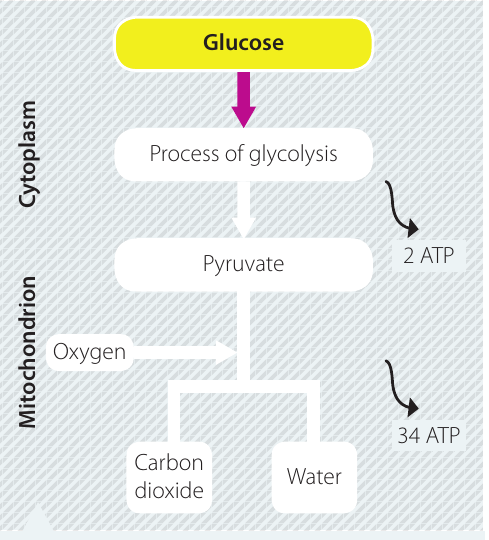
The first step in breaking down glucose is glycolysis. This process:
- Occurs in the cytosol of the cell
- Breaks down glucose (a six-carbon molecule) into two pyruvate molecules (each with three carbon atoms)
- Releases energy in the form of two molecules of ATP
- Actually consists of 10 smaller reactions, each catalysed by a specific enzyme
Stage 2: Mitochondrial reactions
The two pyruvate molecules formed from one glucose molecule then enter the mitochondria, where the remaining reactions of aerobic cellular respiration occur. In the mitochondria:
- Each reaction is catalysed by a specific enzyme
- More energy is produced and released as 34 ATP molecules
- Carbon dioxide and water are also produced
- Total ATP production: ATP molecules per glucose molecule
Important
Summary of ATP production:
- Glycolysis (in cytoplasm): 2 ATP
- Mitochondrial reactions: 34 ATP
- Total per glucose molecule: 36 ATP
This is 18 times more efficient than anaerobic respiration, which is why aerobic respiration is the preferred pathway when oxygen is available.
The relationship between photosynthesis and aerobic cellular respiration
How the processes are connected
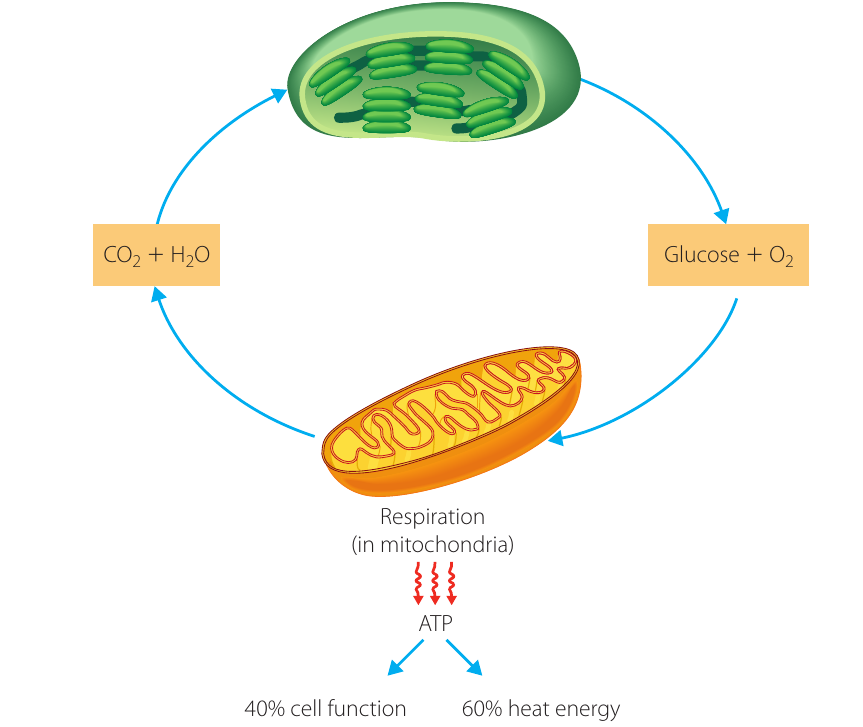
Photosynthesis and aerobic cellular respiration are closely related and interdependent processes. When you look at their general equations, they might appear to be the reverse of each other. However, this is not the case because each process consists of very different series of chemical reactions.
Important
The Interdependence of Photosynthesis and Respiration:
Despite their differences, these processes are intimately connected:
- The products of photosynthesis (glucose and oxygen) are used as inputs for aerobic cellular respiration
- The products of aerobic cellular respiration (carbon dioxide and water) are used as inputs for photosynthesis
This creates a vital cycle that sustains life on Earth.
Where both processes occur
In plant cells that contain both chloroplasts and mitochondria, both processes occur in the same cell. This creates an efficient energy cycle within the cell.
In plant cells that do not contain chloroplasts (such as root cells), the products of photosynthesis (glucose and oxygen) must be transported from other cells that do perform photosynthesis. These products are then used for aerobic cellular respiration to occur.
Note
Energy distribution: Of the ATP energy produced through respiration:
- 40% is used for cell functions
- 60% is released as heat energy
This heat energy helps maintain body temperature in warm-blooded organisms.
Removal of cellular products and wastes
What are cellular wastes?
Wastes are products of cellular reactions that are not required by the organism. They need to be:
- Transported to other cells, or
- Removed from the cell for efficient functioning
Methods of waste removal
Diffusion
Note
Removal from cells usually occurs by diffusion through the cell membrane. Substances removed this way include:
- Oxygen and carbon dioxide gases (easily diffuse through the membrane)
- Wastes formed from protein breakdown
- Water-soluble waste chemical products
Osmosis
Note
Excess water not required by the cell moves out through osmosis. Water-soluble wastes are removed at the same time as the water.
Special note: Oily, fat-soluble substances cannot dissolve in water. The cell attaches these substances to small electrically charged molecules, making them water-soluble so they can be removed when water diffuses out.
Lysosomal breakdown
When parts of the cell break down, wear out, or die, they need to be removed. Lysosomes (which contain digestive enzymes) break down:
- Old cell parts
- Other cellular waste
Any wastes that cannot be eliminated by the lysosome are packaged and removed by exocytosis.
Exocytosis
Exocytosis is used to remove:
- Wastes packaged in vesicles that lysosomes cannot break down
- Useful cellular products (not wastes) such as hormones, enzymes, and mucus
Important
Important distinction:
- Excretion: when wastes leave a cell
- Secretion: when useful products leave a cell to be used elsewhere
Understanding this difference is crucial for comprehending cellular processes.
Remember!
Summary
Key Points to Remember:
-
ATP is the energy currency of cells. It stores energy in high-energy phosphate bonds and delivers it wherever needed through the ATP-ADP cycle.
-
Photosynthesis converts light energy into chemical energy. It occurs in two stages: the light-dependent stage (in grana) splits water to produce oxygen and hydrogen ions, while the light-independent stage (in stroma) uses these hydrogen ions with carbon dioxide to produce glucose.
-
Aerobic respiration produces 36 ATP molecules per glucose. Glycolysis in the cytoplasm produces 2 ATP, while mitochondrial reactions produce an additional 34 ATP, totalling 36 ATP per glucose molecule.
-
Photosynthesis and respiration are interdependent. The products of one process serve as the reactants for the other, creating a vital cycle that sustains life on Earth.
-
Cells have multiple waste removal systems. Wastes can be removed through diffusion, osmosis, lysosomal breakdown, or exocytosis, ensuring efficient cellular function.