Ecosystem Restoration (HSC SSCE Biology): Revision Notes
📚Revision Notes
Ecosystem Restoration
Introduction to restoring damaged ecosystems
Despite concerning global declines in biodiversity, numerous success stories demonstrate that endangered species populations can recover. Some recovery occurs naturally through population cycles, but many successful restorations result from careful management and legal protection measures.
Note
Whale population recovery provides an excellent example of successful ecosystem restoration. After being hunted nearly to extinction, whale species are experiencing remarkable recoveries through a combination of legal protection and active management strategies.
Examples of successful whale recovery include:
- Southern right whales in Australian waters are predicted to approach their pre-whaling population numbers by 2050
- Humpback whale populations are expanding in the north Atlantic Ocean, north Pacific Ocean, and off the Western Australian coast
These recoveries demonstrate that with appropriate protection and management, even severely depleted populations can recover over time.
Mining site restoration
Legal requirements
Australian legislation mandates that mining operations must adhere to rigorous environmental standards. The Mining Act 1992 establishes clear definitions of environmental harm and requires subsequent management of mine sites to minimise this harm.
Important
All mining companies must complete an environmental impact statement (EIS) as part of their mining licence application. This document details how the company will ensure minimal harm to the environment during operations.
Mining companies operating in areas sacred to Indigenous Australians must be particularly mindful of the sensitivities of the traditional owners of the land. The Ranger Uranium Mine in Kakadu National Park, Northern Territory, exemplifies this consideration.
Principles of sustainable development
All Australian state governments encourage the safe and sustainable exploitation of natural resources. Mining companies must demonstrate how they will restore mine sites after operations cease, following the principles of sustainable development:
- Intergenerational equity: The next generation should not inherit a less healthy and diverse environment than the current one
- Biodiversity conservation: Biological diversity and environmental integrity must be preserved
- Precautionary principle: Decisions should err on the side of caution, with the burden of proof on companies to demonstrate their plans are ecologically sustainable
- Environmental limits: Resource extraction should be limited according to the environment's capacity to supply what is required
- Efficiency and resilience: Human efficiency and ecological resilience are crucial factors in sustainable operations
Note
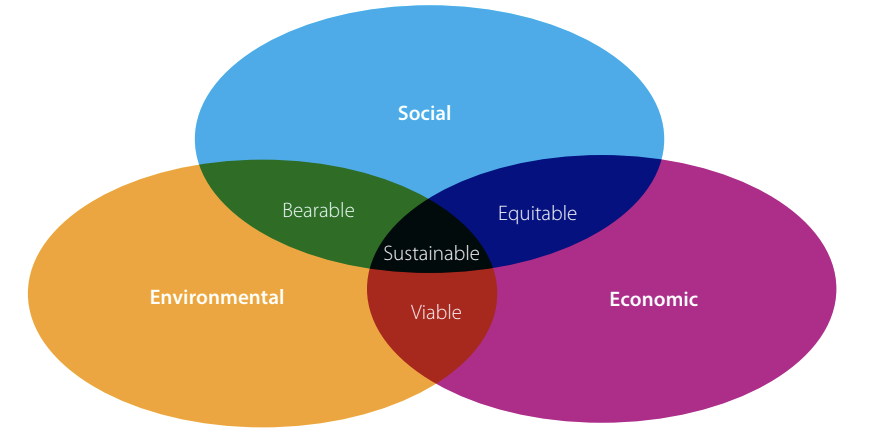
The diagram above illustrates how sustainability requires balancing social, environmental, and economic factors. True sustainability occurs where all three pillars overlap - this is often called the "triple bottom line" approach to development.
Mine site rehabilitation strategies
Mining companies must implement comprehensive restoration strategies when operations cease:
Infrastructure removal:
- Remove all machinery and buildings
- Seal and secure mine entrances and shafts
- Stabilise all underground tunnels
Contamination management:
- Remove contaminated soil
- Manage any chemical contamination appropriately
- Treat tailings and other chemical waste
- Conduct regular testing of local waterways for chemical contamination from run-off, especially acids
Environmental restoration:
- Revegetate and landscape the environment using topsoil and samples of native flora and fauna collected before mining began
- Control weeds and feral pests (such as rabbits) while vegetation re-establishes
- Fence the site to protect it during re-establishment
Pollution control:
- Control gas emissions from the site
- Control dust generated at the mine site
- Schedule truck movements to limit noise pollution
Agricultural land restoration
Improved management practices
With increased awareness of soil and water management science, and better access to information through the Internet and computer modelling, there has been marked improvement in the management of Australian soils and waterways.
Farm owners can have their land evaluated by scientists who create personalised management strategies. The management of salinisation and erosion are high priorities in most areas of Australia.
Specific problems and control measures
The following table outlines major agricultural problems and their control measures:
| Problem | Control measures |
|---|---|
| Soil erosion | • Use minimum till or direct drilling techniques • Avoid leaving soil fallow for extended periods • Reduce livestock stocking rates and employ rotational grazing • Retain stubble after harvest • Grow crops on slopes carefully • Use channels and terraces to store and redirect water • Leave riparian buffer strips to reduce riverbank erosion • Create windbreaks • Use drip irrigation instead of flood irrigation |
| Salinisation | • Replant deep-rooted perennial plants • Use drip irrigation instead of flood irrigation • Mulch garden beds • Plant salt-tolerant plant species • Time sprinkler systems appropriately |
| Eutrophication | • Reduce run-off into streams of nitrogen and phosphorus-containing fertilisers and detergents |
| Introduced species | • Implement quarantine and border control methods • Use biological and chemical control methods • Manage weeds through physical removal in appropriate situations |
| Land clearing | • Replant deep-rooted native vegetation • Re-establish ground cover |
| Pesticide residues | • Use integrated pest management systems that incorporate several strategies besides chemicals (such as traps, barriers, and genetic engineering) |
Note
Key terms explained:
- Stubble: Plant material left after harvest
- Terraces: Step-like formations on slopes that slow water flow
- Riparian buffer strips: Vegetated areas along waterways that filter run-off
- Perennial plants: Plants that live for multiple years and have deeper root systems
- Quarantine: Isolation procedures to prevent the spread of pests and diseases
Biological control methods
Understanding biological control
The use of chemical pesticides (chemical control) provides quick and effective pest elimination. However, pesticides can cause serious ecosystem problems through:
- Bioaccumulation: The accumulation of toxins in individual organisms over time
- Biomagnification: The concentration of toxins as they move up the food chain, resulting in top predators receiving the largest doses
Note
Scientists now favour biological control agents that use knowledge of relationships between organisms to manage pests. The most effective approach combines multiple control methods in what is known as integrated pest management. This strategy uses biological measures as the primary control method and limits chemical use to narrow-spectrum agents that target specific species.
Types of biological control agents
There are four main types of biological control agents:
1. General predators
These organisms consume a wide variety of pest species. Examples include:
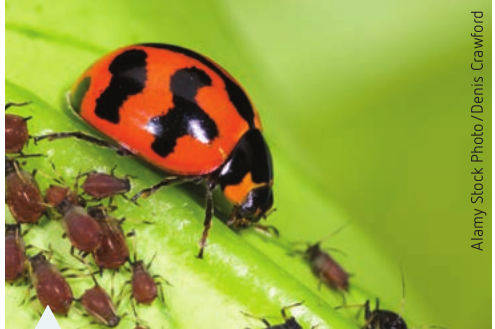
- Ladybirds (ladybugs): Target aphids, caterpillars, mites, and small beetles
- Green ants: Provide cost-effective control of most pests attacking mangoes
Important
Warning about general predators:
Almost all ecological disasters resulting from biological control have occurred due to the introduction of general predators. They can affect non-target species and disrupt ecosystems. This is why specialised predators are generally preferred for biological control programs.
2. Specialised predators
These organisms target one specific pest species or group of closely related species.
Example
Successful Specialised Predator Examples:
- South American weevil: Controls the water weed Salvinia (released in 1980 with great success)
- Moths and flea beetles: Reduce the impact of alligator weed (introduced in 1977)
- South American beetles: Control water hyacinth
These specialised predators tend to establish balanced relationships with their target plants, preventing complete elimination while maintaining control.
3. Parasites
These organisms (such as wasps or flies) lay their eggs in the bodies of host organisms. When the eggs hatch, the larvae feed on the host's body, causing death. Host organisms include scale insects, aphids, moths, and caterpillars.
Example
Parasite Control Success Stories:
- Wasps: Control native stem-girdler moths that damage macadamia and pecan crops in Queensland by laying eggs in moth eggs, which are then consumed by wasp larvae
- Various wasp species: Harnessed to control pests including the Heliothis moth that feeds on cotton plants
4. Microbial diseases
These control agents include bacteria, fungi, and viruses that target specific species and cause death through illness.
Example
Microbial Disease Control Examples:
- Myxomatosis virus and calicivirus: Introduced to control rabbit populations
- 'Myco-insecticides' (fungal insecticides): Target soil-dwelling grubs (larvae) that damage plant roots, including those of pasture grasses, sugar cane, potatoes, and other crops
- Fungi: Used as biological control agents against scarab beetles and other target insects
- Specialised fungi: Infect beetle digestive systems to combat Dutch elm disease by preventing beetles from gaining adequate nutrition
Success of biological control
When properly planned and implemented, biological control offers a sustainable alternative to chemical pesticides. The key is selecting appropriate control agents that:
- Target specific pest species
- Do not harm native or beneficial species
- Establish balanced relationships within the ecosystem
- Work as part of integrated pest management strategies
Important
Exam tip: Remember that biological control is not always successful if poorly planned. The cane toad introduction is a classic example of biological control failure that students should be aware of.
Summary
Key Points to Remember:
- Endangered species populations can recover through careful management and legal protection, as demonstrated by whale population recoveries
- Mining companies must complete environmental impact statements and follow strict rehabilitation procedures when operations cease
- Sustainable development requires balancing social, environmental, and economic factors through five key principles
- Agricultural land degradation can be managed through various strategies targeting specific problems like erosion, salinisation, and eutrophication
- Biological control offers a more sustainable alternative to chemical pesticides by using living organisms to manage pests
- Integrated pest management combines multiple strategies to effectively control pests while minimising environmental harm