Evolution of Australian Biota (HSC SSCE Biology): Revision Notes
📚Revision Notes
Evolution of Australian Biota
Introduction to Australian biota evolution
Australia's geographical separation from other continents has resulted in a unique collection of plants and animals. When Australia severed its final connection with Antarctica approximately million years ago, the continent began a long period of isolation. This isolation allowed Australian species to evolve independently, creating ecosystems found nowhere else on Earth.
Note
Scientists study fossils to understand how present-day organisms evolved from ancient species. The fossil record provides valuable information about the gradual changes that occurred in Australian species over millions of years, offering a window into evolutionary processes that took place over vast timescales.
Australia's changing climate and vegetation
Climate cycles
Australia's climate has alternated between two distinct patterns:
- Warm and wet cycles: Characterized by high rainfall and tropical conditions
- Cold and dry cycles: Marked by low rainfall and arid conditions
These climate fluctuations significantly influenced the types of plants that could survive in different regions, driving evolutionary changes in Australian vegetation.
Vegetation changes
The dominant vegetation has transformed dramatically over time:
Past: Tropical rainforests dominated the landscape, featuring broad-leafed plants adapted to warm, moist conditions.
Present: Open grasslands and deserts now cover much of the continent, with sclerophyll plants as the dominant vegetation. These are plants with hard, leathery leaves that help them survive in dry conditions.
Note
This shift in vegetation occurred gradually as Australia drifted northward and the climate became hotter and drier. Changes in plant life then influenced the evolution of animal species, as fauna had to adapt to new food sources and habitats.
Major Australian fossil sites
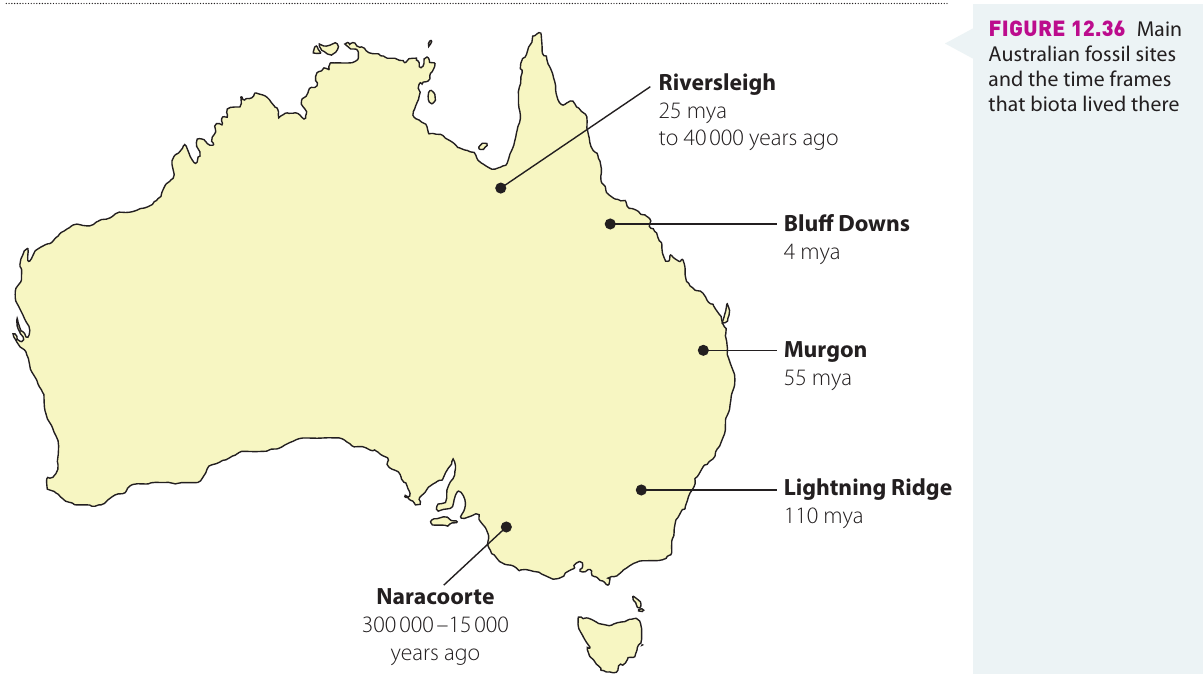
Australia contains several significant fossil sites that provide a window into the continent's biological past. Each site represents a different time period and offers unique insights into evolutionary history.
Important
These fossil sites collectively tell the story of Australian mammal evolution, particularly the development of marsupials and monotremes, in connection with the continent's changing climate and northward drift. They provide crucial evidence for understanding how isolation and environmental change shaped Australia's unique biota.
Key fossil sites and their time periods
Riversleigh (Queensland)
- Time range: million years ago to years ago
- Significance: Represents the Oligo-Miocene period through to the Pleistocene epoch, providing evidence of mammal evolution over at least million years
Naracoorte (South Australia)
- Time range: to years ago
- Significance: Offers an excellent snapshot of Pleistocene organisms and the relationship between climate change and mammal evolution; spans the period of human arrival in Australia
Murgon (East coast)
- Time period: million years ago
- Significance: Revealed evidence that placental mammals and marsupials coexisted in Australia, challenging previous assumptions
Lightning Ridge (Southeast)
- Time period: million years ago
- Significance: Contains fossils from when flowering plants were first establishing in Australia
Bluff Downs (Northeast)
- Time period: million years ago
- Significance: Provides evidence of more recent evolutionary changes
Evolution of Australian mammals
The three mammal groups
Mammals first appeared on Earth approximately million years ago, evolving from reptiles. Three distinct groups gradually evolved from a common ancestor:
- Monotremes: Egg-laying mammals (for example, platypus and echidna)
- Marsupials: Pouched mammals that give birth to underdeveloped young (for example, kangaroos, wombats, koalas)
- Placental mammals (eutherians): Mammals that nourish their young through a placenta before birth (for example, humans, dogs, mice)
Timeline of mammal evolution in Australia
Example
Timeline of Key Events:
– million years ago: The oldest mammals appear in Australia's fossil record. At this time, Australia was still connected to Antarctica, New Zealand, and South America.
million years ago: Flowering plants began establishing across Australia. Mammals shared the land with dinosaurs.
million years ago: Australia's connection with Antarctica was severed, marking the beginning of the continent's long period of isolation.
Present-day Australian mammals
Most surviving mammals in Australia today are marsupials. However, Australia is unique in having representatives of all three mammal groups:
- Monotremes (platypus, echidnas)
- Marsupials (kangaroos, wombats, possums, and many others)
- Small placental mammals (bats, rodents, marine mammals)
Important
This coexistence of all three mammal lineages is found only in Australasia, making it a region of exceptional biological interest. No other region on Earth contains representatives of all three major mammal groups living together.
Convergent evolution in Australian mammals
Despite evolving independently from mammals on other continents, many Australian marsupials closely resemble placental mammals found in the Northern Hemisphere (Europe and North America). This phenomenon is called convergent evolution, where unrelated species evolve similar characteristics because they face similar environmental challenges and occupy similar ecological niches.
Examples of convergent evolution
The comparison between marsupial and placental mammals reveals remarkable similarities:
Small insectivores
- Marsupial: Plantigale (small mouse-like marsupial)
- Placental: Deer mouse
- Similar features: Small size, pointed snout, insect-eating adaptations
Burrowing animals
- Marsupial: Marsupial mole
- Placental: Mole
- Similar features: Powerful digging claws, reduced eyesight, streamlined body
Gliding mammals
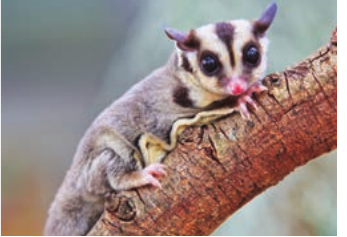
- Marsupial: Sugar glider (shown above)
- Placental: Flying squirrel
- Similar features: Membrane between limbs for gliding, nocturnal habits, tree-dwelling lifestyle
Stocky herbivores
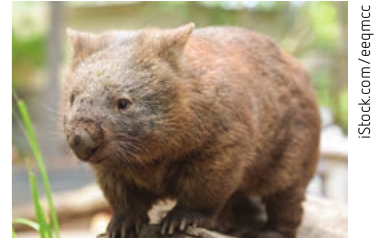
- Marsupial: Wombat (shown above)
- Placental: Woodchuck (groundhog)
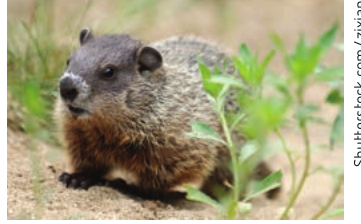
- Similar features: Robust build, burrowing behavior, plant-eating diet
Large herbivores
- Marsupial: Kangaroo
- Placental: Patagonian cavy
- Similar features: Hopping locomotion, grazing behavior, large hind legs
Aggressive carnivores
- Marsupial: Tasmanian devil
- Placental: Wolverine
- Similar features: Powerful jaws, scavenging behavior, stocky muscular build
Note
These similarities arose not because of shared ancestry, but because both groups adapted to similar environments and lifestyles. This provides strong evidence for natural selection as the driving force of evolution.
Origins of present-day Australian biota
Understanding the origins of Australia's current plants and animals helps explain the diversity and distribution of species we see today.
Origins of Australian plants
The distribution and abundance of present-day plants in Australia reflect three main sources:
- Gondwanan residents: Species already present when Australia separated from the supercontinent Gondwana
- Asian dispersal: Plants that spread from South-east Asia to Australia after the continents moved closer
- Introduced species: Plants brought by human settlers in recent history
Origins of Australian animals
Present-day Australian fauna originated from four main sources:
1. Original residents: Animals present when Australia split from Gondwana
- Examples: Frogs, reptiles, monotremes, marsupials, emus, lyrebirds
- These species evolved in isolation for millions of years
2. Asian immigrants: Animals that arrived when sea levels were low, creating land bridges
- Time periods: million years ago and again – years ago
- Examples: Poisonous snakes, back-fanged snakes, rats, mice, bats
3. Aboriginal introductions: Species brought by immigrant traders or later Aboriginal arrivals
- Time period: years ago
- Example: Dingos
4. European introductions: Animals brought by European settlers
- Time period: Beginning years ago
- Examples: Rabbits, foxes, cats, cattle, sheep
Note
The concept of Gondwana is crucial to understanding Australian biota. Gondwana was the ancient southern supercontinent that included Australia, Antarctica, South America, Africa, India, and Madagascar. When Australia separated from Gondwana approximately million years ago, it carried with it a unique assemblage of species that would continue to evolve in isolation.
Environmental pressures and evolutionary change
When climate changes occur in a habitat, the distribution and abundance of living organisms also change. Species that are better adapted to the new conditions survive and reproduce, while those that cannot adapt may become extinct or evolve new characteristics.
Selection pressures on Australian biota
Several factors have influenced the evolution of Australian plants and animals:
Natural selection pressures:
- Changing climate (from warm/wet to cold/dry cycles)
- Altered vegetation patterns
- Continental drift northward into different climate zones
- Competition for resources
Human-induced selection pressures:
- Colonization and land clearing
- Introduction of foreign species
- Habitat destruction
- Hunting and predation by introduced predators
Important
These pressures have led to significant changes in Australian biota:
- Threatened species
- Extinction of some species
- Evolutionary adaptations in surviving species
- Changes in distribution and abundance
Understanding these pressures is crucial for conservation efforts and predicting future changes to Australia's unique ecosystems.
Key terminology
Extinct: A species that no longer exists anywhere on Earth
Extant: A species that still exists today
Understanding which species are extinct and which are extant helps scientists track evolutionary changes and the impact of environmental pressures over time.
Summary
Key Points to Remember:
-
Australia's million years of isolation led to the evolution of unique flora and fauna found nowhere else on Earth.
-
The continent's climate shifted from warm, wet tropical conditions to predominantly dry, arid conditions, causing vegetation to change from rainforests to open grasslands and deserts with sclerophyll plants.
-
Australia's fossil sites, including Riversleigh and Naracoorte, provide crucial evidence of mammal evolution over at least million years.
-
Three groups of mammals exist in Australia: monotremes (egg-laying), marsupials (pouched), and placental mammals, with marsupials being the dominant group.
-
Convergent evolution explains why many Australian marsupials closely resemble placental mammals from other continents—similar environmental challenges led to similar adaptations despite different evolutionary origins.