The Nature of Biology (HSC SSCE Biology): Revision Notes
📚Revision Notes
The Nature of Biology
What is science?
Science is a way of studying the world around us through careful observation and experimentation. It involves asking questions about the natural and physical world, then seeking answers based on evidence.
What makes science unique is its approach to thinking and working. Scientists are characterized by their constant questioning. The knowledge we gain from these questions is not science itself. Rather, it is the product of science, along with the technology that develops from this understanding.
Note
Science is empirical, meaning scientists answer questions by gathering evidence from observations and experiments rather than relying on beliefs or opinions alone. This focus on observable, testable evidence is what distinguishes science from other ways of understanding the world.

What is biology?
Biology emerged as a named field of study in the 19th century, growing from the ancient practices of medicine and natural history. The word "biology" comes from two Greek words: bios (meaning life) and logos (meaning word or discourse).
Biology asks questions about all living organisms, including:
- Plants
- Animals
- Micro-organisms
Biologists investigate many aspects of life:
- How organisms are structured and function
- How and why they have changed over time
- How organisms interact with each other and their environment
- Biodiversity and the continuity of life
- Heredity (how traits are passed on) and variation (differences between organisms)
Note
These areas of interest are organized into specialized branches such as:
- Botany (study of plants)
- Zoology (study of animals)
- Microbiology (study of micro-organisms)
- Evolutionary biology (study of how organisms change over time)
- Ecology (study of interactions between organisms and environments)
- Genetics (study of heredity and variation)
Because all living things are interconnected and depend on each other, biology is a fascinating and complex science.
Scientific theories must be falsifiable
A crucial characteristic of science is that theories must be both testable and falsifiable.
Falsifiable means "able to be disproved." For a theory to be considered scientific, it must be possible to test whether it is not true. This requirement separates science from other disciplines where theories may exist that cannot be tested or disproved.
Supporting versus proving theories
Important
Scientists never talk about proving a theory. Instead, they discuss providing evidence to support a theory. This is a fundamental principle that distinguishes how science operates.
Here's why this distinction matters:
- When enough evidence accumulates supporting a theory, the scientific community accepts it
- Well-supported theories in biology include the cell theory and the Theory of Evolution by Natural Selection
- However, no matter how much supporting evidence exists, just one contradictory experiment can disprove a theory
Note
Einstein's insight on scientific truth:
As Einstein famously said: "No amount of experimentation can ever prove me right; a single experiment can prove me wrong."
This quote perfectly captures why scientists focus on supporting rather than proving theories.
Examples of changing theories
Biology has many examples of theories that were later rejected or modified when new evidence emerged:
- Spontaneous generation - This theory is now obsolete
- One-gene-one-enzyme theory - Later changed when scientists discovered a single gene can code for multiple polypeptides
- Piltdown man - Based on a hoax
- Autism-vaccination hypothesis - Rejected because the scientific method used could not be repeated and was shown to be invalid
The scientific method
The scientific method is how scientists systematically gather information and test ideas. It involves collecting data through observation and measurement, then using this data to create and test hypotheses. This process has built the foundation of scientific knowledge we accept today.
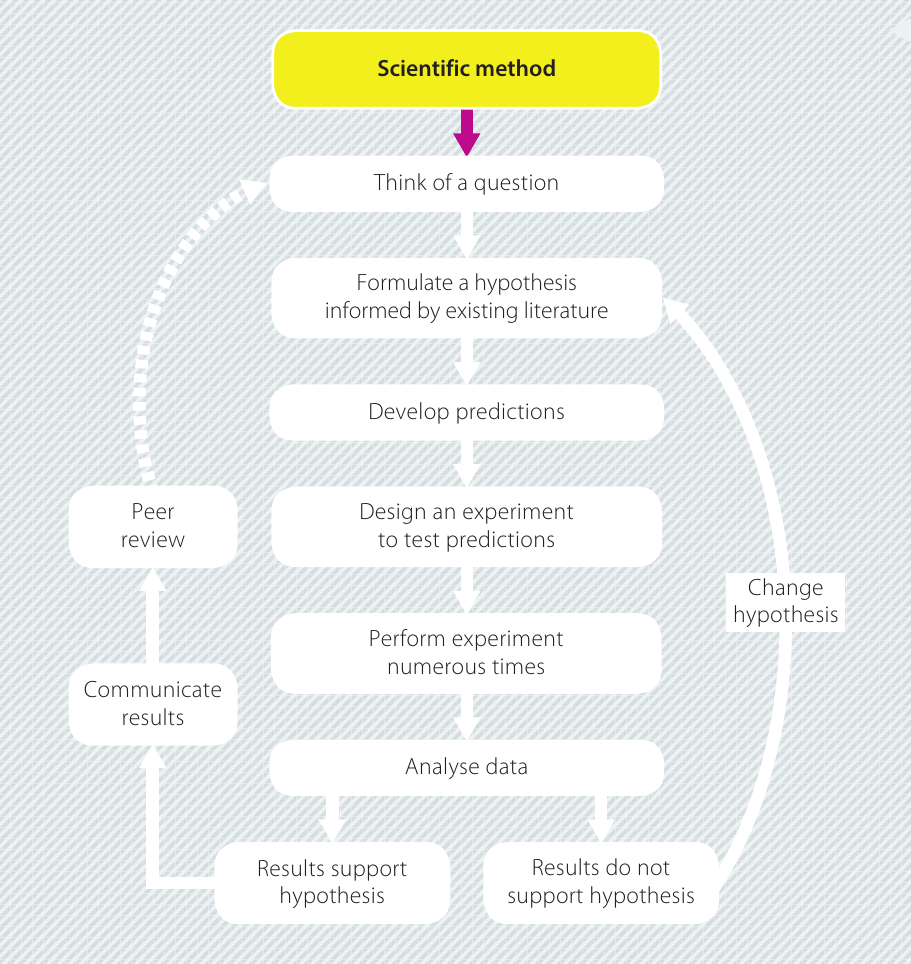
The scientific method involves these key steps:
- Ask a question - Identify what you want to investigate (also called a research question)
- Formulate a hypothesis - Develop a tentative answer to your question based on existing scientific literature
- Make predictions - Determine what should happen if your hypothesis is correct
- Design an experiment - Create a test for your predictions
- Perform the experiment - Conduct the test multiple times
- Analyze data - Examine your results
- Draw conclusions - Determine if results support or do not support your hypothesis
- Communicate results - Share findings with other scientists
- Peer review - Have experts evaluate your work
Understanding hypotheses
A hypothesis is a tentative answer to your research question. It makes a prediction about the relationship between variables you are investigating.
Before forming a hypothesis, scientists typically review existing literature to see if anyone has already answered their question or investigated something similar.
Example
Example Hypothesis: Plant Growth and Fertilizer
You might hypothesize: "If I use fertilizer X on plant species Y, then the plants will grow taller."
You could test this by:
- Growing seedlings in identical conditions
- Applying different amounts of fertilizer X to different groups
- Measuring and comparing seedling height over time
The reality of scientific investigation
Note
Scientific progress is rarely a straight line. Often, initial experiment results make you reassess your direction. This might lead you to:
- Change your hypothesis
- Refine your experimental design
- Pursue a new, more interesting question that emerges
Sometimes scientists begin with only questions but no hypothesis. In these cases, they conduct experiments or make observations to help form a testable hypothesis.
Quality of experiments
For scientific experiments to be useful, they must meet specific quality standards.
Validity
Valid experiments test the hypothesis they intended to test and give consistent results when repeated.
To achieve validity:
- Set up proper controls
- Ensure only the variable being tested changes
- Keep all other conditions the same
Reliability
Reliable experiments can be repeated to give the same results.
To achieve reliability:
- Eliminate or minimize random errors
- Conduct multiple trials
- Use consistent procedures
Accuracy
Accurate experiments have measurements close to the true value.
To achieve accuracy:
- Minimize measurement errors
- Use appropriate measuring instruments
- Follow proper measurement techniques
Important
The VRA Requirement
For an experiment to be valid, it must be both reliable and accurate.
Remember the VRA principle:
- Valid - tests what it's supposed to test
- Reliable - gives consistent results
- Accurate - measurements close to true values
Communication and peer review
Reproducibility
Reproducibility is essential in science. If other scientists cannot repeat an experiment and get the same results, this suggests:
- A mistake was made
- The experiment is not valid
- The hypothesis may be disproved
Note
For example, if measurement uncertainties prevent consistent results, this clearly disproves the hypothesis. This is why detailed documentation of experimental procedures is crucial.
How scientists communicate
Scientists share their work to:
- Exchange new ideas and information
- Contribute to the ongoing development of science
Communication methods include:
- Seminars and conferences
- Scientific journal articles
- Papers (similar to the reports you write for experiments)
The peer review process
Before publication, scientific papers undergo peer review:
- Expert scientists in the relevant field evaluate the paper
- They assess whether:
- The experiments were appropriate
- The conclusions were valid
- The hypothesis is clearly supported or not supported
- If the paper makes a useful contribution and the work is valid, it gets published
- Other scientists can then read and build upon this work
Important
Peer review ensures the quality and reliability of published scientific research. It acts as a quality control system that helps prevent flawed or invalid research from entering the scientific literature.
Scientists also communicate their findings to the public and students in various ways.
Biology as a scientific discipline
Questions biologists ask
Scientific disciplines are characterized by the types of questions they explore. Biology asks questions about:
- How living organisms are organized and grouped
- How living things change over time
- Why some species survive while others do not
- How living things interact with their environments and each other
Approaches to answering biological questions
Biologists answer questions by examining:
- Morphology (form and structure) and functioning
- Reproduction and survival adaptations
- Origin, distribution, and interactions
- Inheritance patterns and diversity
Note
Levels of Biological Study
Biological studies operate at multiple levels:
- Macroscopic - visible to the naked eye
- Microscopic - requiring microscopes
- Molecular - at the level of molecules
Technology and biological understanding develop together, each advancing the other.
The more we discover in biology, the more new questions arise. Many questions remain unanswered, and future biologists will generate questions we haven't even thought of yet.
Models in science
Over time, scientists have built models to represent how living things relate and change. These models are representations of biological reality, not reality itself - just as a model aeroplane is not a real aeroplane.
Types of models
Biologists use three main types of models:
- Physical models - tangible representations you can see and touch
- Mathematical models - composed of equations and data
- Conceptual models - made up of principles, laws, and theories
Note
Scientists often combine different models or switch between them depending on what they are investigating. The flexibility to use different types of models is one of the strengths of scientific inquiry.
Purpose of models
Models serve two important purposes:
- Explain how things work
- Predict what will happen
Models change and improve
Important
Models constantly evolve as we gather more evidence and answer new questions. If a model does not accurately predict experimental results, it is usually revised or replaced.
This adaptability reflects the self-correcting nature of science.
Choosing the right model
Different models may give similar results in some situations but different results in others. Selecting the appropriate model is crucial for obtaining valid and reliable results.
Example
Example: Population Estimation Models
When estimating animal population abundance, different models work better for different situations:
- Closed population mark-recapture model - best for relatively fast-moving animals in stable populations (assumes no birth, death, or emigration)
- Distance sampling model - preferable for slow-moving animals in large numbers
- Open population mark-recapture model - better for fast-moving animals where migration occurs
No single model is always "right" or "true." The key skill is choosing the best model for each specific situation.
Understanding biology: unifying concepts
The knowledge gained from biological investigations can be organized into five major concepts. These concepts help us understand how different areas of biology connect.
Note
The Five Unifying Concepts in Biology:
- Form and function - How the structure of organisms relates to what they do
- Similarity and diversity - What organisms have in common and how they differ
- Stability and change - How organisms maintain themselves while also evolving
- Systems and interactions - How parts work together and affect each other
- Patterns, order, and organization - Regular structures and arrangements in living things
These concepts link to the four main modules in Year 11 Biology:
- Cells as the basis of life
- Organization of living things
- Biological diversity
- Ecosystem dynamics
Building your understanding
Biology is not just a collection of isolated facts. Every idea connects to other ideas. As you learn, create concept maps to:
- Record content knowledge
- Show connections between different topics and modules
- Build your own mental models of biological concepts
Depth studies: working scientifically
Depth studies give you opportunities to work as a scientist and solve scientific problems.
When conducting a depth study, you will:
- Pose questions about a biological topic
- Develop hypotheses to answer your questions
- Seek evidence to support or disprove hypotheses through:
- Reviewing existing scientific literature
- Conducting your own experiments
- Analyze data to determine if hypotheses are supported
- Represent data using appropriate methods (often mathematical or graphical)
- Communicate findings to others using methods suitable for your audience
Note
This process mirrors what professional scientists do in their research. Depth studies provide valuable experience in scientific thinking and methodology.
Remember!
Summary
Key Points to Remember:
-
Science is empirical - it relies on observable evidence from experiments and observations, not just ideas or beliefs.
-
Theories can be disproved but never proven - scientists gather evidence to support theories, but one contradictory experiment can disprove a theory no matter how much supporting evidence exists.
-
The scientific method is systematic - it follows a process of questioning, hypothesizing, experimenting, analyzing, and communicating, though the path is not always straight.
-
Quality experiments must be valid, reliable, and accurate - they test what they intend to test, give consistent results when repeated, and produce measurements close to true values.
-
Biology uses models to explain and predict - physical, mathematical, and conceptual models represent biological reality and are constantly refined as we learn more.