Organisation of Cells (HSC SSCE Biology): Revision Notes
📚Revision Notes
Comparing Different Types of Organisms
Introduction to organismal diversity
Living organisms on Earth display remarkable diversity in their structure and appearance. Despite these obvious differences, at the cellular level, organisms share many fundamental similarities. Each cell must obtain nutrients, carry out metabolic processes, and dispose of waste products effectively.
Note
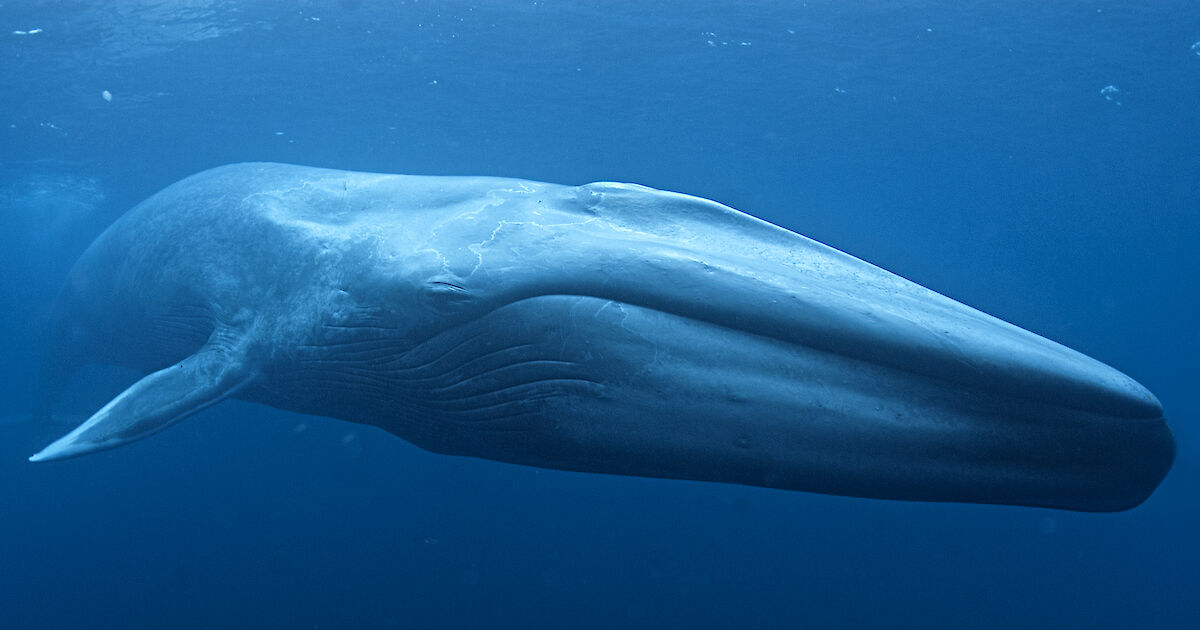
Even massive organisms like the blue whale have cells that are similar in size, shape, and function to those found in single-celled organisms. The key differences between organisms lie in how their cells are organized and work together.
Three types of organismal organization
Organisms can be classified into three main categories based on their cellular organization:
- Unicellular organisms - composed of a single cell
- Colonial organisms - groups of identical cells working together
- Multicellular organisms - many different specialized cells functioning as one organism
Similarities across all organism types
All three organizational types share fundamental characteristics:
- Composed of cells as their basic unit
- Cells possess cell membranes, cytosol, ribosomes, and genetic material
- Cells must carry out essential life processes
Key differences between organism types
Important
The main differences relate to:
- Number of cells present
- Types of cells present
- Level of organization and specialization
Unicellular organisms
Unicellular organisms contain only one cell that performs all necessary life functions. This single cell can be either prokaryotic (like bacteria) or eukaryotic (like Paramecium).
Prokaryotic unicellular organisms
Prokaryotes are the oldest form of life on Earth, existing for approximately to billion years. These organisms consist of a single prokaryotic cell without membrane-bound organelles or a nucleus.
Key characteristics include:
- Simple cellular structure
- No specialized organelles
- Limited number of metabolic reactions occurring simultaneously
- Highly adaptable - remain the most widespread organisms on Earth
Eukaryotic unicellular organisms
Unicellular eukaryotes possess specialized organelles that allow them to carry out life processes more efficiently than prokaryotes. These membrane-bound compartments enable different metabolic reactions to occur in separate locations within the cell.
Surface area to volume ratio in unicellular organisms
Important
A critical advantage of unicellular organisms is their high surface-area-to-volume ratio (SA:V). Their microscopic size means:
- Large surface area relative to cell volume
- Efficient movement of substances (nutrients, gases, water) across the cell membrane
- All parts of the cell can access required materials quickly
- Waste products can be removed efficiently through the cell membrane
- Direct exposure to the external environment enables rapid exchange
Colonial organisms
Colonial organisms consist of groups of identical single-celled organisms living together as a colony. Each individual cell can carry out all functions necessary for life independently, yet the colony provides advantages through cooperation.
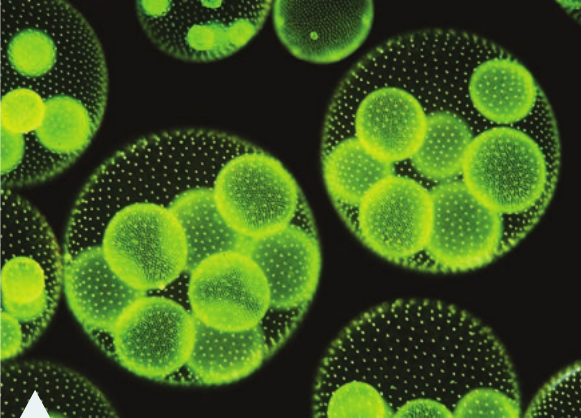
Volvox - a colonial algae
Volvox serves as an excellent example of colonial organization. This organism was first observed by Anton van Leeuwenhoek (1632-1723), who crafted his own microscope lenses and made precise observations of microscopic life.
Example
Key features of Volvox colonies:
- Hollow sphere containing to algal cells
- Each cell has two flagella for movement
- Cells connected by cytoplasmic strands enabling coordinated swimming
- Colony is only one cell thick
- Each cell contains a red 'eyespot' for light detection
- Cells at one end have more developed eyespots, allowing directional movement toward light
- All cells contain chloroplasts for photosynthesis
- Some colonies can also absorb nutrients from their environment
Despite showing simple specialization, Volvox lacks true tissues and organs, so it is classified as a unicellular colony rather than a multicellular organism.
Choanoflagellates
These eukaryotic organisms can exist either as free-living single cells or grouped in colonies. Each cell has:
- An ovoid or spherical cell body
- A single collared flagellum
Note
Research on choanoflagellate genetics suggests they represent an evolutionary link between unicellular and multicellular organisms, providing insights into how complex life may have evolved.
Multicellular organisms
Multicellular organisms are composed of many different types of cells. Similar cells group together to perform specialized functions that work together for the efficient operation of the entire organism.
Key characteristics of multicellular organisms
Unlike unicellular and colonial organisms, specialized cells in multicellular organisms:
- Cannot survive independently
- Depend on other cell types to perform functions they cannot
- Work together in a coordinated manner
Addressing the surface area challenge
Multicellular organisms are larger overall, giving them a smaller total SA:V. This creates a challenge because passive transport alone cannot meet all cellular needs. This problem is solved through functional organization:
Organization at the cellular level:
- Large organisms contain numerous small cells
- Each individual cell maintains its own large SA:V
- This arrangement increases the efficiency of diffusion and osmosis in each cell
Organization into tissues:
- Cells don't simply clump together randomly
- Similar cells organize into groups called tissues
- Examples: blood tissue and skin tissue in animals; photosynthetic tissue and epidermal tissue in plants
Organization into organs and systems:
- Small multicellular organisms may still rely primarily on diffusion and osmosis
- Large multicellular organisms organize tissues into organs and organ systems
- Specialized systems develop for efficient nutrient uptake (digestive system) and gas exchange (respiratory system)
Division of labour in multicellular organisms
Division of labour occurs when different cell types (tissues) become structurally suited to carry out different functions. This specialization increases overall efficiency:
- Some cells obtain nutrients
- Other tissues enable movement
- Some cells support growth
- Specialized cells handle waste excretion
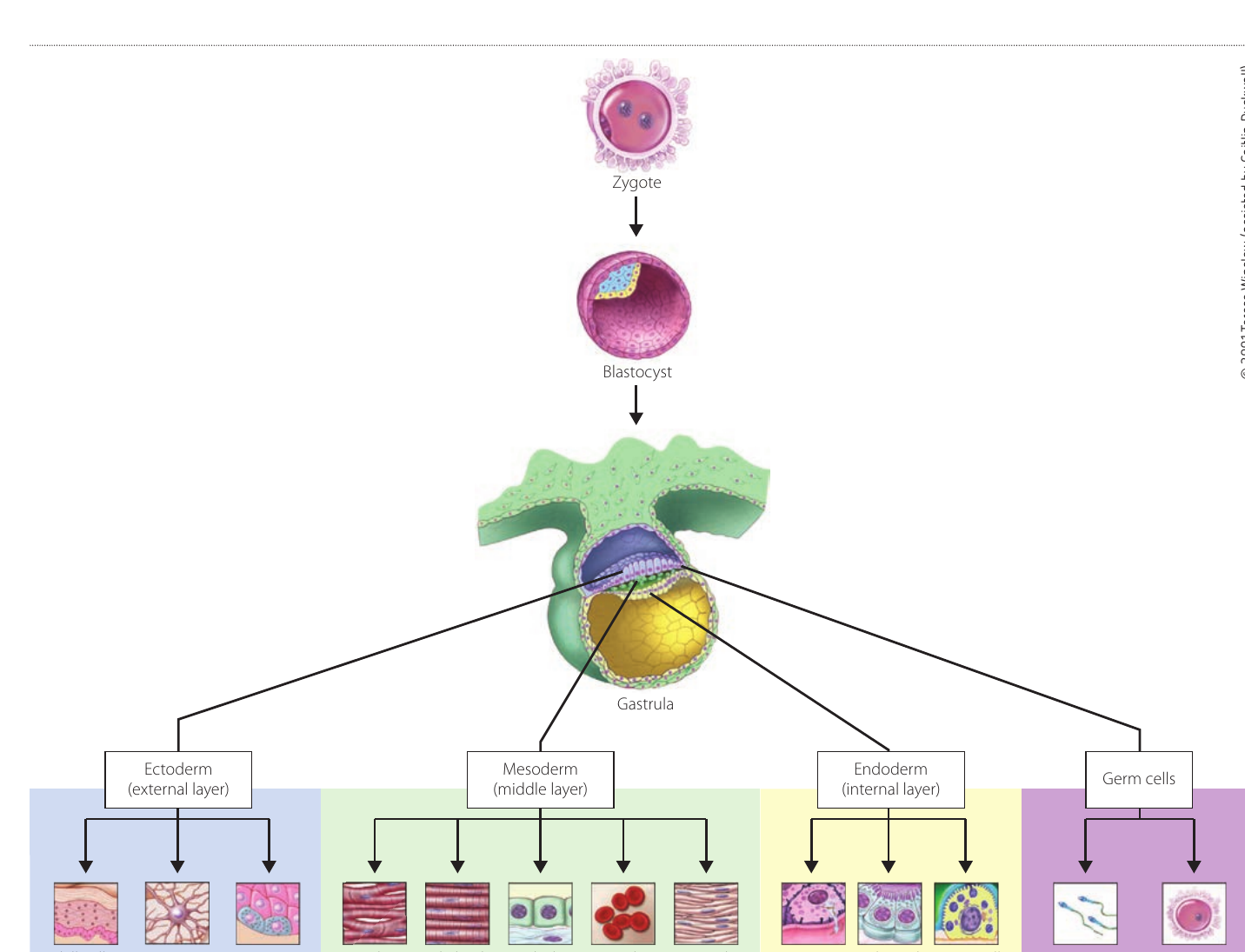
Development and specialization
Young cells, called embryonic cells, begin with similar structures. In early development:
- Their primary function is cell division through mitosis
- They require protection and nutrients to grow
- As they mature, they develop structural changes enabling specialized functions
- Different cells become specialized for fighting infection, storing nutrients, processing information, secreting hormones, or providing protection
Note
The diagram above shows how a single embryonic cell can differentiate into the many specialized cell types found in a multicellular organism such as a human.
Investigation 4.1
A practical investigation to compare cells of unicellular, colonial and multicellular organisms
This practical investigation allows you to observe and compare the features of different cell types from the three organizational categories.
Aim: To observe and compare the features of different types of cells from unicellular, colonial and multicellular organisms
Materials required:
- Light microscope
- Mini-grid
- Chopping board
- Knife or scalpel
- Forceps
- Dissecting needle
- Microscope slides and coverslips
- Pipettes
- Prepared or fresh specimens:
- Unicellular eukaryotes (Euglena, Amoeba, Paramecium)
- Colonial organism (Volvox)
- Plant cells (onion epidermis, Spirogyra, root hair cells)
- Animal cells (human nerve cells or epithelial cells)
- Labelled diagram of a bacterial cell
Risk assessment
| What Are the Hazards? | What Risk Does This Hazard Pose? | How Can You Safely Manage This Risk? |
|---|---|---|
| Knife/scalpel | Sharp edges can cause cuts | Use the knife/scalpel with care, hold it by the handle and keep your fingers away from the sharp edge of the blade. |
| Microscope slides/coverslips | Sharp edges can cause injury if broken | Handle with care. Push gently on the coverslip. Always focus by moving the objective lens away from slide. |
Important
Always follow proper safety procedures when handling microscope equipment and biological specimens. Review the risk assessment table carefully before beginning the investigation.
Method
- Observe one specimen from each category provided
- Draw a labelled diagram of each specimen, including the magnification used
- Estimate the size of each cell observed
- Record any other relevant information about the cells
Results
Complete your observations by:
- Labeling each diagram as either: unicellular prokaryote, unicellular eukaryote, colonial organism, or multicellular organism
- Completing a summary table with specimen name, cell type, estimated size (in micrometers), and other relevant features
Analysis points
Consider these aspects when analyzing your observations:
- Similarities: What features do all the cells share?
- Differences: How do the cell types differ from each other?
- Complexity: How does the complexity of unicellular organisms compare with multicellular organisms?
Cell structure and specialization
In multicellular organisms, there exists a vast array of cell structures and types. The structure and arrangement of cells directly relate to their specific functions. These specialized cells work together to ensure the organism functions most efficiently.
Forming specialized cells
Differentiation is the process by which cells become specialized to perform particular functions. During differentiation, cells develop suitable structural features that allow them to carry out specific functions, making them structurally different from other cell types and from the embryonic cells from which they originated.
Stem cells - the source of specialized cells
All specialized cells originate from stem cells. These cells are:
- Undifferentiated with no specialized structure or function
- Able to divide many times over a long period
- Capable of becoming specialized into various cell types
Important
Stem cells exist in two forms:
- Embryonic stem cells - found in embryos during early development
- Adult stem cells - found in specific locations in the mature body, such as:
- Brain tissue
- Bone marrow (producing blood cells)
Key terminology:
- Cell specialization refers to the particular functions that a cell performs
- Differentiation is the process a stem cell undergoes to become specialized
The differentiation process
During growth and development, cells (except sex cells) constantly divide through mitosis, producing identical copies. All cells in an organism (excluding sex cells) contain the same genetic information in their genes. However:
- Cells don't use all their genetic information
- Different cells develop because only certain genes are 'switched on'
- Which genes activate depends on the cell's location in the organism
- Activated genes control the types of proteins the cell produces
- These proteins determine the cell's structure and therefore its specialized function
Example
How Location Determines Specialization:
- Cells in outer layers become skin cells
- Cells beneath the surface become muscle cells
- Location determines specialization
Consequences of differentiation
Once differentiated into a particular cell type, specialized cells:
- Lose their capacity to develop into other cell types
- Many lose their ability to divide
- Cannot revert to a stem cell state
Plant cell differentiation
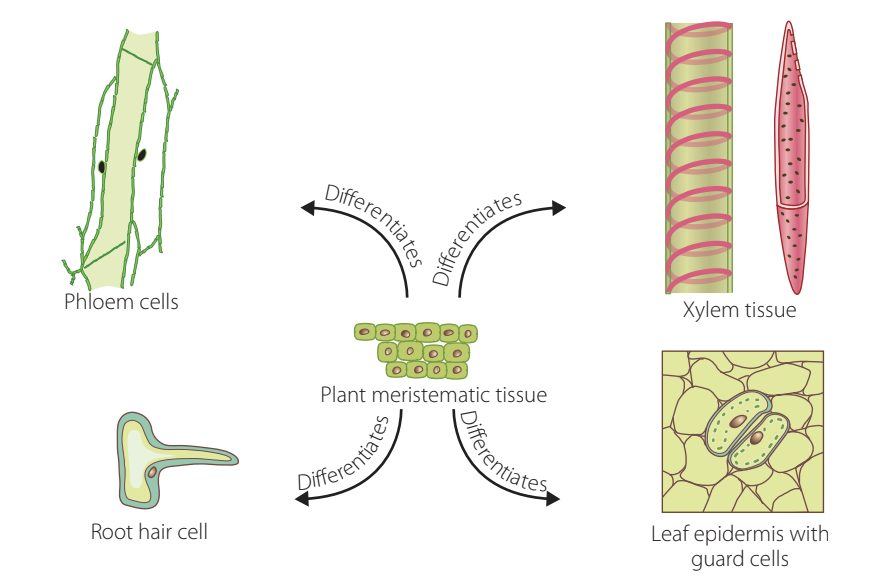
In plants, undifferentiated cells are found in meristematic tissue, located in young growing regions such as root and shoot tips. As these cells divide and mature, they differentiate into specialized cells the plant requires for effective functioning.
Note
The diagram shows how plant meristematic tissue differentiates into various specialized cell types including phloem cells, xylem tissue, root hair cells, and leaf epidermis with guard cells.
Cells working together
While multicellular organisms have significant advantages - including large size and the ability to carry out many varied activities efficiently - their specialized cells cannot survive independently. Each cell type relies on others to perform functions it cannot do itself.
Communication and coordination
Efficient functioning requires well-developed communication and coordination between specialized cells:
In animals:
- Chemical secretions relay messages
- Nerve cells transmit information rapidly throughout the body
- Blood cells bind and transport oxygen
- Heart muscle cells pump blood
- Various cells provide nutrients and remove wastes
In plants:
Note
Communication occurs through chemical signals and physical contact between cells enables coordination. Unlike animals, plants have no nerve cells and no centralized control centre.
Relationship between cell structure and function
The structure of a cell directly relates to its specific function. Many examples demonstrate this fundamental biological principle.
Cells involved in substance exchange
Parts of the body involved in exchanging substances with the environment have special structural features to increase their SA:V, enabling more efficient exchange of materials.
Structural modifications include:
- Flattened cells - such as the squamous epithelium lining air sacs (alveoli) in lungs. This flat shape provides greater SA:V than cube-shaped cells, allowing efficient gas exchange.
- Elongated cells - such as palisade cells in plant leaves. These long, column-shaped cells have increased SA:V for efficient photosynthesis and gas exchange.
- Membrane extensions - such as:
- Microvilli - tiny folds on cells lining the small intestine, dramatically increasing surface area for nutrient absorption
- Root hairs - extensions of root epidermal cells that increase surface area for water and mineral absorption
Red blood cells - a detailed example
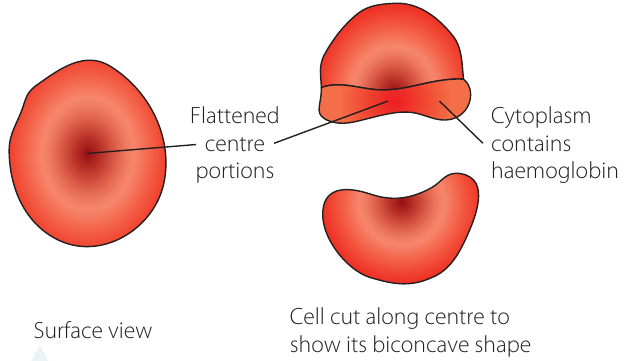
Red blood cells provide an excellent example of how structure relates to function. Their function is to transport oxygen throughout the body in the blood.
Example
Structural Features Supporting Oxygen Transport:
-
Very small size - enables the cell to squeeze through tiny capillaries that contact every body cell
-
Biconcave disc shape - the flattened center portions increase SA:V, allowing rapid oxygen diffusion
-
Absence of nucleus - more space available to carry haemoglobin
-
Absence of organelles - maximum space for haemoglobin
-
High haemoglobin content - this protein chemically binds oxygen in the lungs and releases it to body cells
Each structural feature directly supports the cell's primary function of oxygen transport, demonstrating the intimate relationship between form and function in biology.
Remember!
Summary
Key Points to Remember:
-
Three types of organisms exist: unicellular (one cell), colonial (groups of identical cells), and multicellular (many different specialized cells)
-
High SA
is crucial for unicellular organisms as it enables efficient diffusion of nutrients, gases, and wastes across the cell membrane -
Colonial organisms like Volvox represent a transitional form between unicellular and multicellular life, showing simple specialization while maintaining cell independence
-
Multicellular organisms overcome SA
challenges through organization into tissues, organs, and systems, with each small cell maintaining its own high SA:V -
Stem cells are the source of all specialized cells through the process of differentiation, where only specific genes are activated based on cell location
-
Cell structure directly relates to function - cells involved in substance exchange have increased surface area through flattening, elongation, or membrane extensions like microvilli and root hairs