Cell Organisation, Specialisation, and Functioning (HSC SSCE Biology): Revision Notes
📚Revision Notes
Cell Organisation, Specialisation, and Functioning
Introduction to cellular organisation
In multicellular organisms, specialised cells work together to form tissues. Different types of tissues combine to create organs, which carry out specific functions within organ systems. This hierarchical organisation allows complex organisms to function efficiently and perform tasks that would be impossible for a single cell.
Note
The hierarchical organisation from cells to organ systems represents a fundamental principle in biology: complexity through organisation. Each level builds upon the previous one, creating increasingly sophisticated structures capable of performing more complex functions.
The key levels of organisation are:
- Cells → Tissues → Organs → Organ systems → Organism
Animal tissues
Complex animals contain four general types of tissues, each composed of many different specialised cells. These tissues work together to form organs and organ systems.
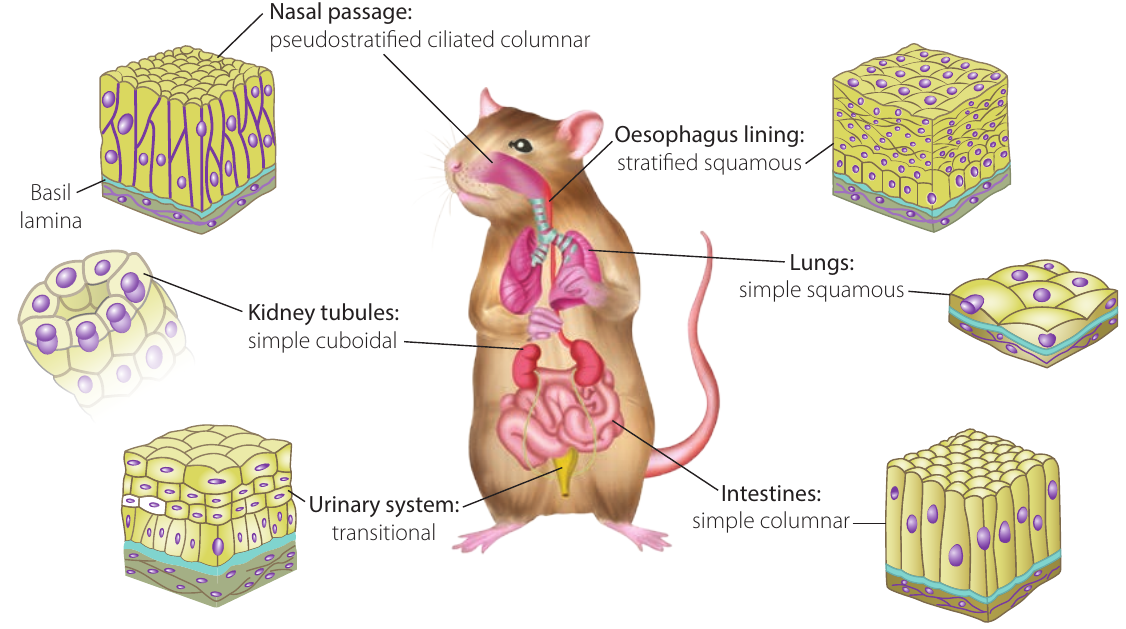
Epithelial tissue
Epithelial tissue covers body surfaces, protects organs, and forms glands. This tissue has several important characteristics:
- Cells are densely packed together
- Can occur in single sheets or multiple layers, depending on location and function
- Does not contain blood vessels
- Relies on underlying connective tissue for nutrients
- Has two distinct surfaces:
- One surface exposed to the exterior or body cavity
- One surface exposed to adjacent tissue
The cells in epithelial tissue are organised very close to each other, which helps them act as barriers against injury and infection. Skin is composed of epithelial tissue, as are the surfaces of organs in the digestive system, respiratory system, and many other body organs.
Note
The dense packing of epithelial cells is a key structural feature that directly relates to its protective function. This arrangement creates an effective barrier that prevents pathogens and harmful substances from entering the body while maintaining the integrity of internal organs.
Some epithelial tissue is specialised for absorption or secretion. For example, the epithelial tissue lining the larynx secretes mucus to keep the surface moist.
Connective tissue
Connective tissue is remarkably diverse in both form and function. However, all connective tissue shares one common feature: an extracellular matrix with cells scattered throughout it.
The extracellular matrix is made up of:
- Collagen fibres (provide strength)
- Elastin fibres (provide flexibility)
- Additional substances to fill spaces
Connective tissue provides support, binds different parts of the body together, and protects against damage.
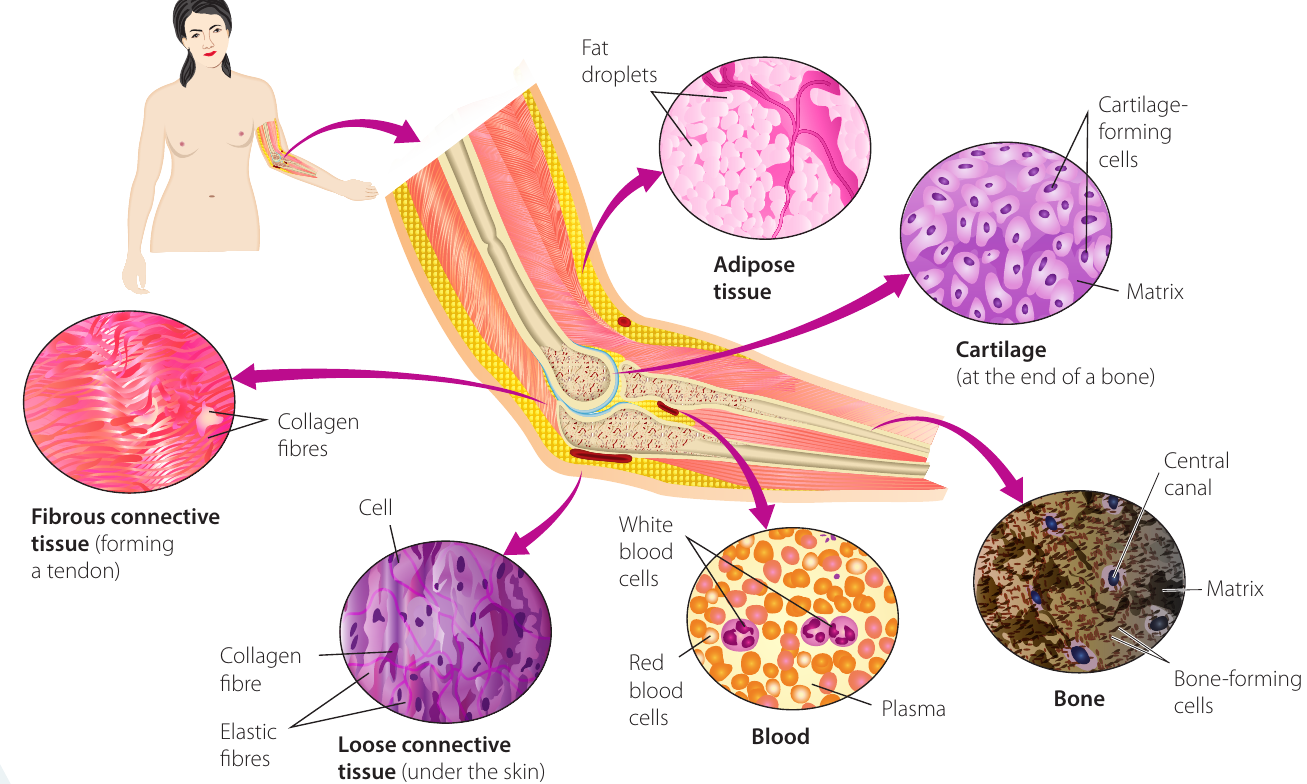
The different types of connective tissue vary in their cell density and the ways their cells are specialised. Examples include:
Adipose tissue:
- Consists of fat storage cells
- Functions include energy storage, insulation, protection, and cushioning
- Cells contain a large fat droplet that occupies most of the cell space
- The nucleus is pushed to one side by the fat droplet
Cartilage:
- Composed of dense collagen fibres
- Provides both strength and flexibility
- Offers cushioning
- Found in areas requiring these properties: nose, rib cage, trachea, and ends of long bones
Collagen in skin:
- Stops the skin from tearing away from bone
- Elastic fibres restore the skin to its original position and shape
Important
The extracellular matrix is what distinguishes connective tissue from other tissue types. Unlike epithelial tissue where cells are tightly packed, connective tissue cells are embedded in this matrix, which provides structural support and allows the tissue to perform its binding and protective functions.
Nervous tissue
The nervous system includes the brain, spinal cord, and peripheral nerves. It contains nervous tissue that is highly specialised for communication between all parts of the body.
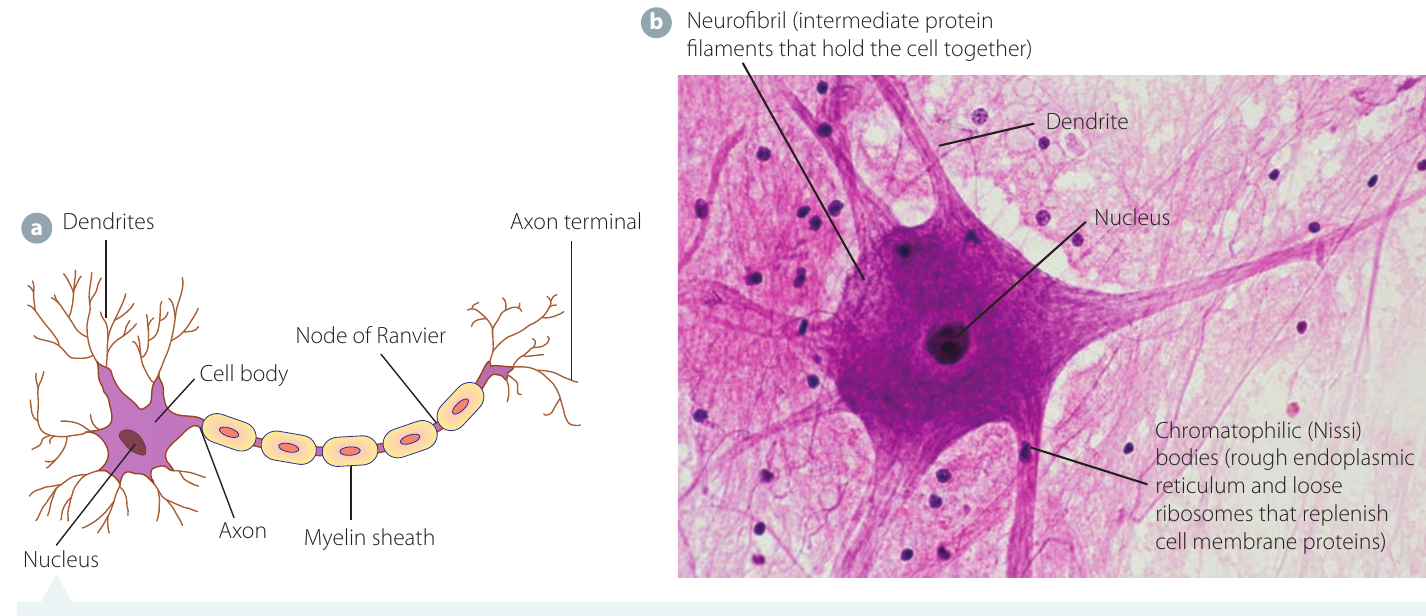
Nerve cells, called neurons, are the key components of nervous tissue. Neurons are highly specialised for passing messages between themselves and other cells in the body.
Neurons consist of:
- Dendrites: Multi-branched extensions that receive messages
- Cell body: Contains the nucleus and processes signals
- Axon: Long extension that carries messages away from the cell body
- Axon terminal: Where messages are passed to the next cell
The extensive branching of dendrites increases the surface area available to receive messages. Electrical messages pass through the cell body and travel along the axon to be passed to neighbouring neurons, muscles, or glands.
Note
The branching of dendrites and the long axon are structural specialisations that enable neurons to convey messages efficiently throughout the body. The axon can be over a metre long in some neurons, allowing signals to travel from the spinal cord to distant muscles or organs.
Muscle tissue
Muscle tissue contains muscle cells called muscle fibres that are highly specialised for contraction. There are three types of muscle cells: skeletal, cardiac, and smooth. All three types are elongated and contain the proteins actin and myosin, which interact to cause cells to lengthen and shorten.
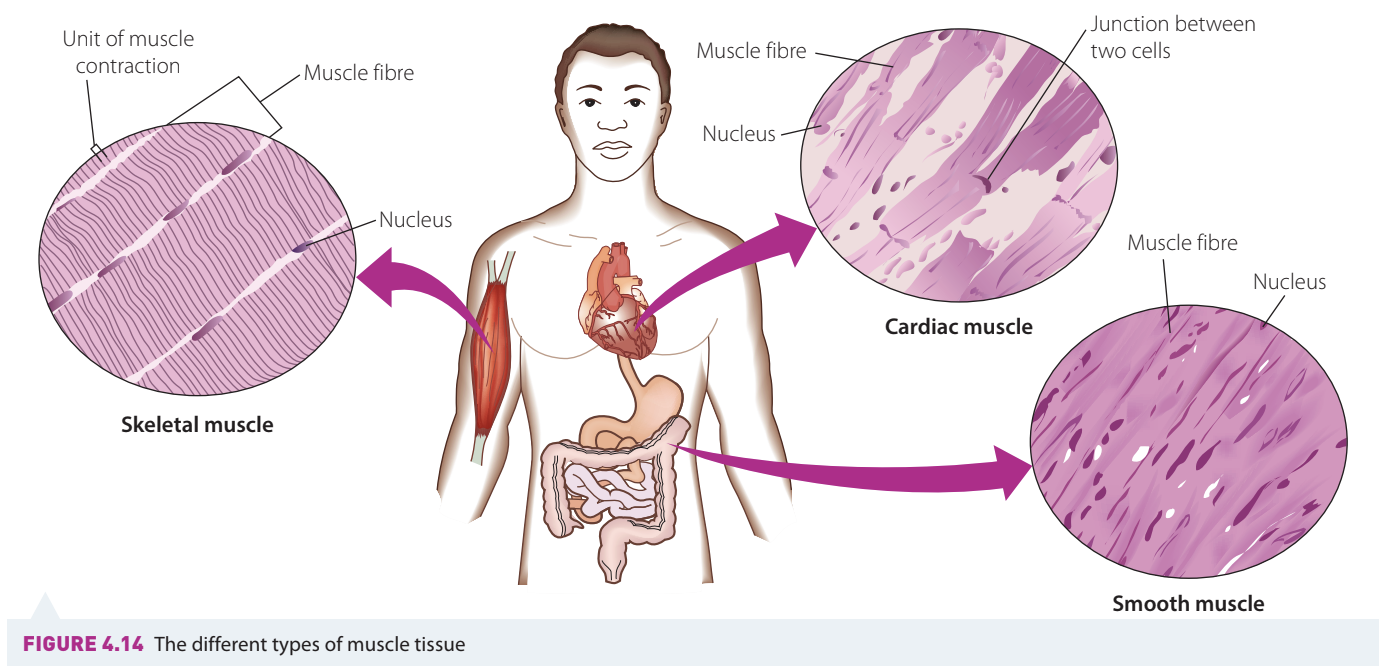
Skeletal muscle fibres:
- Long cells with visible striations (light and dark areas)
- Striations are caused by the arrangement of actin and myosin
- Attached to bones
- Contraction causes movement in the organism
- Classified as voluntary muscle (require conscious thought to function)
Cardiac muscle fibres:
- Present in the heart
- Also have striations
- Individual cells have connection junctions necessary for coordinated heart beating
- Classified as involuntary muscle (function automatically)
Smooth muscle fibres:
- Do not have striations
- Contractions push substances through specialised organs such as the gastrointestinal tract, blood vessels, and urethra
- Classified as involuntary muscle (function automatically)
Important
The key distinction between voluntary and involuntary muscle is critical for understanding body control:
- Voluntary muscles (skeletal) are under conscious control and allow deliberate movements
- Involuntary muscles (cardiac and smooth) function automatically without conscious thought, ensuring vital processes like heartbeat and digestion continue continuously
Plant tissues
Plants follow a similar pattern of organisation to animals, progressing from organelles in cells to systems that make up the whole organism. Cells with similar structures group together in tissues to perform shared functions. Different tissues combine to form organs that carry out specific functions. Multiple organs then form organ systems that contribute to the overall functioning of the plant.
Plant organ systems
Plant organs can be grouped into three systems:
- The shoot system is the part of the plant above ground. It supports the plant, enables transport of substances, exchanges gases, and carries out photosynthesis and reproduction. Organs in the shoot system include leaves, stems, and reproductive organs.
- The root system is the part of the plant below ground. It absorbs water and nutrients from the soil for use by the rest of the plant. The roots, including root hairs, are organs of the root system.
- The vascular system is for transport. It is made up of xylem and phloem vessels and extends throughout the plant.
Note
Unlike animal organ systems which are often localised to specific body regions, the vascular system in plants extends throughout the entire organism, connecting the shoot and root systems. This continuous network ensures efficient transport of water, nutrients, and photosynthetic products between all parts of the plant.
Four main plant tissue types
Plants contain four main types of tissues: meristematic tissue, dermal tissue, vascular tissue, and ground tissue.
Meristematic tissue
Meristematic tissue is found at the tips of roots and shoots. In woody plants, it can also be found in buds and in a ring around the stem. Meristematic areas are where cells divide to produce new growth. Cell differentiation to produce specialised cells can also occur here.
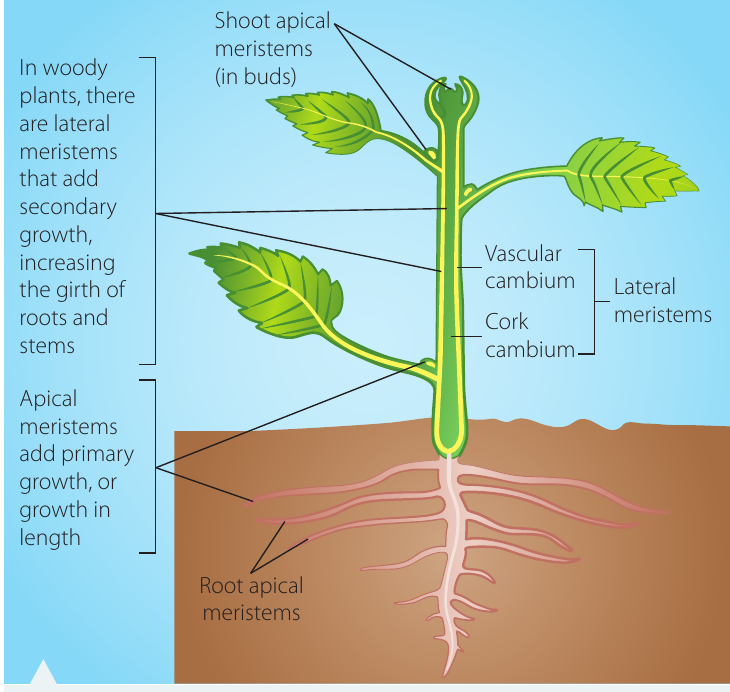
Characteristics of meristematic cells:
- Cube-shaped
- Very small
- Capable of division
Primary growth (growth in length) occurs from apical meristems at tips of roots and shoots.
Secondary growth (increase in girth) occurs from lateral meristems in woody plants.
Note
Meristematic tissue is analogous to stem cells in animals - these are undifferentiated cells that retain the ability to divide and specialise. This allows plants to continue growing throughout their lives, unlike most animals which stop growing after reaching maturity.
Dermal tissue
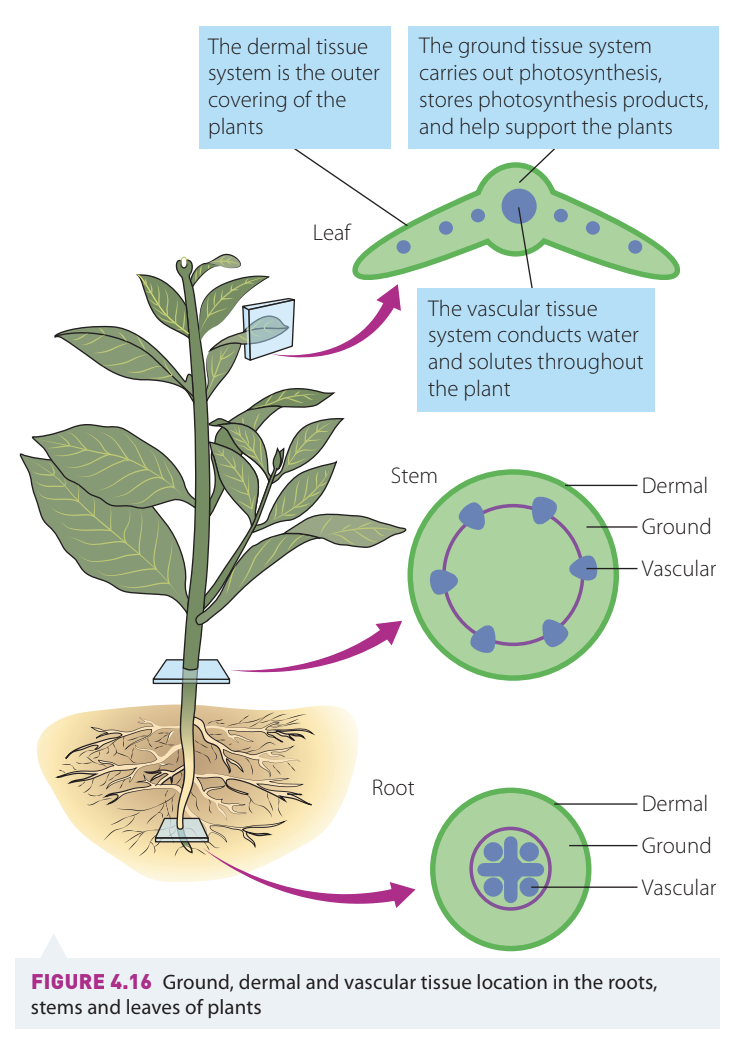
Dermal tissue protects plant tissues and is found on the outer layers of stems, roots, and leaves. It protects the plant from damage and controls interactions with the plant's surroundings.
The epidermal layer is the outermost layer of dermal tissue. It secretes a waxy layer called the cuticle, which is vital for reducing water loss from the plant.
Features of epidermal cells:
- Wide variety of cell types
- Most lack chloroplasts
- Can produce fine hairs on surfaces of leaves and stems
Functions of epidermal hairs:
- Trap a layer of air next to the leaf
- Prevent air flow
- Decrease water evaporation from the leaf
- Some hairs contain substances harmful to insects that feed on them
Root hairs are specialised epidermal cells with very fine projections that:
- Increase surface area for water movement into roots
- Increase water and mineral uptake
Important
The cuticle is a critical adaptation for terrestrial plants. Without this waxy protective layer, plants would lose water through their surfaces at a rate that would make survival on land impossible. The cuticle represents a key evolutionary innovation that enabled plant colonisation of land.
In woody plants, a bark layer forms when layers of specialised cells (which soon die) replace the epidermis.
Vascular tissue
Vascular tissue is responsible for transporting substances around the plant. It is found in roots, stems, and leaves.
There are two main types of vascular tissue:
Xylem tissue:
- Transports water and mineral salts from roots to leaves
- Provides structural support
Phloem tissue:
- Transports the products of photosynthesis around the plant
- Distributes sugars and other nutrients
Note
The distinction between xylem and phloem reflects the two-way transport system in plants:
- Xylem carries water and minerals upward from roots to leaves
- Phloem distributes sugars and nutrients throughout the plant in multiple directions
This bidirectional system ensures all parts of the plant receive both water and energy resources.
Ground tissue
Ground tissue includes all internal cells of a plant other than vascular tissue. This tissue makes up the bulk of the plant and consists of various cell types that are specialised for:
- Food storage
- Support
- Photosynthesis
The ground tissue system carries out photosynthesis, stores photosynthesis products, and helps support the plant.
Investigation 4.3: Examining tissue structure and function
This investigation involves observing different types of tissues both digitally and through a light microscope to understand how their structure relates to their function.
Safety considerations
Important
Safety First: When working with microscope slides and coverslips, be aware that sharp edges can cause injury if broken. Handle slides with care and always focus by moving the objective lens away from the slide to prevent damage to both the slide and the lens.
Investigation procedure
The investigation requires:
- Observation of two different animal tissue types
- Observation of one plant tissue type
- Using low and high power magnification to see maximum detail
- Drawing diagrams of cells observed
- Describing cell structure
- Explaining how structure relates to function
- Identifying the organ and organ system for each tissue
Note
Results should be recorded in a table format that includes the type of tissue, example, diagram, description of structure, function, how structure relates to function, and the organ or organ system. This systematic approach helps you connect the structural features of cells with their specific functions.
Remember!
Summary
Key Points to Remember:
Four main animal tissue types:
- Epithelial tissue (covers and protects)
- Connective tissue (supports and binds)
- Nervous tissue (communicates)
- Muscle tissue (contracts and moves)
Cell specialisation enables function: The specific structure of each cell type directly relates to its function. For example, neurons have long axons to transmit signals over distances, and muscle fibres contain actin and myosin for contraction.
Four main plant tissue types:
- Meristematic tissue (growth)
- Dermal tissue (protection)
- Vascular tissue (transport)
- Ground tissue (storage, support, photosynthesis)
Hierarchical organisation maximises efficiency: The arrangement of cells into tissues, organs, and systems in multicellular organisms allows for efficient functioning and capabilities beyond what a single cell could achieve.
Tissues work together in organs: Different tissue types combine in organs to carry out specific functions. The particular tissues present in an organ depend on what function that organ performs.