Analytical Techniques (HSC SSCE Chemistry): Revision Notes
📚Revision Notes
Analytical Techniques
Introduction to analytical techniques
Understanding the structure of organic molecules is crucial for chemists. It helps them learn how chemical bonds form and how different molecules interact with each other. This knowledge is particularly important for understanding biological molecules such as DNA, enzymes, and ribosomes. When we know molecular structures in detail, down to individual atoms, we can develop new medicines and improve early diagnosis of diseases like cancer.
Note
Medical Applications
The detailed knowledge of molecular structures has led to significant advances in medicine, including:
- Development of new therapeutic drugs
- Improved early detection methods for cancer
- Better understanding of how biological molecules function in the body
The key to success in these medical advances lies in the specialised instruments that allow chemists to determine molecular structures. Each analytical instrument provides unique information about a substance. By combining data from multiple techniques, chemists can build a complete three-dimensional picture of the molecule's structure. The chemist's role is to interpret this information and translate it into a meaningful structural representation.
Overview of organic spectrometry
The analytical techniques used to study organic compounds are collectively known as organic spectrometry. These techniques work by monitoring how molecules respond when exposed to different types of energy. Each spectrometer uses a specific energy source to probe different aspects of molecular structure.
Note
Each spectrometry technique works by applying a specific type of energy to a molecule and measuring how the molecule responds. This response provides unique information about the molecule's structure and properties.
The four analytical techniques
There are four main analytical techniques used in organic chemistry:
Mass spectroscopy
This technique uses high-energy electrons to analyse substances. It provides information about the molar mass of molecules and can detect different isotopes of elements. Mass spectroscopy is highly sensitive, requiring only small amounts of sample material while providing detailed structural information.
Nuclear magnetic resonance (NMR) spectroscopy
NMR spectroscopy uses radio waves as its energy source. The data obtained from NMR helps chemists determine the carbon-hydrogen backbone of molecules, revealing how atoms are connected within the structure.
Infrared (IR) spectroscopy
This technique uses infrared waves (heat energy) to examine substances. IR spectroscopy identifies the types of chemical bonds and functional groups present in molecules. The spectra produced can act as unique "fingerprints" that help identify specific compounds.
Ultraviolet-visible (UV-vis) spectrophotometry
UV-vis spectrophotometry uses ultraviolet and visible light to analyse substances. This technique measures the concentration of organic compounds and can also use absorption spectra as "fingerprints" for compound identification.
The following table summarises the energy sources and data outputs for each technique:
| Technique | Energy source | Data output |
|---|---|---|
| Mass spectroscopy | High-energy electrons | Peaks correlating to the ratio that indicate the molar mass and isotopic abundances |
| NMR spectroscopy | Radio waves | Peaks that are useful for determining the C—H backbone of a molecule |
| IR spectroscopy | Infrared waves | Bands used to determine the type of bonds and functional groups present; may identify compounds using spectra as 'fingerprints' |
| UV-vis spectrophotometry | UV-visible waves | Absorption spectra that show the concentration of organic compounds; may identify compounds using spectra as 'fingerprints' |
Important
Nobel Prize Recognition
Mass spectroscopy and NMR spectroscopy have been so revolutionary in determining molecular structure and function that Nobel Prizes in Chemistry have been awarded to the scientists who developed these techniques. This highlights their fundamental importance in modern chemistry.
The electromagnetic spectrum
The electromagnetic spectrum refers to all the different types of electromagnetic radiation that the Sun emits. This radiation travels as waves with varying energies and wavelengths. We can only see a small portion of this spectrum called the visible spectrum, which contains the colours of the rainbow.
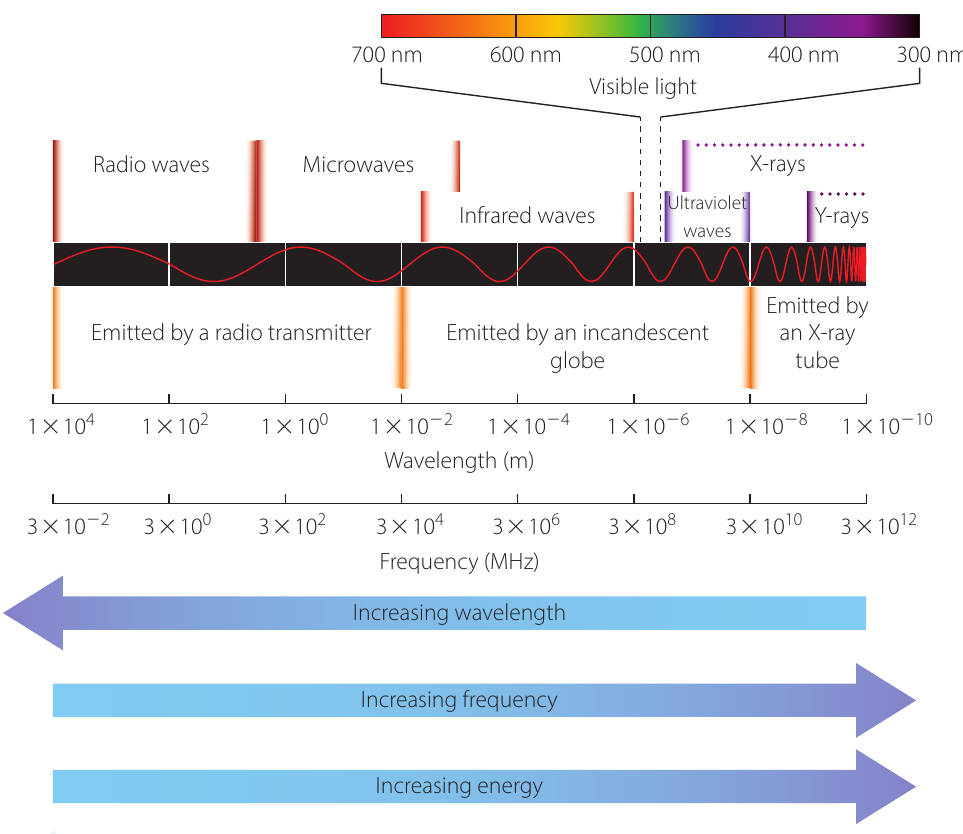
The electromagnetic spectrum ranges from radio waves (lowest energy, longest wavelength) to gamma rays (highest energy, shortest wavelength). The visible portion can be split into different colours, with red light having less energy and a longer wavelength than violet light.
Key relationships in the electromagnetic spectrum
Three important properties of electromagnetic radiation are related:
- Wavelength: The distance between successive wave peaks, measured in metres (m) or nanometres (nm, where )
- Frequency: The number of waves passing a point per second, measured in hertz (Hz) or megahertz (MHz, where )
- Energy: The amount of energy carried by the radiation
Important
Critical Relationships to Remember
These properties have specific relationships that are fundamental to understanding spectroscopy:
- Wavelength and energy are inversely related: as wavelength increases, energy decreases
- Frequency and energy are directly related: as frequency increases, energy increases
- As you move from radio waves to gamma rays across the spectrum, energy and frequency increase while wavelength decreases
How analytical techniques use the electromagnetic spectrum
Each analytical technique relies on a specific part of the electromagnetic spectrum. The energy range used corresponds to the type of molecular information the technique can reveal:
- Mass spectroscopy uses the highest energy (high-energy electrons)
- UV-vis spectrophotometry uses ultraviolet and visible light
- IR spectroscopy uses infrared radiation (lower energy than visible light)
- NMR spectroscopy uses radio waves (lowest energy)
By using different parts of the spectrum, these techniques can examine different aspects of molecular structure, from overall molecular mass to specific bond types and arrangements.
Note
Complementary Information
The fact that each technique uses a different energy range is not a limitation—it's an advantage! Each energy range interacts with molecules in a unique way, revealing different structural features. This is why combining multiple techniques provides such a complete picture of molecular structure.
Summary
Key Points to Remember
- There are four main analytical techniques for studying organic compounds: mass spectroscopy, NMR spectroscopy, IR spectroscopy, and UV-vis spectrophotometry
- Each technique uses a different energy source from the electromagnetic spectrum and provides unique structural information
- The electromagnetic spectrum ranges from low-energy radio waves to high-energy gamma rays, with visible light representing only a small portion
- Energy increases as wavelength decreases and frequency increases across the electromagnetic spectrum
- Combining information from multiple analytical techniques allows chemists to build a complete three-dimensional picture of molecular structure