Green Polymers – A Case Study (HSC SSCE Chemistry): Revision Notes
📚Revision Notes
Green Polymers – A Case Study
Introduction: The need for green polymers
Most synthetic polymers today come from crude oil, which is a non-renewable resource. Experts predict that the world's oil reserves could be depleted by the middle or end of this century. This creates two major problems for the plastics industry:
- Resource depletion: Oil supplies are running out
- Plastic pollution: Poor recycling practices and throwaway consumer habits lead to environmental damage
Important
The dual challenge facing the plastics industry is both the depletion of oil reserves and the environmental impact of plastic waste. These interconnected problems require innovative solutions that address both resource sustainability and environmental protection.
There are two main viewpoints about the future of plastics:
View 1 - Develop alternatives now: Some scientists argue that we should develop alternative raw materials for plastics immediately. They suggest using ethanol as a source of ethylene, which is already used as a fuel additive and could provide the key monomer needed for many common polymers.
View 2 - Oil will remain viable: Others believe that as oil becomes scarcer and more expensive for fuel, the plastics industry will be less affected by price rises. This is because raw material costs are a smaller proportion of the final product cost for plastics. These people think oil will eventually become the exclusive domain of the plastics industry and last for many more decades.
Regardless of which view is correct, it makes sense for the plastics industry to develop alternative sources for its core monomers, particularly ethylene and propene.
Cellulose as a chemical feedstock
What is cellulose?
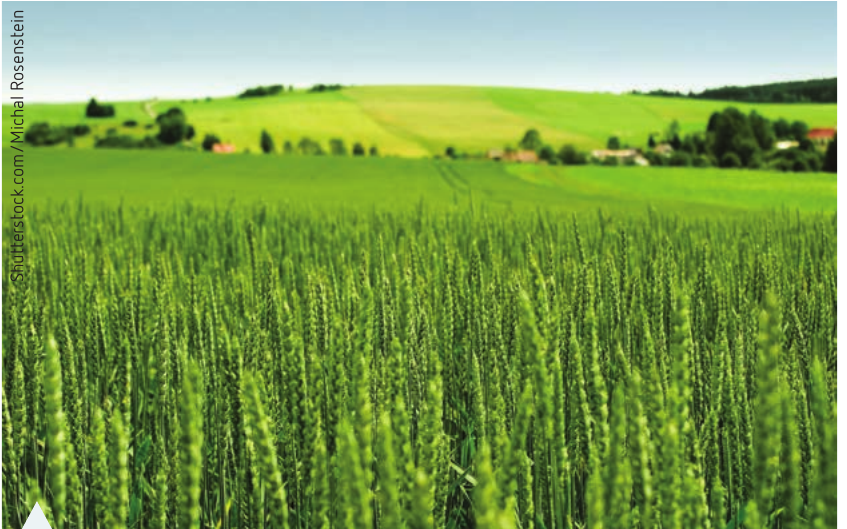
Cellulose is a naturally occurring condensation polymer called a polysaccharide. It consists of 3000 or more glucose monomer units linked together. Cellulose is a major component of plant material, making up approximately 33% of all vegetable matter from sources like cereal crops. In comparison, starches and sugars are only minor components of plants.
Note
Cellulose's abundance in plant matter (one-third of all vegetable material) makes it an attractive renewable resource for chemical production. This is significantly more than starches and sugars, which are only minor components of plants.
Each glucose unit in cellulose contains six carbon atoms. This makes it potentially useful as a building block for petrochemicals that typically contain 2-4 carbon atoms, such as:
- Ethylene (2 carbon atoms)
- Propylene (3 carbon atoms)
- Butane (4 carbon atoms, used for synthetic rubber)
Converting cellulose to useful chemicals
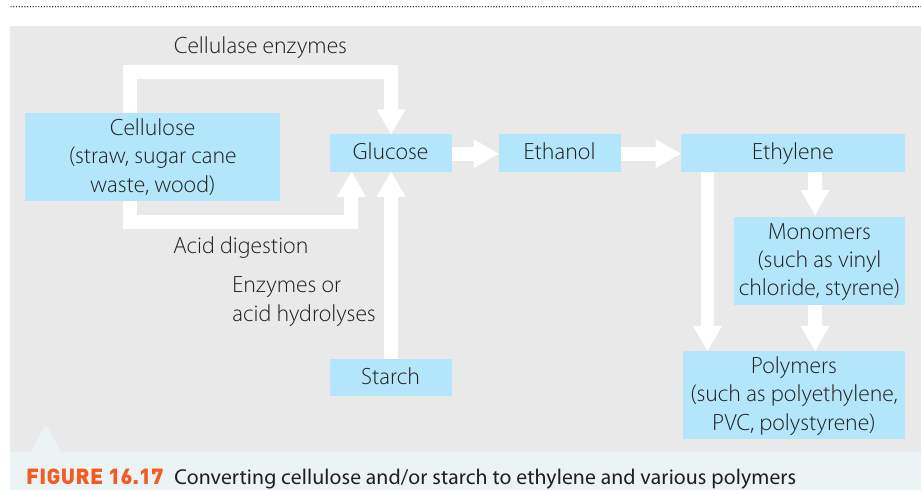
The diagram above shows how cellulose can be converted to ethylene and eventually to various polymers. The process works as follows:
- Cellulose (from straw, sugar cane waste, or wood) is broken down into glucose
- Glucose is fermented with yeast to produce ethanol
- Ethanol is dehydrated to form ethylene
- Ethylene can be used to make monomers (like vinyl chloride and styrene)
- These monomers form polymers (like polyethylene, PVC, and polystyrene)
Starch can also follow a similar pathway through glucose to ethanol and ethylene.
Example
Conversion Pathway: From Plant to Plastic
The complete transformation follows this sequence:
Step 1: Plant cellulose (straw, sugar cane waste, wood)
↓
Step 2: Glucose (through breakdown)
↓
Step 3: Ethanol (through fermentation with yeast)
↓
Step 4: Ethylene (through dehydration)
↓
Step 5: Monomers (vinyl chloride, styrene)
↓
Step 6: Polymers (polyethylene, PVC, polystyrene)
Methods for breaking down cellulose
Breaking cellulose into glucose is very difficult because the long, near-linear chains of cellulose hydrogen bond to each other, forming compact fibres. This makes it hard for chemicals to reach the glucose-glucose links. However, there are two main processes:
Method 1: Digestion by cellulase enzymes
Cellulase enzymes are found in bacteria in the stomachs of herbivores and in certain fungi. The industrial process works as follows:
- Finely grind cellulose-containing materials (grain husks, stalks, bagasse, old newspapers)
- Treat with sodium hydroxide solution or hot water to swell and open up the cellulose fibres
- Digest with cellulase enzymes to produce a glucose solution
Method 2: Digestion with strong acid
This method involves:
- Heat a suspension of cellulose-containing materials (including wood chips) with moderately concentrated sulfuric acid solution
- The acid breaks cellulose into glucose
- Filter off insoluble matter (especially lignin from wood pulp)
- Remove impurities
- Neutralise the acid to produce a glucose solution
Note
In both methods, the resulting glucose solution can be fermented with yeast to form ethanol, which can then be dehydrated to ethylene if needed. The key difference is that enzymatic digestion uses biological catalysts while acid digestion uses chemical processes.
Energy and cost considerations
While converting cellulose to ethanol and ethylene does work, there are important limitations:
Important
Energy Paradox: Much of the energy required (keeping mixtures hot, running machinery) often comes from oil. This means more oil might be used making ethylene this way than by cracking oil directly. This creates a significant challenge for the sustainability of cellulose-based polymer production.
- Making ethanol from cellulose is considerably more expensive than making it from starch or sugars, despite cellulose being cheaper as a starting material
- However, scientists are working hard to develop more efficient methods
Alternative sources
Algae show promise as another alternative source:
- Can be grown in controlled, large-scale environments
- Produce oils that can be converted to hydrocarbons and ethanol
- Grow very quickly and can be harvested within a week
- This is faster than traditional plant crops
The chemical industry can also reduce raw material needs through improved recycling practices.
Biopolymers from nature
What are biopolymers?
Biopolymers are polymers that are made totally or in large part by living organisms.
Originally, this term referred only to biologically synthesised polymers such as:
- Cellulose
- Starch
- Proteins
- Nucleic acids
Now the definition includes:
- Chemically modified versions of natural polymers
- Polymers produced by manipulating biological organisms
Historical context
Partially synthetic biopolymers based on cellulose have been used commercially for nearly a century. The first plastic was cellulose nitrate, patented in 1869 as celluloid. This was a synthetically modified form of cellulose.
Note
The concept of biopolymers is not new – humans have been modifying natural polymers for commercial use since the 19th century. What has changed is our ability to produce and engineer these materials more efficiently and sustainably.
Examples of renewable polymers
The table below shows various renewable polymers, their source materials, and common applications:
| Polymer | Crop or renewable material | Common uses |
|---|---|---|
| Starch-based polymers | Wheat, potatoes, corn | Compost bags, foam packaging fill, some food packaging |
| Polylactic acid (PLA) | Wheat, potatoes, corn | Food packaging, medical applications |
| Cellulose | Farmed wood | Cereal bar wrappers |
| Polyhydroxyalkanoates (PHA) | Plant-derived sugars and oils | Medical devices such as orthopaedic pins |
| Polyesters | Corn | Textiles |
| Polyurethane | Soy or castor oil | Car seats |
| Polyethylene | Sugar cane | Resins |
Biodegradable synthetic plastics
The biodegradability problem
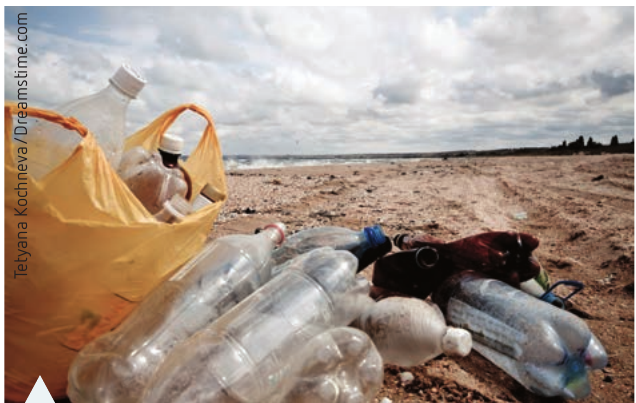
One major issue with synthetic polymers compared to natural polymers is that they are not biodegradable. This means plastics discarded into the environment or placed in rubbish dumps are not decomposed naturally by bacteria or fungi.
Important
Environmental Impact: Plastics make up 4% of landfill by volume. While natural polymers eventually decompose, synthetic polymers persist in the environment, causing ongoing environmental problems. This persistence is one of the most significant challenges facing modern waste management.
Solutions: biodegradable plastics
Synthetic biodegradable plastic materials have been developed and are used in some packaging applications. For example, photodegradable plastics are sometimes used for six-pack can carriers.
However, there are still potential problems:
- A photodegradable plastic buried in landfill won't degrade without light exposure
- When biodegradable plastics decompose, they may release undesirable substances like mineral fillers, metal salts, or other potentially dangerous additives into the environment
Graft copolymers
One innovative approach involves alternating biopolymer sections with synthetic sections in the same polymer molecule. This is called a graft copolymer.
When disposed of:
- Microbes attack the biopolymer sections
- This breaks the polymer chain into many smaller units
- Biological processes convert the remaining fragments into shorter hydrocarbon chains
Example
Worked Example: Biodegradable Rubbish Bags
Biodegradable rubbish bags demonstrate the graft copolymer concept in action:
Design: Alternating segments of starch and ethylene
How it works:
- Starch segments provide biodegradable sections
- Ethylene segments provide strength and flexibility
- When disposed of, microbes attack the starch sections
- This breaks the polymer chain into smaller, more manageable units
- Biological processes continue decomposing the fragments
Variation: A stronger, stiffer (but less biodegradable) version can be made using cellulose instead of starch.
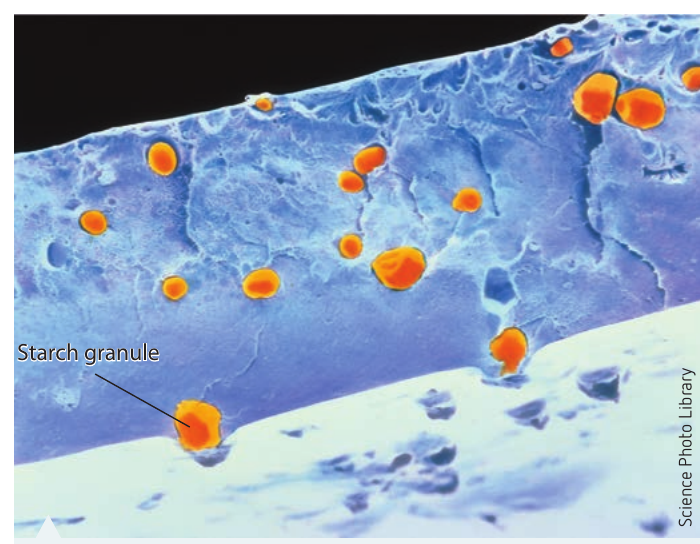
The image above shows a close-up view of biodegradable plastic under a scanning electron microscope. The orange spheres are starch granules embedded in the plastic. When the plastic is disposed of:
- Starch granules absorb water and expand
- The plastic breaks up
- This increases the surface area in contact with soil bacteria
- Bacteria digest the plastic more effectively
Environmental triggers
Researchers are investigating ways to add an environmental trigger to increase biodegradability:
- A catalyst is added to the starch molecule
- When the rubbish bag enters the environment, microbes release the catalyst as they consume the starch
- This catalyst makes the bag decompose even more quickly
Note
Important clarification: The plastics don't disappear completely. They are converted to other forms of matter through biological and chemical processes. The goal is to break them down into harmless compounds that can be naturally recycled by ecosystems.
The development of biopolymers and biodegradable plastics demonstrates how chemists have designed materials in response to environmental and economic issues.
Investigation 16.3: Biopolymers
Aim: To research a biopolymer and link its structure to its properties and uses.
Tasks:
- Choose a biopolymer to research
- Identify and draw:
- The monomer(s) that make up the biopolymer (structural formulae)
- At least one unit of the biopolymer (structural formula)
- Analyse the biopolymer:
- Identify its properties
- Describe at least one use and relate it to the properties
- Relate the properties to the structure
- Determine if it can replace existing petrochemical polymers or has a completely new use
- Present your findings as a video for the class
- Watch and critique at least two other class videos
Remember!
Summary
Key Points to Remember:
-
Green polymers are alternatives to oil-based plastics made from renewable resources like plant materials
-
Cellulose makes up 33% of plant matter and can be broken down into glucose using either cellulase enzymes or acid digestion
-
The conversion pathway is: Cellulose → Glucose → Ethanol → Ethylene → Polymers
-
Biopolymers are polymers made totally or in large part by living organisms, including natural polymers and chemically modified versions
-
Biodegradable plastics can be broken down by microorganisms, helping reduce plastic pollution
-
Graft copolymers alternate biodegradable and synthetic sections, allowing microbes to break them down into smaller units
-
Energy considerations are crucial: converting cellulose to polymers may use more oil than direct cracking, creating a sustainability challenge that researchers are working to overcome