Enthalpy (HSC SSCE Chemistry): Revision Notes
📚Revision Notes
Enthalpy
What is enthalpy?
Enthalpy is a fundamental concept in chemistry that helps us understand energy changes during chemical reactions. Think of enthalpy as a measure of the total energy stored within a substance or group of substances. This energy is primarily the chemical energy held in the bonds between atoms.
Note
An important point to remember is that we cannot directly measure the absolute enthalpy of a substance. Instead, we can only measure how enthalpy changes during a chemical reaction or physical process. This is similar to measuring altitude - we often talk about changes in height rather than absolute position.
Change in enthalpy ()
The change in enthalpy for a chemical reaction, represented by the symbol , is defined as the heat absorbed per mole of specified reactant or product when the reaction occurs at constant pressure.
Most laboratory experiments occur at constant atmospheric pressure (in containers open to the air). This means that the heat absorbed or released during a reaction is a direct measure of .
Understanding
The change in enthalpy represents the difference in energy between products and reactants:
Important
The Greek letter delta () means "change in", and it always represents the final state minus the initial state. In chemical reactions, this means products minus reactants.
Endothermic and exothermic reactions
Chemical reactions can either absorb or release energy, which determines the sign of :
Endothermic reactions absorb heat from their surroundings. In these reactions, the products have more energy than the reactants because energy has been absorbed during the reaction. For endothermic reactions, is positive ().
Exothermic reactions release heat to their surroundings. In these reactions, the products have less energy than the reactants because energy has been released. For exothermic reactions, is negative ().
Graphical representation
The relationship between enthalpy changes and the energy levels of reactants and products can be visualised in energy diagrams:
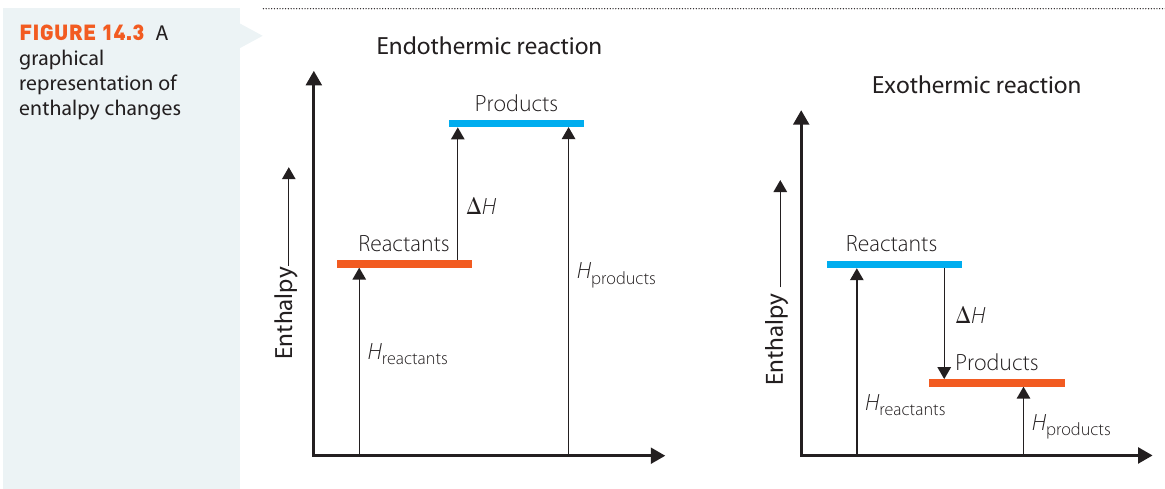
Note
In the endothermic diagram (left), notice how the products are at a higher energy level than the reactants, with the upward arrow showing the positive value. In the exothermic diagram (right), the products are at a lower energy level, with the downward arrow indicating the negative value.
Writing enthalpy changes
When expressing enthalpy changes, we write the balanced chemical equation followed by the value. For example, for the combustion of methane:
The term is sometimes called the heat of reaction.
Specifying amounts - the importance of "per mole"
The definition of includes the phrase "per mole of specified reactant or product" because chemical equations can be written in different ways. This specification is crucial to avoid ambiguity.
For example, consider the formation of water from hydrogen and oxygen. We could write:
or
These equations describe the same reaction but in different amounts. To be clear, we must specify which substance we're referring to:
- kJ per mole of oxygen
- kJ per mole of water (or per mole of hydrogen)
Important
Always specify "per mole of which substance" when stating values. Without this specification, the value is ambiguous and meaningless.
Alternatively, we write the specific equation:
Here, "per mole" means per mole of the reaction as written - in this case, per mole of hydrogen or per mole of water formed.
The importance of physical states
Changes of state (solid to liquid, liquid to gas, etc.) involve absorption or release of energy. Therefore, enthalpy changes depend on the physical state of both reactants and products.
Important
When writing chemical equations in the context of energy changes, we must always indicate the physical state:
- (s) for solid
- (l) for liquid
- (g) for gas
- (aq) for aqueous solution (dissolved in water)
This ensures we're comparing like with like when discussing energy changes.
Enthalpy of solution
Definition
The molar enthalpy of solution (or heat of solution), , is the heat absorbed when one mole of a substance dissolves in a large excess of water.
If heat is absorbed during dissolution, is positive and the process is endothermic. If heat is released, is negative and the process is exothermic.
Dissolution of different substances
Covalent molecular substances (such as glucose, ethanol or iodine) dissolve by forming individual molecules that move independently through the solution. For glucose:
Ionic substances dissolve by breaking up into separate ions, which then move freely and independently through the solution. This process is called dissociation. For potassium nitrate:
Measuring enthalpy changes experimentally
Enthalpy changes for many chemical reactions can be measured by mixing known amounts of reactants at the same temperature in a well-insulated container and measuring the temperature after the reaction is complete.
Experimental setup
A simple calorimeter can be made using polystyrene foam cups, which provide good insulation and have negligible heat capacity:
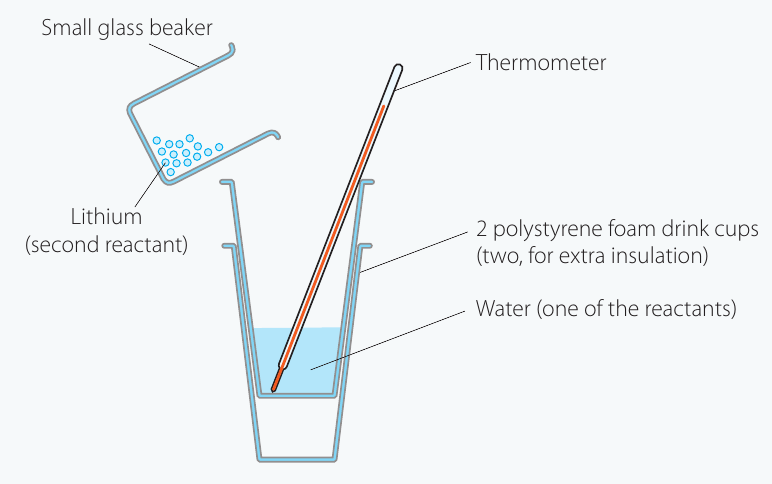
The key features of this setup are:
- Nested polystyrene cups for insulation to minimise heat loss
- A thermometer to measure temperature changes
- A small beaker to add one reactant to the other
- Water or solution as one of the reactants
Calculation procedure
To calculate molar enthalpy changes from experimental data, follow these steps:
Step 1: Calculate the amount of heat released or absorbed using:
where:
- is the heat absorbed or released (in joules)
- is the mass of the final solution (in kilograms)
- is the specific heat capacity of the solution (typically assumed to be J K kg, the value for water)
- is the temperature change (final temperature − initial temperature, in °C or K)
Step 2: Calculate the number of moles that reacted:
Step 3: Calculate the heat released or absorbed per mole:
Step 4: Determine the sign of :
- is positive for heat absorbed
- is negative for heat released
Worked example: combustion reactions
Example
Worked Example: Calculating for Combustion of Pentane
Step 1: Write the balanced equation
Step 2: Calculate the molar mass of pentane
Step 3: Calculate moles of pentane burned
Given mass = 3.4 g
Step 4: Calculate heat released per mole
Heat released by 0.048 mol = 165 kJ
Step 5: State the sign of
Combustion releases heat, so is negative.
Final Answer
Worked example: reaction in solution
Example
Worked Example: Lithium and Water Reaction
Step 1: Write the balanced equation
Step 2: Use the heat formula
Step 3: Calculate the mass in kilograms
Mass of solution:
Step 4: Substitute values into the formula
Specific heat capacity:
Temperature change:
Now calculate heat:
Step 5: Calculate moles of lithium used
Molar mass of lithium:
Step 6: Scale up to 2 moles of lithium
From the equation, 2 moles of Li react.
Step 7: State the sign of
Heat is released, so is negative.
Final Answer
Important assumptions in calorimetry
When performing these calculations, we typically make several assumptions:
Note
Standard Calorimetry Assumptions:
- The heat capacity of the container is negligible
- Heat loss to the surroundings is negligible (good insulation)
- The specific heat capacity of the solution equals that of pure water ( J K kg)
- The density of aqueous solutions is g mL
These assumptions introduce some error, but they simplify calculations and give reasonably accurate results for dilute solutions.
Remember!
Summary
Key Points to Remember:
-
Enthalpy () is the total energy stored in a substance, but we can only measure changes in enthalpy (), not absolute values.
-
. Always products minus reactants!
-
Sign convention: Endothermic reactions have positive (heat absorbed); exothermic reactions have negative (heat released).
-
Always specify "per mole of which substance" when stating values, and always include physical states in chemical equations dealing with energy changes.
-
To measure experimentally: calculate heat using , determine moles reacted, then find heat per mole with the correct sign.