Changes to Equilibrium and Le Chatelier's Principle (HSC SSCE Chemistry): Revision Notes
📚Revision Notes
Changes to Equilibrium and Le Chatelier's Principle
Introduction to equilibrium changes
The position at which chemical equilibrium is established depends on the specific conditions of the system. When you understand how reactions behave, you can predict what happens when these conditions are altered. This knowledge allows chemists to select optimal conditions for industrial processes and laboratory reactions.
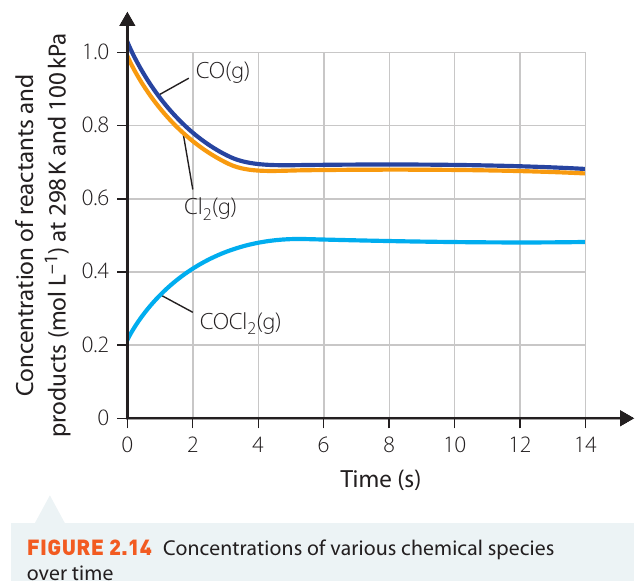
When conditions such as temperature, concentration, partial pressure, or volume change in a system at equilibrium, the system is temporarily disturbed. The system then responds by re-establishing equilibrium, with either the forward or reverse reaction proceeding at a faster rate until a new equilibrium is reached.
Understanding equilibrium shifts
Note
When we say equilibrium "shifts to the right", this means the forward reaction is favoured and more products are formed. Remember that products appear on the right-hand side of chemical equations. Conversely, when equilibrium "shifts to the left", the reverse reaction is favoured and more reactants are produced. These terms simply describe changes in the relative concentrations at equilibrium - they don't mean equilibrium physically moves anywhere.
Le Chatelier's principle
French chemist Henri Louis Le Chatelier developed a principle that summarises how equilibrium systems respond to changes in conditions. This principle is fundamental to predicting and controlling chemical reactions.
Important
The principle states:
"If a system at equilibrium is subject to a change in conditions, then the system will behave in such a way so as to partially counteract the imposed change."
Five-step approach to applying Le Chatelier's principle
When using Le Chatelier's principle to predict equilibrium changes, follow this systematic approach:
- Identify the imposed change - What specific condition has been altered?
- Determine the opposite - What would counteract this change? (This is what the system will attempt to do)
- Identify the favoured reaction - Will the forward or reverse reaction be preferred?
- Determine the equilibrium shift - Does equilibrium shift left or right?
- Predict concentration changes - What happens to the concentration of each aqueous substance or gas?
Changes to concentration and partial pressure
When you change the concentration of any substance involved in an equilibrium reaction, Le Chatelier's principle predicts that the system will respond to counteract that change and restore equilibrium.
Effect of increasing reactant concentration
If the concentration of a reactant increases, the system responds by favouring the forward reaction to consume the excess reactant. This shifts equilibrium to the right, which:
- Increases product concentrations
- Decreases reactant concentrations
- Does not return the added reactant to its original concentration (only partially counteracts)
Example
Worked Example: Hydrogen Iodide Formation
Consider the hydrogen iodide formation reaction:
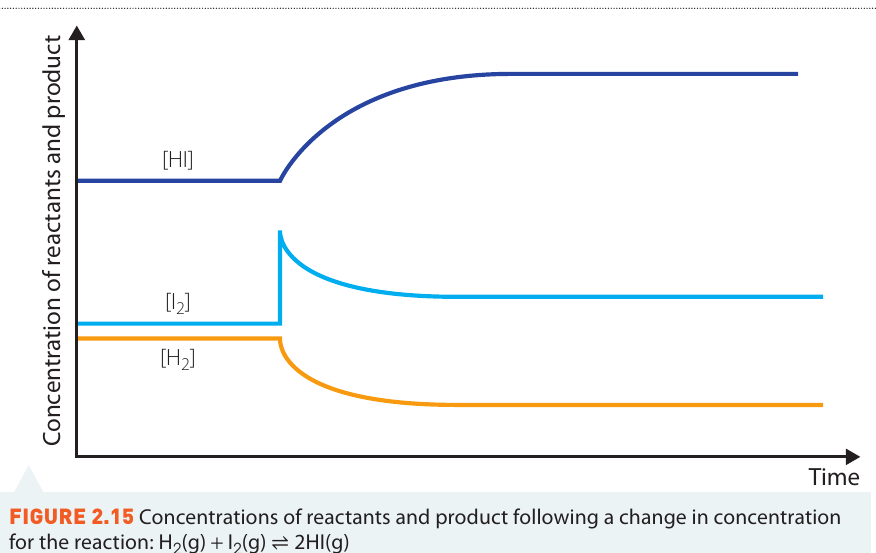
When additional iodine () is added to this system, there is a sudden jump in iodine concentration on the graph. The system then responds according to collision theory: more iodine molecules mean more frequent collisions between and molecules, so the forward reaction rate increases. As product accumulates, the reverse reaction rate also increases until equilibrium is re-established at a new position.
Effect of decreasing product concentration
If the concentration of a product decreases, the system favours the forward reaction to replace the removed product. Again, equilibrium shifts to the right, with product concentrations increasing and reactant concentrations decreasing.
Relationship between partial pressure and concentration
Note
For gaseous systems, partial pressure and concentration are directly related - both depend on the number of particles in a given volume. Therefore, changes in partial pressure have the same effect as concentration changes. You can use partial pressures to indicate concentration in gas-phase equilibrium systems.
Example: ammonia synthesis
Consider the industrially important ammonia synthesis reaction:
If hydrogen gas () is added without changing the container volume, the hydrogen concentration increases. According to Le Chatelier's principle, the system responds by favouring the forward reaction, which consumes hydrogen. This shifts equilibrium to the right:
- Hydrogen and nitrogen concentrations decrease
- Ammonia concentration increases
- The new hydrogen equilibrium concentration remains higher than before the addition
Summary of concentration and partial pressure effects
| Change imposed | Reaction favoured | Equilibrium shift | Effect on reactants | Effect on products |
|---|---|---|---|---|
| Increase reactant concentration/pressure | Forward | Right | Decrease | Increase |
| Decrease reactant concentration/pressure | Reverse | Left | Increase | Decrease |
| Increase product concentration/pressure | Reverse | Left | Increase | Decrease |
| Decrease product concentration/pressure | Forward | Right | Decrease | Increase |
Investigation: effect of concentration changes
The iron(III) thiocyanate system provides an excellent demonstration of concentration effects:
The complex ion is deep red, allowing visual observation of equilibrium changes. Adding more or shifts equilibrium right, intensifying the red colour. Removing (by adding a reagent that reacts with it) shifts equilibrium left, reducing the red colour intensity.
Changes to volume and pressure
Volume and pressure changes in gaseous systems affect all gaseous substances simultaneously. This differs from concentration changes, which typically affect one substance at a time. The reaction that is favoured depends on the relative number of gas molecules on each side of the equation.
Effect of increasing volume (decreasing pressure)
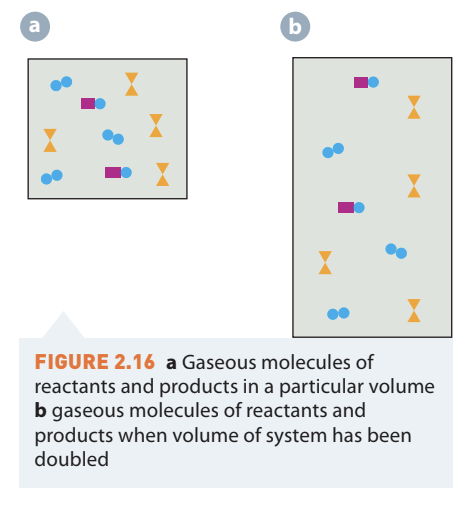
When the volume of a container holding gases increases, the molecules have more space to move around. This causes:
- Initial decrease in concentration of all gases (same number of molecules in larger volume)
- Corresponding decrease in system pressure (pressure and volume are inversely related)
- System response favouring the reaction that increases total gas molecules (to increase pressure)
Example
Worked Example: Ammonia Synthesis Volume Change
For the reaction:
Notice the 4:2 ratio of gas molecules - 4 reactant molecules (3 + 1 ) produce 2 product molecules ().
If the container volume doubles, the concentration and pressure of all gases halve immediately. The system responds by favouring the reverse reaction, which produces more total gas molecules:
- Initially, the reverse reaction is favoured
- Ammonia concentration decreases
- Hydrogen and nitrogen concentrations increase
- System continues adjusting until forward and reverse rates are equal again
Effect of adding water to aqueous equilibria
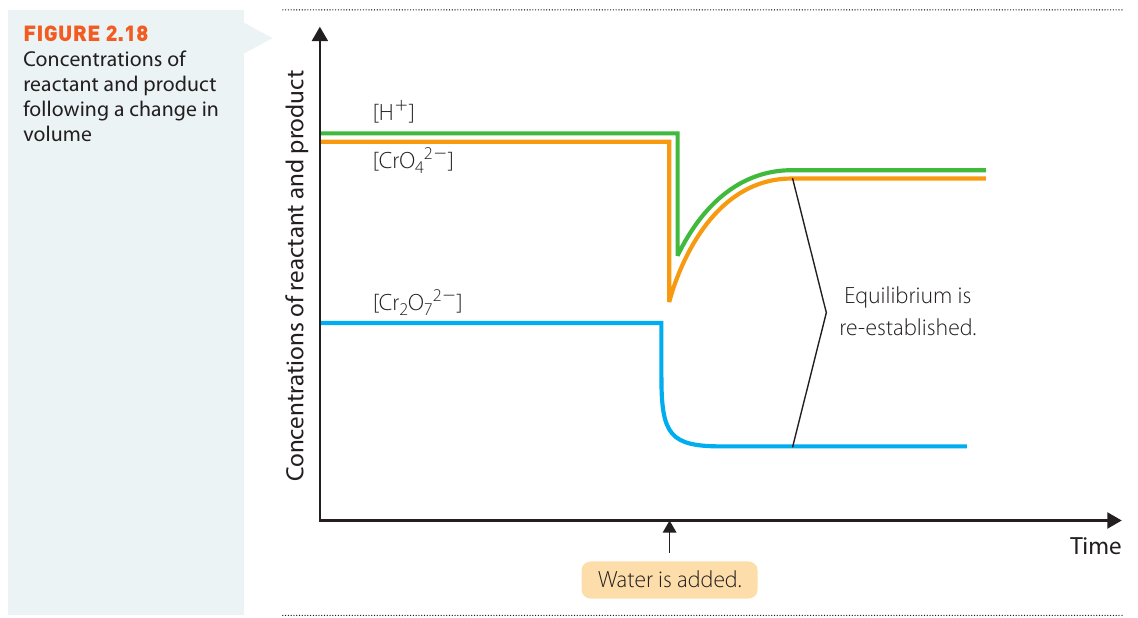
Adding water to a solution containing an equilibrium decreases the concentration of all aqueous species. The principle is the same as for gases - the reaction using more aqueous molecules experiences the greatest initial rate decrease.
Consider the chromate-dichromate equilibrium:
When water is added, concentrations of all aqueous ions suddenly decrease. Since four aqueous molecules are consumed to produce one dichromate ion, the reverse reaction is favoured. Note that water concentration is considered constant in aqueous solutions, so it doesn't appear in equilibrium considerations.
Special case: equal moles of gas
Note
When a reaction has equal numbers of gas molecules on both sides, volume changes don't affect equilibrium position. For example:
This equation shows 2 gas molecules on each side (1 + 1 = 2 ). When volume changes, concentrations of reactants and products change equally, so both forward and reverse reaction rates change by the same amount. The rates remain equal, so equilibrium position is unaffected.
Investigation: volume changes in gaseous systems
The nitrogen dioxide-dinitrogen tetraoxide system demonstrates volume effects:
Nitrogen dioxide is brown, while dinitrogen tetraoxide is colourless. When the volume is decreased (by compressing a syringe), the mixture initially darkens as all gas concentrations increase. Then the equilibrium shifts toward the product side (fewer molecules), and the colour lightens. This is a clear visual demonstration of Le Chatelier's principle in action.
Changes to temperature
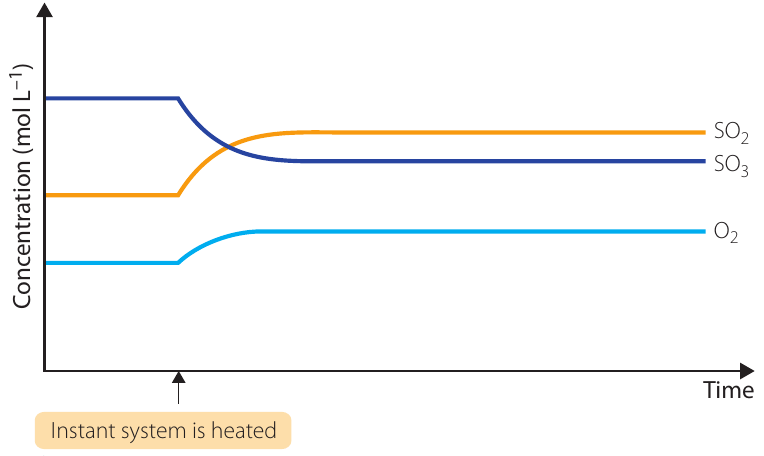
Temperature changes affect equilibrium systems differently from concentration, pressure, or volume changes. When temperature changes, there are no sudden jumps in concentration. Instead, concentrations change gradually as the system responds to the temperature change.
Understanding exothermic and endothermic reactions
Every reversible reaction has one direction that is exothermic (releases energy) and one that is endothermic (absorbs energy). Consider the sulfur trioxide formation reaction:
The negative enthalpy change indicates the forward reaction is exothermic (releases per mole). We can rewrite this with energy as part of the equation:
This shows energy appears as a "product" of the forward reaction. Consequently, the reverse reaction must be endothermic (absorbs energy).
Effect of increasing temperature
When temperature increases (adding energy to the system), Le Chatelier's principle predicts the system will favour the reaction that absorbs energy - the endothermic reaction. For the sulfur trioxide example, heating favours the reverse reaction:
- Sulfur dioxide and oxygen concentrations increase
- Sulfur trioxide concentration decreases
- Equilibrium shifts to the left
Effect of decreasing temperature
When temperature decreases (removing energy from the system), the system favours the exothermic reaction to produce heat energy and restore temperature. This shifts equilibrium toward the exothermic direction.
Activation energy considerations
Note
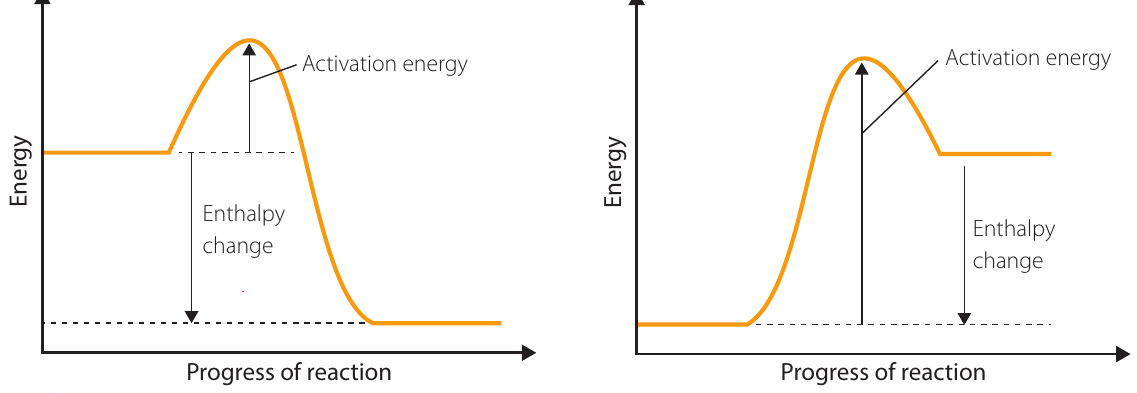
The effect of temperature on equilibrium can be explained by examining activation energies. In any reversible reaction:
- The exothermic reaction has lower activation energy
- The endothermic reaction has higher activation energy
- The difference in activation energies equals the enthalpy change
Collision theory explanation
When temperature increases, both forward and reverse reaction rates increase because molecules have more kinetic energy and collide more frequently with sufficient energy to react. However, the rate increase is greater for the endothermic reaction (higher activation energy).
This happens because temperature increase has a proportionally larger effect on reactions with higher activation energies. More molecules gain sufficient energy to overcome the higher energy barrier of the endothermic reaction.
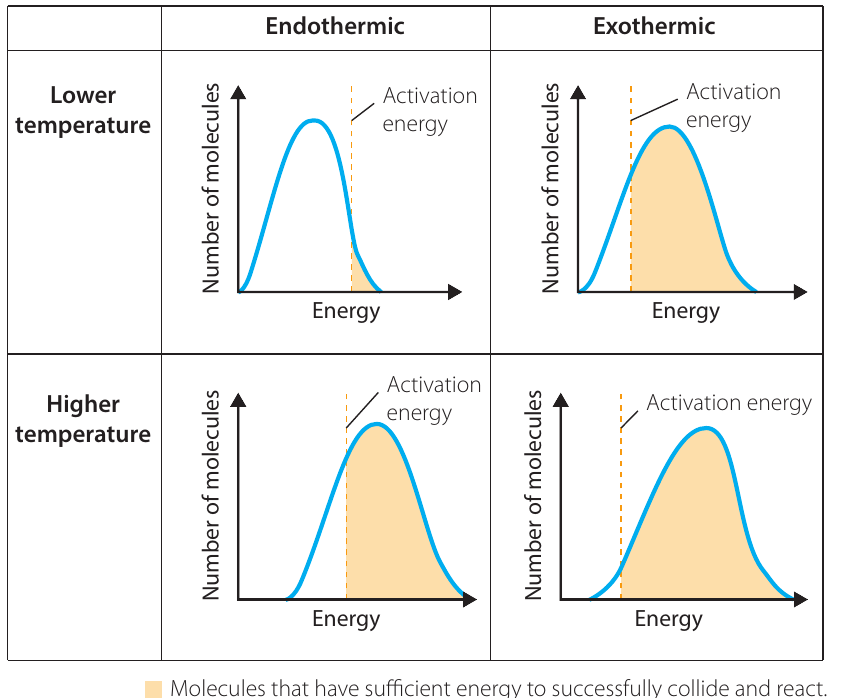
As the endothermic reaction proceeds faster, its products accumulate, which then increases the rate of the reverse (exothermic) reaction. This continues until the two rates are equal again and a new equilibrium is established.
Important
While reaction rates explain how equilibrium is re-established, it is the energy change (not the rate) that drives the equilibrium shift according to Le Chatelier's principle.
Investigation: temperature effects on cobalt complexes
The cobalt complex equilibrium provides an excellent visual demonstration:
The hydrated cobalt ion () is pink, while the chloro complex () is deep blue. Heating the pink solution causes it to turn blue, indicating the forward reaction is endothermic. Cooling returns the blue colour to pink, confirming the reverse reaction is exothermic.
Addition of a catalyst
Catalysts occupy a special position in equilibrium chemistry - they affect how quickly equilibrium is reached but do not change the equilibrium position itself.
How catalysts work
Note
A catalyst lowers the activation energy for both the forward and reverse reactions equally. This means:
- Both reaction rates increase by the same proportion
- The ratio of forward to reverse rates remains constant
- Equilibrium is reached faster
- The final equilibrium concentrations are identical to those without a catalyst
Practical importance
Although catalysts don't affect equilibrium position, they are crucial in industrial chemistry because they allow reactions to reach equilibrium much faster. This improves production efficiency and reduces energy costs.
Identifying changes on concentration-time graphs
Different types of changes to equilibrium systems produce characteristic patterns on graphs of concentration versus time. Understanding these patterns helps you identify what change was made to a system.
Summary of graphical indicators
| Change to system | Key feature on graph |
|---|---|
| Increase concentration/pressure of one substance | Sudden increase in one substance only |
| Decrease concentration/pressure of one substance | Sudden decrease in one substance only |
| Increase volume / decrease pressure | Sudden decrease in all gaseous species |
| Decrease volume / increase pressure | Sudden increase in all gaseous species |
| Increase temperature | No sudden changes; gradual concentration changes |
| Decrease temperature | No sudden changes; gradual concentration changes |
| Addition of catalyst | Reaches same equilibrium position in shorter time |
Key graphing principles
Concentration/pressure changes: Only one substance shows a sudden change - the one that was added or removed. Other substances then gradually adjust as equilibrium shifts.
Volume/pressure changes: All gaseous substances change suddenly and simultaneously, then gradually adjust to new equilibrium.
Temperature changes: No sudden changes occur. All concentrations change gradually as one reaction becomes favoured over the other.
Catalyst addition: The graph shows the same final equilibrium concentrations are reached, but the time to reach equilibrium is reduced.
Summary
Exam tips
-
Always write the equation first - This helps you count molecules and identify exothermic/endothermic directions.
-
Use the 5-step approach - Working systematically through Le Chatelier's principle reduces errors.
-
Watch for equal moles - If gas molecules are equal on both sides, pressure/volume changes don't affect equilibrium.
-
Include energy in equations - Writing energy as a reactant (endothermic) or product (exothermic) makes temperature effects clearer.
-
Remember "partial counteraction" - The system responds to oppose the change but cannot completely reverse it.
-
Distinguish between rate and position - Catalysts affect rate only; they never change equilibrium position.
-
Graph interpretation - Sudden changes indicate concentration/pressure/volume changes; gradual changes indicate temperature changes.
Summary
Remember!
Key Points to Remember:
-
Le Chatelier's principle: If a system at equilibrium is subject to a change in conditions, the system will behave in such a way as to partially counteract the imposed change.
-
Concentration changes: Increasing a substance favours the reaction that consumes it; decreasing a substance favours the reaction that produces it.
-
Volume and pressure: Increasing volume (decreasing pressure) favours the reaction producing more gas molecules; decreasing volume (increasing pressure) favours the reaction producing fewer gas molecules.
-
Temperature changes: Increasing temperature favours the endothermic reaction; decreasing temperature favours the exothermic reaction. Temperature changes show no sudden concentration changes on graphs.
-
Catalysts: Lower activation energy for both forward and reverse reactions equally, speeding up equilibrium attainment without changing the equilibrium position.