Common Ion Effect (HSC SSCE Chemistry): Revision Notes
📚Revision Notes
Common Ion Effect
Introduction to the common ion effect
When studying solution equilibria, you may have learned about situations where a single ionic salt dissolves in water. The common ion effect introduces an important variation on this concept. This effect occurs when you add a substance that shares an ion with a sparingly soluble salt already present in solution.
For example, imagine you have a test tube containing calcium sulfate (), which is sparingly soluble in water. If you then add sodium sulfate () to this test tube, both compounds share the sulfate ion (). This shared ion is called a common ion, and its presence affects the solubility of the original salt.
Important
Key Principle: Adding a common ion to a saturated solution decreases the solubility of the salt.
Understanding the effect using Le Chatelier's principle
To understand why the common ion effect occurs, we can apply Le Chatelier's principle to a solubility equilibrium.
Consider calcium sulfate dissolving in water:
This equilibrium exists when calcium sulfate is in a saturated solution.
What happens when we add sodium sulfate?
Sodium sulfate () is a soluble salt. When added to water, it completely dissociates:
When you add sodium sulfate to the test tube containing calcium sulfate, you are increasing the concentration of sulfate ions () in the solution.
Le Chatelier's principle in action
According to Le Chatelier's principle, when you increase the concentration of one component in an equilibrium system, the system responds by shifting to reduce that concentration. In this case:
- The increased concentration of causes the equilibrium to shift backwards (to the left)
- This shift favours the reverse reaction
- More solid calcium sulfate precipitates out of solution
- The concentration of ions decreases
- The overall result is that calcium sulfate becomes less soluble
Note
This qualitative explanation shows why the common ion effect occurs: the system responds to the added ion by shifting the equilibrium to reduce its concentration, which means more solid precipitates and overall solubility decreases.
Quantitative analysis of the common ion effect
Now let's examine the common ion effect using calculations. This will show you exactly how much the solubility changes.
Example
Worked Example: Calcium Sulfate in Water versus in Sodium Sulfate Solution
The solubility product constant () for calcium sulfate at is .
Part A: Solubility in pure water
For the equilibrium:
The equilibrium expression is:
In pure water, when calcium sulfate dissolves, it produces equal concentrations of calcium and sulfate ions. If we call this concentration (representing solubility):
Substituting into the expression:
Solving for :
Result: In pure water, the calcium ion concentration is .
Part B: Solubility in sodium sulfate solution
Now let's calculate what happens when calcium sulfate dissolves in a solution that already contains sodium sulfate.
Since sodium sulfate completely dissociates and has a 1:1 ratio with sulfate ions:
When calcium sulfate dissolves in this solution:
- (from dissociation of )
- (from both sodium sulfate and calcium sulfate)
However, because sodium sulfate completely dissociates and calcium sulfate only sparingly dissociates, the value of is much smaller than . This means:
Therefore, we can make a simplifying assumption:
Substituting into the equilibrium expression:
Solving for :
Result: In sodium sulfate solution, the calcium ion concentration is .
Comparing the results
Notice that is indeed much smaller than , which validates our simplifying assumption.
Important
Key Observation: The calcium ion concentration decreased from to mol L when the common ion was present. This confirms that calcium sulfate is less soluble when a common ion is present, supporting our qualitative prediction using Le Chatelier's principle.
Worked example: silver iodide solubility
Let's examine another detailed example comparing the solubility of silver iodide in water versus in a potassium iodide solution.
Example
Worked Example: Silver Iodide Solubility with Common Ion Effect
Problem Statement
Compare both qualitatively and quantitatively the solubility of silver iodide in water with its solubility in potassium iodide (). The for silver iodide is at .
Solution
Step 1: Write the balanced equation
Step 2: Qualitative analysis using Le Chatelier's principle
When potassium iodide is added to a solution containing silver iodide, the concentration of iodide ions () increases. According to Le Chatelier's principle, the equilibrium system will respond by shifting backwards (favouring the reverse reaction). This increases precipitation of silver iodide, meaning the solubility of silver iodide decreases.
Step 3: Write the equilibrium expression
Step 4: Calculate solubility in water
In pure water:
Therefore:
Solubility of in water is mol L.
Step 5: Calculate solubility in potassium iodide solution
Since potassium iodide completely dissociates with a 1:1 ratio:
When silver iodide dissolves:
- (from dissociation of )
- (from both and )
Since , we can approximate:
Substituting into the equilibrium expression:
Solubility of in mol L potassium iodide is mol L.
Step 6: Compare the values
To see how much the solubility decreased:
Conclusion: The solubility of silver iodide is approximately 27 million times less in mol L potassium iodide compared to its solubility in water.
This dramatic decrease clearly demonstrates the powerful effect of the common ion on solubility.
Practical investigation: demonstrating the common ion effect
Investigation 4.5: Teacher demonstration
Aim
To observe the common ion effect in action using a saturated sodium chloride solution.
Materials required
- saturated solution
- Dropper bottle containing concentrated
- Dropper bottle containing
- 3 test tubes
- Test tube rack
- 3 small labels
- Measuring cylinder () or disposable droppers
- Safety glasses
Risk assessment
Important
Key Safety Considerations:
- Concentrated hydrochloric acid is highly corrosive - use in a fume cupboard or well-ventilated area
- sodium hydroxide is very corrosive - wear safety glasses
- Always wash hands immediately after handling chemicals
Method
- Label the three test tubes A, B and C
- Add of saturated sodium chloride solution to each test tube
- To test tube B, add 10 drops of concentrated hydrochloric acid. Record your observations
- To test tube C, add 10 drops of sodium hydroxide. Record your observations
- Compare the three test tubes
What to observe
Note
Understanding the Setup:
- Test tube A serves as the control (no additions made)
- Test tube B receives , which provides additional chloride ions () - the common ion
- Test tube C receives , which provides additional sodium ions () - the common ion
When a common ion is added to either test tube B or C, you should observe increased precipitation of sodium chloride crystals due to the common ion effect.
Results and conclusion
Record your observations in a carefully designed table. Consider these questions:
- What was the purpose of test tube A? (It serves as a control for comparison)
- How does this investigation illustrate the common ion effect? (Adding a common ion causes more precipitation)
Investigation 4.6: Determining for lead(II) iodide
Introduction
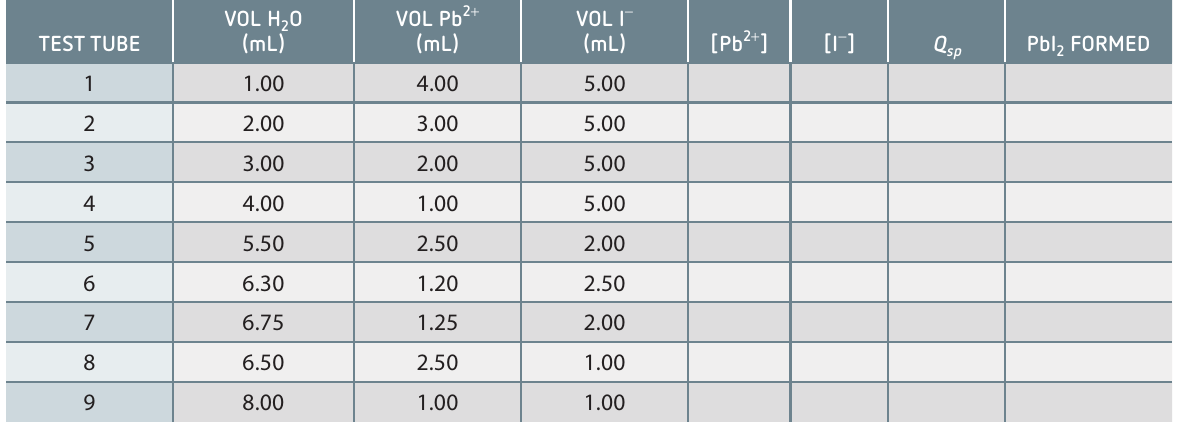
This investigation allows you to determine the solubility product constant indirectly by preparing mixtures with different concentrations of lead ions () and iodide ions ().
The equilibrium is:
The ionic product is:
Note
In some test tubes, will exceed and a precipitate will form. In others, will be less than and no precipitate will form. By finding the boundary between these two cases, you can determine the range for .
Aim
To determine the for lead(II) iodide.
Materials required
- Burette containing
- Burette containing
- Burette containing deionised water
- 9 large test tubes
- Test tube rack
- 9 small labels
- Heavy metal waste bottle
- Retort stands and burette clamps
- Safety glasses
Risk assessment
Important
Key Safety Considerations:
- Lead salts are highly toxic - use burettes for dispensing
- Always wear safety glasses
- Wash hands immediately after use
- Dispose of all solutions in the heavy metal waste bottle provided
Method
- Label each test tube from 1 to 9
- Prepare each mixture according to the volumes specified in the table below
- Always add the water to the test tube first (this prevents local supersaturation)
- Leave each mixture for at least 30 minutes before checking for precipitate formation
Analysis of results
Step 1: Calculate ion concentrations
For each test tube, calculate the concentration of each ion using:
Step 2: Calculate values
Use the calculated ion concentrations to determine for each mixture:
Step 3: Determine the range
- Identify the smallest value where a precipitate formed
- Identify the largest value where no precipitate formed
- The lies between these two values
Conclusion
Compare your experimental range for with the literature value provided on the NESA data sheet. Discuss possible reasons for any differences, such as:
- Temperature variations
- Experimental uncertainties in volume measurements
- Time allowed for equilibrium to establish
- Purity of reagents
Summary of key concepts
Summary
Essential Concepts of the Common Ion Effect:
Definition: The common ion effect occurs when adding a common ion to a saturated solution decreases the solubility of the salt.
Mechanism: This effect can be explained using Le Chatelier's principle. When you increase the concentration of one ion in an equilibrium system, the system shifts to reduce that concentration, favouring precipitation.
Quantitative impact: Calculations show that the decrease in solubility can be dramatic. For example, silver iodide is 27 million times less soluble in potassium iodide solution compared to pure water.
Practical applications: The common ion effect is important in many areas of chemistry, including precipitation reactions, buffer solutions, and analytical chemistry.
Remember!
Summary
Key Points to Remember:
-
Adding a common ion always decreases solubility - when you add a substance containing an ion that's already present in a saturated solution, the sparingly soluble salt becomes even less soluble
-
Le Chatelier's principle explains why - increasing the concentration of one component causes the equilibrium to shift backwards, favouring precipitation and reducing solubility
-
The effect is quantifiable - you can calculate exactly how much the solubility changes using the solubility product constant () and the concentration of the added common ion
-
Use the simplifying assumption - when the common ion comes from a completely dissociating salt, its concentration is much larger than the contribution from the sparingly soluble salt, so you can approximate
-
Safety is essential - when working with chemicals in investigations, always follow proper safety procedures, wear appropriate protective equipment, and dispose of waste correctly