Revision: Structure of Ionic Compounds and Water (HSC SSCE Chemistry): Revision Notes
📚Revision Notes
Revision: Structure of Ionic Compounds and Water
Introduction to solubility
Solubility is a fundamental concept in chemistry with many practical applications in our daily lives. Understanding how substances dissolve helps us in various situations:
- Stain removal: Choosing the right solvent to dissolve and remove different types of stains
- Painting: Understanding solvents for cleaning brushes and thinning paint
- Food and beverages: Dissolving solids like coffee granules in water
- Laboratory safety: Proper disposal of chemicals based on their solubility and toxicity
Important
Although copper salts dissolve easily in water, they should never be poured down the drain in school laboratories. This is because dissolved chemicals eventually reach our waterways and can enter food chains or water supplies. The World Health Organization has set as the safe maximum level of copper ions in drinking water.
Note
Indigenous Australians have understood solubility for thousands of years, using running water to dissolve and remove toxins from potential food sources.
Structure of ionic compounds
Ionic compounds have a distinctive crystalline structure that is important to understand before exploring how they dissolve in water.
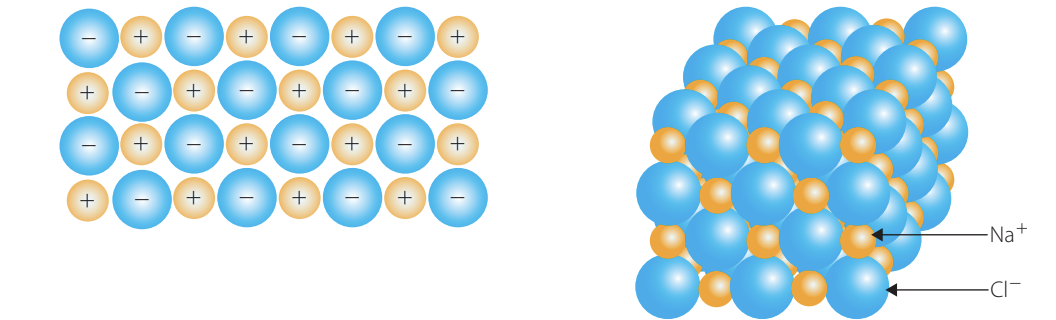
In an ionic crystal:
- Positive ions (cations) and negative ions (anions) are arranged in a regular, repeating pattern
- Every cation is surrounded by anions, and every anion is surrounded by cations
- Electrostatic attraction between oppositely charged ions extends throughout the entire crystal
- There are no individual molecular units (like separate NaCl molecules), just a continuous three-dimensional array of ions held together by ionic bonds
This orderly arrangement creates the characteristic properties of ionic compounds, including their high melting points and ability to conduct electricity when dissolved in water.
Note
The continuous three-dimensional network of ions means that ionic compounds don't exist as individual molecules. Instead, the entire crystal is one large interconnected structure held together by electrostatic forces between all the ions.
Structure of water
Water is a simple molecule with remarkable properties that make it an excellent solvent.
Molecular composition and polarity
Water () consists of two hydrogen atoms covalently bonded to one oxygen atom. The key to water's properties is its polarity:
- Oxygen has a much higher electronegativity than hydrogen
- Electrons in the O—H covalent bonds are more strongly attracted to oxygen
- This creates a partial negative charge () on oxygen
- Hydrogen atoms are left with a partial positive charge ()
- The hydrogen atom is very small, allowing water molecules to get close to each other
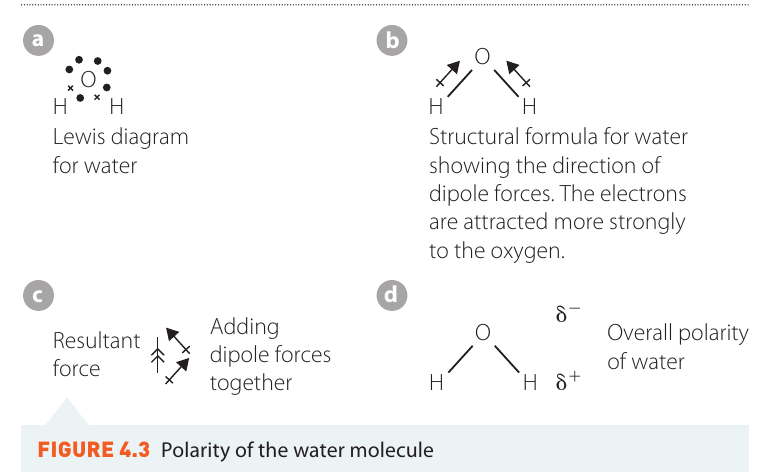
The diagram above shows:
- (a) Lewis structure showing electron arrangement
- (b) Structural formula with arrows indicating dipole forces pulling electrons toward oxygen
- (c) How adding the two dipole forces together gives a resultant force
- (d) Overall polarity showing partial charges: on oxygen and on hydrogen
Hydrogen bonding
The large electronegativity difference between oxygen and hydrogen, combined with water's polarity, allows water molecules to form hydrogen bonds with each other.
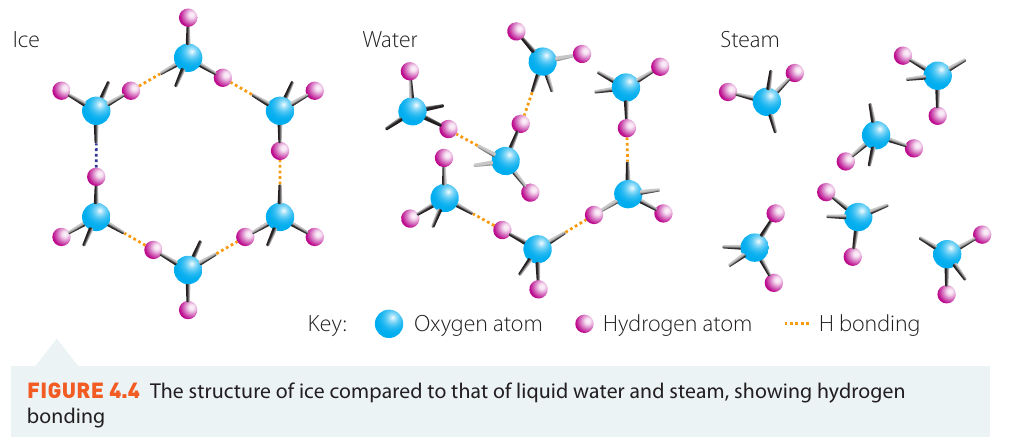
The figure above compares water in three states:
- Ice: Highly ordered structure with extensive hydrogen bonding creating a rigid crystalline lattice
- Liquid water: Molecules still hydrogen bonded but with less order, allowing flow
- Steam: Individual molecules with no hydrogen bonding, moving freely
Note
Hydrogen bonding is crucial because it allows chemists to predict whether substances will dissolve in each other. Generally, polar substances (with hydrogen bonding capability) dissolve well in water. This is the basis of the principle "like dissolves like".
Water as a solvent
Water has unique properties that make it an exceptional solvent:
- Pure water is liquid from to , providing a wide working temperature range
- Water dissolves and transports materials across the planet and through living cells
- Water forms hydrogen bonds or ion-dipole bonds with many substances, from salts to proteins
Water of crystallisation
What is water of crystallisation?
When many ionic compounds crystallise from aqueous solution, they incorporate water molecules into their crystal structure in a fixed ratio. These compounds are called hydrated compounds.
Example
Example: Hydrated Copper(II) Sulfate
(hydrated copper(II) sulfate) contains five water molecules for each unit of copper(II) sulfate. The dot in the formula separates the ionic compound from the water molecules.
Ion-dipole bonds and ligands
The water molecules in hydrated compounds are held in place by ion-dipole bonds:
- The ion (from the salt) and the dipole (from water) form weak bonds
- These bonds are weaker than ionic or covalent bonds but strong enough to hold water in the crystal
- Water molecules or other molecules that form dipole bonds to metal atoms are called ligands
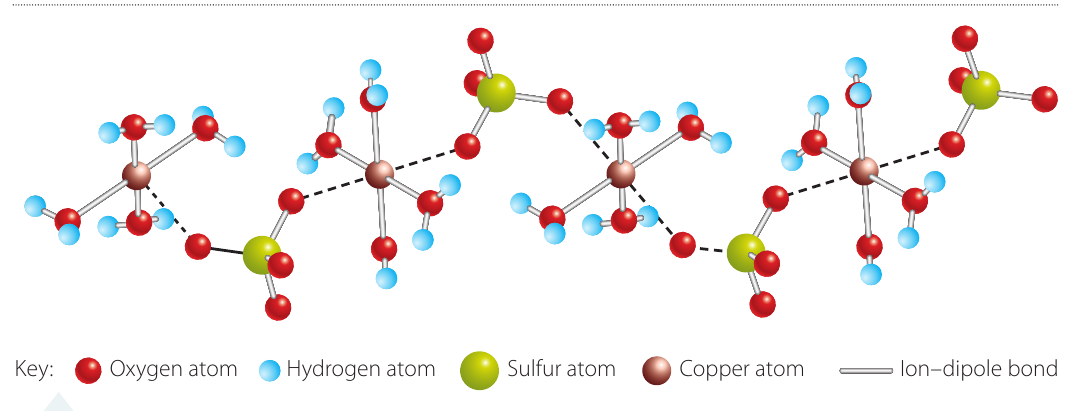
The molecular structure of hydrated copper(II) sulfate shows:
- Water ligands arrange around the central copper ion ()
- The arrangement follows VSEPR theory, forming an octahedral shape
- Since copper is a cation (positive), the negative oxygen end of water points toward it
- Sulfate ions () are also present in the structure
- Ion-dipole bonds (shown as dashed lines) connect the copper ion to the water molecules
Anhydrous compounds
When you heat a hydrated compound, the water of crystallisation evaporates. Once all water molecules are removed, the compound is anhydrous (without water).
This process is useful for determining the formula of hydrated salts:
- Weigh a known mass of the hydrated compound
- Heat the compound to remove all water
- Weigh the remaining anhydrous compound
- Calculate the mass of water lost
- Use this data to determine the empirical formula
Important
Important observation: Some hydrated salts change colour when water is removed (like , which changes from blue to white), making it easy to see when all water has evaporated. However, many salts remain white in both forms, making it more challenging to determine the endpoint.
Summary
Key Points to Remember:
-
Ionic compounds have a crystalline structure with alternating positive and negative ions held together by electrostatic attraction throughout the entire crystal.
-
Water is polar due to the electronegativity difference between oxygen and hydrogen, creating partial charges ( on oxygen, on hydrogen).
-
Hydrogen bonding between water molecules occurs because of water's polarity and gives water many of its unique properties, including its ability to dissolve ionic compounds.
-
Water of crystallisation refers to water molecules incorporated into ionic crystal lattices in fixed ratios. Hydrated compounds contain water; anhydrous compounds have had the water removed.
-
Ion-dipole bonds form between ions and the polar water molecules, both in crystals (water of crystallisation) and in solution (dissolution). These bonds are weaker than ionic or covalent bonds but are essential for solubility.