Solving Scientific Problems (HSC SSCE Chemistry): Revision Notes
📚Revision Notes
Solving Scientific Problems
Introduction to scientific problem-solving
Science involves the organised investigation of natural phenomena and the physical world. Scientists work by observing their surroundings and conducting systematic investigations to answer questions. This approach is described as empirical, meaning that scientific conclusions are based on evidence gathered through observation and experimentation, rather than speculation or opinion.
Note
What does empirical mean?
When we say science is empirical, we mean that scientists answer questions by using evidence - specifically observational and experimental evidence. This distinguishes science from other ways of understanding the world that might rely on belief, tradition, or pure logic without testing.
When you solve scientific problems, you follow established methods that help ensure your findings are reliable and valid. Understanding these methods is essential for conducting your own investigations and evaluating scientific claims made by others.
The nature of science
Scientific knowledge is testable and falsifiable
Scientific theories and ideas must be testable through experimentation and observation. Importantly, they must be falsifiable, which means it must be possible to disprove them through evidence. This is a fundamental principle of science.
Important
The Principle of Falsifiability
Scientists cannot definitively prove a theory is correct. Instead, they gather evidence that supports or contradicts it. As Albert Einstein eloquently stated: "No amount of experimentation can ever prove me right; a single experiment can prove me wrong."
This captures the essence of scientific thinking - theories are supported by accumulated evidence, but a single contradictory finding can disprove them.
Accepted and rejected theories
When substantial evidence supports a theory over time, it becomes widely accepted by the scientific community. Atomic theory is an excellent example. Extensive evidence supports the idea that all matter consists of atoms. Scientists have used atomic theory to make predictions about atomic behaviour, and experimental evidence has consistently supported these predictions. As a result, the scientific community accepts atomic theory.
However, not all proposed theories remain accepted. The phlogiston theory demonstrates how science evolves as new evidence emerges. In the 17th century, scientists proposed that combustion released a substance called phlogiston. This theory initially explained many observations of burning materials. However, further experimentation revealed inconsistencies.
Example
Contrasting Scientific Theories: Atomic Theory vs Phlogiston Theory
Atomic Theory - Accepted:
- Extensive evidence supports that all matter consists of atoms
- Scientists successfully predicted atomic behaviour based on the theory
- Experimental evidence consistently supported these predictions
- The scientific community accepts this theory
Phlogiston Theory - Rejected:
- Proposed that combustion released a substance called "phlogiston"
- Initially explained many observations of burning materials
- Further experimentation revealed inconsistencies (e.g., magnesium gains mass when burning, contradicting the theory)
- Antoine Lavoisier's careful measurements demonstrated combustion required oxygen, not release of phlogiston
- As contradictory evidence mounted, scientists abandoned the theory
This example illustrates an important aspect of science: theories must adapt as new evidence becomes available. When evidence no longer supports a theory, the scientific community revises or rejects it.

The scientific method
The scientific method provides a systematic framework for investigating questions and solving problems. It follows a logical sequence of steps, though scientists may repeat certain stages if initial results are inconclusive.
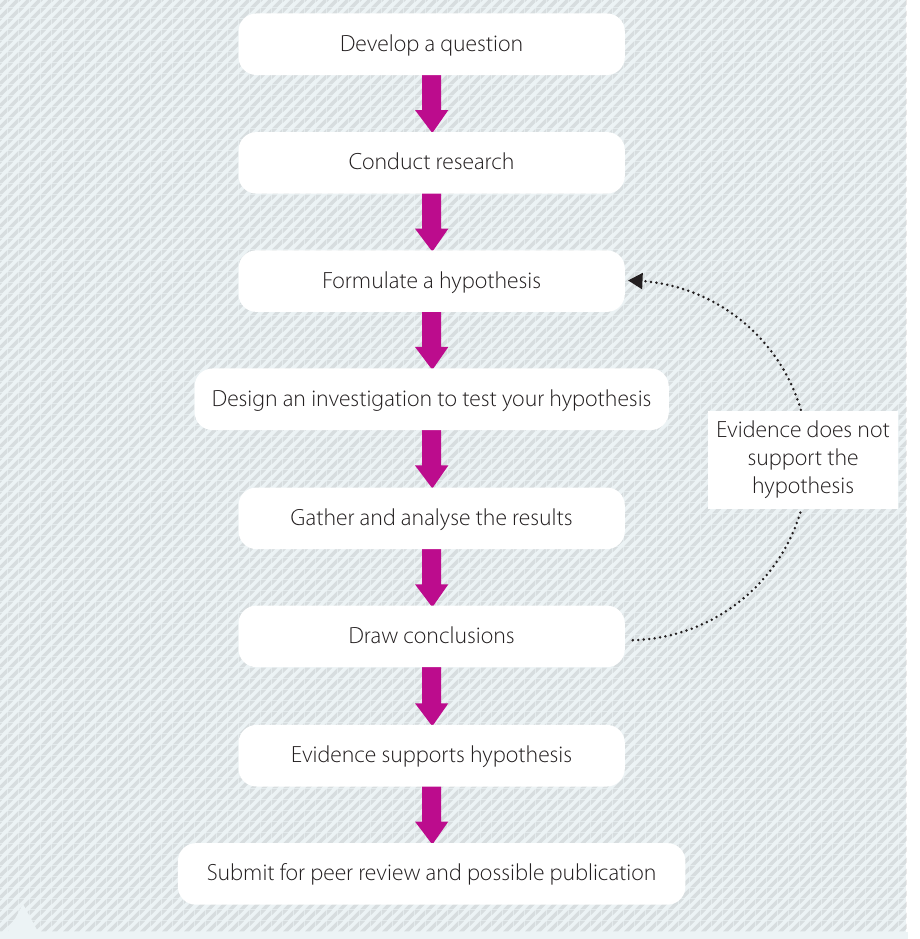
Steps in the scientific method
1. Develop a question
Scientific investigations begin with curiosity. You identify something you want to understand or explain, then formulate a clear, testable question.
2. Conduct research
Before designing experiments, research existing knowledge about your topic. Review scientific literature, previous studies, and relevant theories. This background research helps you understand what is already known and identifies gaps in current knowledge.
3. Formulate a hypothesis
A hypothesis is a tentative explanation that answers your question. It is not a wild guess - it should be based on observations or literature research. Importantly, a hypothesis must be testable through experimentation.
Note
What makes a good hypothesis?
A good hypothesis must be:
- Based on observations or background research (not random guessing)
- Testable through experimentation
- Clear and specific
For example: "Increasing temperature increases the rate of a chemical reaction" can be tested by measuring reaction times at different temperatures.
4. Design an investigation to test your hypothesis
Plan how you will test your hypothesis. Consider what variables you will measure, what equipment you need, and how you will ensure your results are reliable. A well-designed investigation controls factors that might affect your results.
5. Gather and analyse the results
Conduct your investigation carefully, recording all measurements and observations. After collecting data, analyse it to identify patterns or trends. This might involve calculations, creating graphs, or statistical analysis.
6. Draw conclusions
Based on your analysis, determine whether the evidence supports or contradicts your hypothesis. Your conclusions must be justified by the data you collected.
7. Evaluate hypothesis support
If evidence supports your hypothesis, it adds to the body of knowledge about your topic. You can then submit your work for peer review. If evidence does not support your hypothesis, you need to modify your explanation and design new tests. This iterative process is normal in science - not all investigations immediately produce conclusive results.
Important
The Iterative Nature of Science
The scientific method is not always linear. If your evidence doesn't support your hypothesis, you don't simply fail - you:
- Revise your hypothesis based on what you learned
- Design new tests to investigate the modified explanation
- Repeat the process until you find a well-supported explanation
This cycle of testing, learning, and refining is fundamental to scientific progress.
8. Submit for peer review and possible publication
Scientists share their findings with the scientific community through peer review. Expert scientists in the same field evaluate the research methods, analysis, and conclusions. They assess whether the investigation was valid and whether the conclusions are justified. If the work meets scientific standards and contributes new knowledge, it is published for others to build upon.
Solving problems through depth studies
Depth studies provide opportunities for you to work scientifically and develop problem-solving skills. They allow you to investigate topics that interest you while applying the principles of scientific inquiry.
What are depth studies?
During depth studies, you pose scientific questions, develop hypotheses, and gather evidence to test them. The evidence might come from your own experiments or from existing scientific literature. You analyse data to determine whether it supports your hypotheses, often representing findings mathematically or graphically. Finally, you communicate your results to others, choosing presentation methods appropriate for your audience.
Depth studies can be completed individually or collaboratively. In research teams, different members often have specific roles and responsibilities, reflecting how professional scientists work.
Purposes of depth studies
Completing depth studies allows you to:
- Apply working scientifically skills in practice
- Develop deeper understanding of specific chemistry concepts
- Evaluate claims made in media by comparing them with scientific literature
- Design and conduct investigations to test product claims or media statements
- Explore how scientific understanding of chemical concepts has developed over time
- Identify important trends and information through data analysis
Types of depth studies
There are two main categories of depth studies:
Note
Primary vs Secondary Source Investigations
Primary source investigations involve collecting your own data first-hand. You physically perform experiments, make observations, or conduct fieldwork. This includes laboratory investigations, field studies, and constructing working models. Primary investigations give you direct experience with scientific methods and techniques.
Secondary source investigations use data or information collected by others. These typically involve searching scientific literature, analysing published studies, or examining historical development of scientific concepts. For example, investigating how understanding of atomic structure has evolved over time would be a secondary source investigation.
Depth studies can be presented in various formats:
- Scientific reports
- Media articles
- Video presentations
- Poster displays
Choose the presentation format that best suits your audience and the nature of your findings. Regardless of format, always present data analysis clearly using tables, graphs, flowcharts, or diagrams.
Stages in conducting investigations
Depth studies and scientific investigations follow four main stages. Each stage requires specific working scientifically skills.
Stage 1: Initiating and planning
This stage involves:
Questioning and predicting: Formulate clear, testable questions or develop hypotheses that propose answers to your questions. Your hypothesis should be based on observations or background research.
Planning: Research background information relevant to your topic. Assess potential risks and ethical considerations - you must conduct investigations safely and responsibly. Design valid experiments that will effectively test your hypothesis. Consider what variables to measure, how to control other factors, and what equipment you need.
Stage 2: Implementation and recording
This stage involves:
Conducting investigations: Carry out your planned investigation safely. Use appropriate technology and measuring instruments correctly. Follow proper laboratory techniques and safety procedures.
Processing data and information: Collect and record all data immediately and accurately. Organise information systematically so it can be analysed effectively. Process raw data through calculations or conversions as needed.
Note
Exam tip
When writing about investigations, always link your conclusions explicitly to your evidence. Use phrases like "The data shows..." or "This is supported by the observation that..." to demonstrate evidence-based thinking.
Stage 3: Analysing and interpreting
This stage involves:
Analysing data: Look for patterns, trends, or relationships in your data. Represent data graphically or mathematically to identify these patterns clearly. Evaluate whether your data is reliable and sufficient to draw conclusions.
Problem-solving: Draw conclusions based on your analysis. Justify your conclusions with evidence from your data. Determine whether your evidence supports or contradicts your hypothesis. Answer the questions you posed at the beginning of your investigation.
Stage 4: Communicating
The final stage involves presenting your findings to others. Use appropriate scientific language, visual representations (graphs, diagrams, tables), and technology to communicate your scientific ideas, procedures, and results clearly. Consider your audience and choose communication methods that will be effective and engaging for them.
Recordkeeping in scientific investigations
The importance of logbooks
A logbook is a detailed record of everything you do during an investigation. For professional scientists, logbooks are legal documents that provide important evidence of their work. If research is questioned, the logbook serves as proof of what was done, when, and how.
Scientists maintain strict standards for logbooks. Every entry is dated, records are kept in permanent form (pen, not pencil), and entries may be signed. Logbooks can be provided as evidence in court cases, such as patent disputes or accusations of data falsification.
Your logbook serves as the primary source of information when writing up your depth study. Whether you use a physical notebook or electronic record, your logbook should comprehensively document your investigation.
What to include in your logbook
A complete logbook contains:
- Notes from planning stages of your investigation
- Details of experimental methods and procedures
- Diagrams showing experimental set-ups or arrangements
- All raw results (original measurements and observations)
- Derived results, calculations, and analysis
- Graphs and data representations
- Ideas and thoughts about your investigation
- Printouts or copies of relevant information
- File names and locations of electronic data
- Photos and other supporting materials
Best practices for maintaining logbooks
Make an entry every time you work on your depth study. At the start of each session, record the date and names of everyone working with you.
Important
Critical Logbook Rules
Write as you work: Record information immediately as you collect it. It is easy to forget important details if you don't document them straight away. Never record data on scrap paper intending to transfer it later - always record directly in your logbook.
Use permanent records: Write in pen if using a physical logbook. Results must be recorded in permanent form. Never use pencil or correction fluid. If you need to cross something out, draw a single line through it and add a note explaining why. If using an electronic logbook, use track changes or strikethrough features rather than deleting, and add comments to explain changes.
Be complete, not perfect: Your logbook doesn't need to be neat, but it must be complete. It should contain all information about your investigation, even unsuccessful attempts or preliminary ideas. Annotated diagrams often provide concise ways to present information.
Note
Exam tip
When asked about scientific investigations in exams, remember that valid conclusions require properly recorded, reliable data. Understanding the importance of systematic recordkeeping demonstrates your awareness of scientific rigour.
Remember!
Summary
Key Points to Remember:
-
Science is empirical - conclusions must be based on observational and experimental evidence, not speculation or opinion.
-
Scientific theories are falsifiable - they can be disproved by contradictory evidence but never definitively proven. Scientists accumulate supporting evidence rather than claiming absolute proof.
-
The scientific method provides a systematic approach to investigation: develop questions, conduct research, formulate hypotheses, design investigations, analyse results, draw conclusions, and submit for peer review. The process is iterative if evidence doesn't support initial hypotheses.
-
Depth studies develop your ability to work scientifically by allowing hands-on investigation of topics that interest you. Primary source investigations involve collecting your own data, while secondary source investigations use existing literature and data.
-
A logbook is an essential, detailed record of your investigation. Record information immediately in permanent form, include all aspects of your work (planning, methods, results, analysis, ideas), and never delete or erase entries - cross them out with explanations if needed.