Chemical Reactions and the Law of Conservation of Mass (HSC SSCE Chemistry): Revision Notes
📚Revision Notes
Chemical Reactions and the Law of Conservation of Mass
Introduction to chemical reactions
Chemistry involves two major aspects: understanding the structure of substances and studying the permanent changes that occur when materials are mixed together. These permanent changes are known as chemical reactions.
Chemical reactions are happening all around us constantly. When you light a gas burner on a stove, you're initiating a chemical reaction. Cooking food involves chemical reactions. Cars move because of chemical reactions occurring in their engines. Many everyday materials are produced through chemical reactions, including the iron and steel in vehicles and appliances, the copper in water pipes and electrical wiring, and the aluminium in window frames and aeroplanes.
Note
The quantitative aspects of chemical reactions are extremely important in practical applications. For instance, foundry workers need to calculate precisely how much coke (carbon) to mix with iron ore to convert it all to iron, and they need to know how much iron will be produced. Similarly, cooks need to determine the correct amount of baking soda to mix with cream of tartar to make a cake rise properly without leaving a bitter taste.
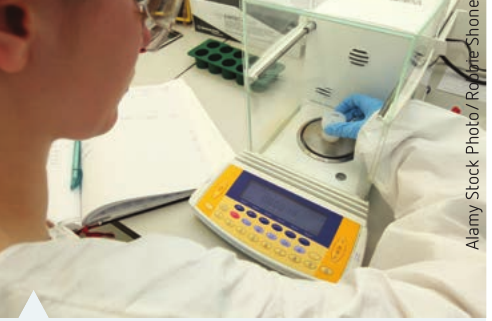
Understanding mass conservation through investigation
A fundamental principle of chemical reactions can be demonstrated through a simple experiment designed to test whether mass is conserved during a chemical reaction.
Investigation: Mass in chemical reactions
Aim: To determine whether mass remains constant during a chemical reaction.
Materials required:
- Calcium chloride (dried)
- Sodium hydrogen carbonate
- measuring cylinder
- Water
- Universal indicator in dropper bottle
- teaspoons
- Glass vial with flat bottom
- Resealable plastic storage bag
- Electronic balance
Important
Safety considerations: Chemicals could splash into eyes, so safety glasses must be worn throughout the investigation. Consider any other risks specific to your laboratory environment and implement appropriate safety measures.
Procedure:
- Add one teaspoon of calcium chloride to the plastic bag
- Add one teaspoon of sodium hydrogen carbonate to the bag
- Place of water and four drops of universal indicator solution into the glass vial
- Carefully stand the glass vial upright in the bag, ensuring it won't fall over
- Seal the bag completely
- Weigh the sealed bag and record the mass
- Invert the bag to allow the indicator solution to mix with the solid chemicals
- Observe and record what happens
- Reweigh the sealed bag and record the final mass
Note
Expected observations: During the investigation, you should observe evidence of a chemical reaction occurring, such as colour changes from the universal indicator, bubbling or fizzing, and possibly temperature changes. The purpose of conducting this investigation in a sealed bag is to prevent any materials from escaping into the surrounding environment, which would affect the mass measurements.
Analysis questions:
- How can you tell that a chemical reaction is occurring? Look for visual changes such as colour changes, gas production (bubbling), or temperature changes
- Why is it important to use a sealed bag? The sealed system prevents any products from escaping, particularly gases
- Would the results differ if the bag wasn't sealed? If the bag were open, any gases produced would escape, causing an apparent loss of mass
Summary
Conclusion: This investigation demonstrates that mass is conserved during the chemical reaction. The total mass before the reaction equals the total mass after the reaction, even though new substances have been formed.
The law of conservation of mass
The investigation demonstrates a fundamental principle in chemistry called the law of conservation of mass.
Important
The Law of Conservation of Mass
Matter cannot be created or destroyed, but can only be transformed from one form to another.
This fundamental law has two important implications for all chemical reactions:
Mass is conserved
The total mass of all products formed in a reaction equals the total mass of all reactants that were consumed. This can be expressed as:
This means that if you start with of reactants, you will end up with exactly of products, even though the substances have changed form.
The number of atoms of each element is conserved
During a chemical reaction, atoms are neither created nor destroyed; they are simply rearranged into different combinations. For example, in the reaction between zinc and hydrochloric acid to form zinc chloride and hydrogen gas:
- The number of chlorine atoms in the products equals the number in the reactants
- The number of zinc atoms remains the same
- The number of hydrogen atoms is conserved
Although new substances are formed during chemical reactions, no new atoms appear and no atoms disappear. New compounds are created by rearranging the atoms from the original substances (the reactants) into different configurations.
Chemical equations: Representing reactions
Chemists use equations to describe precisely what happens during chemical reactions. There is a systematic process for writing these equations correctly.
Word equations
The first step in representing a chemical reaction is to write a word equation. This requires knowing all the reactants (starting materials) and all the products (substances formed). For example, when solid phosphorus reacts with chlorine gas, it forms liquid phosphorus trichloride. The word equation is:
In this equation, phosphorus and chlorine are the reactants, while phosphorus trichloride is the product. The arrow means "reacts to form" or "yields".
Symbol equations
After writing the word equation, we convert it into a symbol equation (also called a chemical equation). This involves replacing the words with chemical symbols and formulae. To do this successfully, you need to know or be able to work out the correct formulae for all substances involved.
For the phosphorus and chlorine reaction, the symbol equation is:
Balanced equations
Because mass and the number of atoms are conserved in chemical reactions, a correct chemical equation must have the same number of atoms of each element on both sides of the arrow. We achieve this by placing coefficients (numbers) in front of the formulae until the atoms balance.
For the phosphorus reaction, the balanced equation becomes:
Let's verify this is balanced:
- Phosphorus: atoms on the left, atoms on the right ✓
- Chlorine: atoms on the left, atoms on the right ✓
State symbols
The final step is to add state symbols to indicate the physical state of each substance:
- for solid
- for liquid
- for gas
- for aqueous solution (dissolved in water)
The complete balanced equation with state symbols is:
This equation reads: "Two atoms of solid phosphorus react with three molecules of chlorine gas to form two molecules of liquid phosphorus trichloride."
Another example: Hydrogen and chlorine reaction
Let's work through another example step by step. Hydrogen gas reacts with chlorine gas to form hydrogen chloride gas.
Example
Worked Example: Writing a Balanced Equation
Step 1 - Word equation:
Step 2 - Convert to symbols and formulae:
Step 3 - Balance the equation:
Looking at the atoms:
- Left side: hydrogen atoms, chlorine atoms
- Right side: hydrogen atom, chlorine atom
We need to place a coefficient of in front of :
Now checking:
- Left side: hydrogen atoms, chlorine atoms
- Right side: hydrogen atoms, chlorine atoms ✓
Step 4 - Add state symbols:
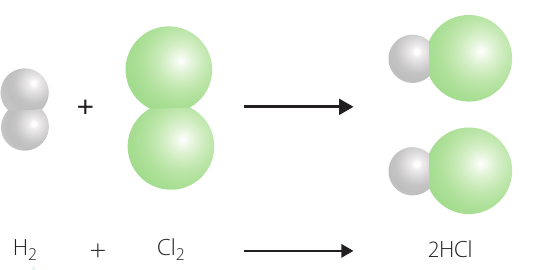
This diagram shows the molecular representation of the reaction, illustrating how one molecule of hydrogen () combines with one molecule of chlorine () to produce two molecules of hydrogen chloride ().
Worked example: Balancing a decomposition reaction
Let's work through a more complex example: the decomposition of copper nitrate to form copper oxide, nitrogen dioxide, and oxygen gas.
Example
Worked Example: Balancing a Decomposition Reaction
| Step | Equation | Explanation |
|---|---|---|
| Write word equation | copper nitrate → copper oxide + nitrogen dioxide + oxygen | Identify all reactants and products |
| Convert to formulae | Write correct chemical formulae. Remember copper typically has a valence of | |
| Start balancing | Begin with atoms that appear in only one place on each side. Copper is already balanced (one on each side). For nitrogen: we have atoms on the left, so we need on the right by placing before | |
| Balance oxygen | Count oxygen atoms: Left side has O, right side has O. We need even numbers, so place before , which requires before and before . Now: Left = O atoms; Right = O atoms ✓ | |
| Add state symbols | Complete the equation with physical states |
This balanced equation tells us that two formula units of solid copper nitrate decompose to produce two formula units of solid copper oxide, four molecules of nitrogen dioxide gas, and one molecule of oxygen gas.
Step-by-step guide to writing chemical equations
To write a complete, balanced chemical equation, follow these systematic steps:
- Write a word equation that includes all reactants and all products
- Write the formulae for all substances involved (this creates an unbalanced equation)
- Balance the equation by placing coefficients in front of symbols or formulae:
- Start with atoms that occur in only one place on each side of the equation
- Save elements that appear in multiple compounds for later
- Check your work by counting atoms of each element on both sides
- Add state symbols: , , ,
Note
Exam tip: As you gain more experience, you may be able to skip the word equation step and go straight to writing formulae. However, when learning, it's best to follow all steps carefully to avoid mistakes.
Remember!
Summary
Key Points to Remember:
- The law of conservation of mass states that matter cannot be created or destroyed during a chemical reaction, only changed from one form to another
- In every chemical reaction, the total mass of products equals the total mass of reactants
- The number of atoms of each element is conserved during a chemical reaction - atoms are rearranged but not created or destroyed
- A balanced chemical equation must have equal numbers of atoms of each element on both sides of the arrow
- Chemical equations should include state symbols , , , or to show the physical state of each substance
- When balancing equations, start with atoms that appear in only one place on each side, then work through the more complex atoms