Relative Mass: Atomic, Molecular, and Formula (HSC SSCE Chemistry): Revision Notes
📚Revision Notes
Relative Mass: Atomic, Molecular, and Formula
Introduction
In chemistry, we need to compare the masses of different atoms and molecules. Since atoms are extremely small (about 1-2 billion atoms fit along a 30 cm ruler edge), measuring their actual masses is very difficult.
Note
The mass of a single hydrogen atom is approximately grams - far too small to measure practically in laboratory settings!
Instead, chemists developed a system of relative masses - comparing the mass of one atom to a standard reference atom.
This system allows us to perform important calculations, such as:
- Determining how much of each reactant to use in a chemical reaction
- Calculating how much product a reaction will make
- Working out the composition of compounds
Relative atomic mass
Understanding the concept
Relative atomic mass (also called atomic weight) compares the mass of an atom to the mass of a carbon-12 atom, which is taken as exactly 12. This doesn't mean carbon-12 has a mass of 12 grams or 12 of any unit - it's simply assigned the number 12 as our reference point.
To understand this better, imagine comparing the masses of different atoms to carbon:
- A titanium atom is four times as heavy as a carbon atom, so titanium's relative atomic mass is
- Three helium atoms together equal one carbon atom in mass, so helium's relative atomic mass is
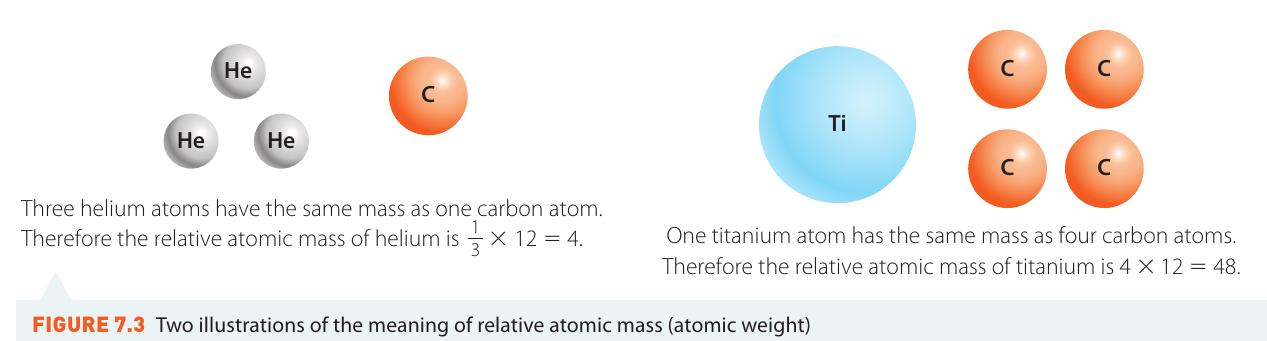
This visual representation shows how we compare atomic masses using carbon-12 as our standard.
Note
Why carbon-12? Carbon is abundant, stable, and forms many compounds, making it an ideal reference standard. The choice of 12 as its reference value keeps atomic masses close to whole numbers for most elements.
Table of common atomic masses
Here are the relative atomic masses of some commonly encountered elements:
| Element | Symbol | Atomic Mass | Element | Symbol | Atomic Mass |
|---|---|---|---|---|---|
| Aluminium | Al | 26.98 | Lead | Pb | 207.2 |
| Argon | Ar | 39.95 | Magnesium | Mg | 24.31 |
| Calcium | Ca | 40.08 | Mercury | Hg | 200.6 |
| Carbon | C | 12.01 | Nitrogen | N | 14.01 |
| Chlorine | Cl | 35.45 | Oxygen | O | 16.00 |
| Copper | Cu | 63.55 | Phosphorus | P | 31.97 |
| Fluorine | F | 19.00 | Potassium | K | 39.10 |
| Gold | Au | 197.0 | Silver | Ag | 107.9 |
| Helium | He | 4.003 | Sodium | Na | 23.99 |
| Hydrogen | H | 1.008 | Sulphur | S | 32.07 |
| Iodine | I | 126.9 | Uranium | U | 238.0 |
| Iron | Fe | 55.85 | Zinc | Zn | 65.38 |
Note
Exam tip: For NSW HSC examinations, always use the atomic masses from the periodic table provided, which gives values to four significant figures.
The isotope complication
Many elements exist as isotopes - atoms with the same number of protons but different numbers of neutrons. This means atoms of the same element can have different masses. For example, chlorine has two main isotopes: chlorine-35 and chlorine-37.
Important
Because of isotopes, we cannot simply use the mass number of one isotope as the relative atomic mass. We must calculate a weighted average based on how much of each isotope exists in nature.
Because of isotopes, we need to refine our definition:
The relative atomic mass of an element is the average mass of the atoms present in the naturally occurring element, relative to the mass of a carbon-12 atom taken as exactly 12.
To calculate this average, we use the relative abundance (percentage) of each isotope. The formula is:
Worked example: Chlorine isotopes
Example
Worked Example: Calculating the relative atomic mass of chlorine
Chlorine has two isotopes:
- Chlorine-35: 75% abundance
- Chlorine-37: 25% abundance
Calculate the relative atomic mass of chlorine.
Solution:
Consider 100 atoms of naturally occurring chlorine. Of these, 75 have a mass of 35 and 25 have a mass of 37.
Therefore, the relative atomic mass of chlorine is 35.5.
Why this makes sense: The answer (35.5) is closer to 35 than to 37 because there's more chlorine-35 (75%) than chlorine-37 (25%) in nature.
Note
Key point: The relative atomic mass is NOT the actual mass of an atom. It's a pure number with no units - just a comparison to carbon-12.
Relative molecular mass
Definition and calculation
For compounds made of molecules (covalent compounds), we use relative molecular mass (also called molecular weight). This is the mass of one molecule of the compound compared to a carbon-12 atom.
The calculation rule is simple:
The relative molecular mass equals the sum of the relative atomic masses of all atoms in the molecular formula.
Mathematically:
where represents relative molecular mass and represents relative atomic mass.
Simple examples
Let's calculate the relative molecular mass of some common compounds:
Water ():
- 2 hydrogen atoms:
- 1 oxygen atom:
- Total: 18.02
Nitrogen dioxide ():
- 1 nitrogen atom:
- 2 oxygen atoms:
- Total: 46.01
Sulphuric acid ():
- 2 hydrogen atoms:
- 1 sulphur atom:
- 4 oxygen atoms:
- Total: 98.09
Worked example: Sucrose
Example
Worked Example: Calculating the relative molecular mass of sucrose
Calculate the relative molecular mass of table sugar (sucrose), which has the formula .
Solution:
Using for relative molecular mass and for relative atomic mass:
Substituting the values:
The relative molecular mass of sucrose is 342.3.
Remember: Count all atoms carefully. In , there are 12 carbon atoms, 22 hydrogen atoms, and 11 oxygen atoms.
Relative formula mass
When to use formula mass
Many compounds, especially ionic compounds, don't exist as separate molecules. Instead, they form crystal lattices - orderly arrangements of ions bound together.
For example, sodium chloride () doesn't have individual molecules.
Important
Key distinction:
- Molecular mass is used for covalent compounds that exist as discrete molecules
- Formula mass is used for ionic compounds that exist as extended lattice structures
For these compounds, we use relative formula mass instead of molecular mass.
Examples of formula mass
Sodium chloride ():
- 1 sodium atom:
- 1 chlorine atom:
- Total: 58.44
Calcium fluoride ():
- 1 calcium atom:
- 2 fluorine atoms:
- Total: 78.08
Worked example: Calcium phosphate
Example
Worked Example: Calculating the relative formula mass of calcium phosphate
Calculate the relative formula mass of calcium phosphate, .
Solution:
- 3 calcium atoms:
- 2 phosphorus atoms:
- 8 oxygen atoms:
Rounding appropriately:
Remember!
Summary
Key Points to Remember:
-
Carbon-12 is the standard reference
-
Relative atomic mass accounts for isotopes
-
These are pure numbers with no units
-
Molecular mass = sum of atomic masses
-
Use molecular mass for covalent compounds and formula mass for ionic compounds