Boyle's Law and Charles's Law (HSC SSCE Chemistry): Revision Notes
📚Revision Notes
Boyle's Law and Charles's Law
Introduction
When studying gases, we need to understand how they behave when conditions like temperature and pressure change. This is where the gas laws become essential. In this note, we'll explore two fundamental gas laws: Boyle's Law and Charles's Law. These laws help us predict and calculate how gas volumes respond to changes in pressure and temperature.
Note
Understanding gas laws is crucial for many real-world applications, from predicting weather patterns to designing engines and understanding respiratory physiology. These fundamental principles form the foundation of thermodynamics and physical chemistry.
Understanding Boyle's law
What is Boyle's law?
Boyle's Law describes the relationship between the pressure and volume of a gas when temperature remains constant. Robert Boyle discovered in that when you compress a gas (increase its pressure), its volume decreases proportionally, and vice versa.
The key principle is this: for a fixed amount of gas at constant temperature, the product of pressure and volume always equals the same constant value.
Mathematical expression
Boyle's Law can be written as:
where:
- = pressure of the gas
- = volume of the gas
- = a constant value
This means that pressure and volume are inversely proportional. If you double the pressure, the volume halves. If you reduce the pressure to one-fifth of its original value, the volume increases five times.
Note
The inverse relationship means that as one variable increases, the other decreases by the same factor. This is different from a direct relationship where both variables change in the same direction.
Practical form of Boyle's law
A more useful form of this equation for calculations is:
where:
- and = initial pressure and volume
- and = final pressure and volume
Both products equal the same constant . You can use any units for pressure and volume, as long as you use the same units on both sides of the equation.
Investigating Boyle's law
The relationship between pressure and volume can be investigated experimentally using a simple apparatus. A sealed syringe containing air is clamped vertically, and weights (such as paving bricks or heavy books) are placed on top. The additional weight increases the pressure on the gas inside.
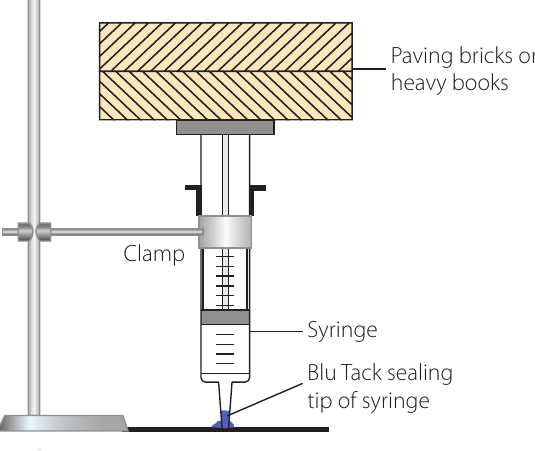
As you add more weight, the gas volume decreases. By recording different weights and corresponding volumes, you can verify that remains approximately constant.
Note
In practice, the product might not be perfectly constant due to experimental limitations such as temperature fluctuations, gas leaks, or measurement errors. However, the trend will clearly demonstrate the inverse relationship.
Example
Worked Example: Boyle's Law Calculation
Problem: A sample of gas originally had a volume of L at and kPa pressure. What volume would it have at kPa pressure?
Solution:
Using :
Given:
- kPa
- L
- kPa
Substituting values:
Answer: The volume decreases from L to L when pressure increases from kPa to kPa, demonstrating the inverse relationship.
Important
Exam Tip for Boyle's Law
Always check your answer makes physical sense. If pressure increases, volume should decrease (and vice versa). Include units in your calculations to ensure they cancel correctly.
Understanding Charles's law
What is Charles's law?
Charles's Law describes how the volume of a gas changes with temperature when pressure remains constant. French physicist Jacques Charles discovered in that gas volume increases linearly with temperature.
The absolute temperature scale
Before we can properly express Charles's Law, we need to understand the absolute temperature scale (also called the Kelvin scale). When scientists plotted volume versus temperature for different gases and extrapolated their data, they found that all lines intersected the temperature axis at (more precisely ).
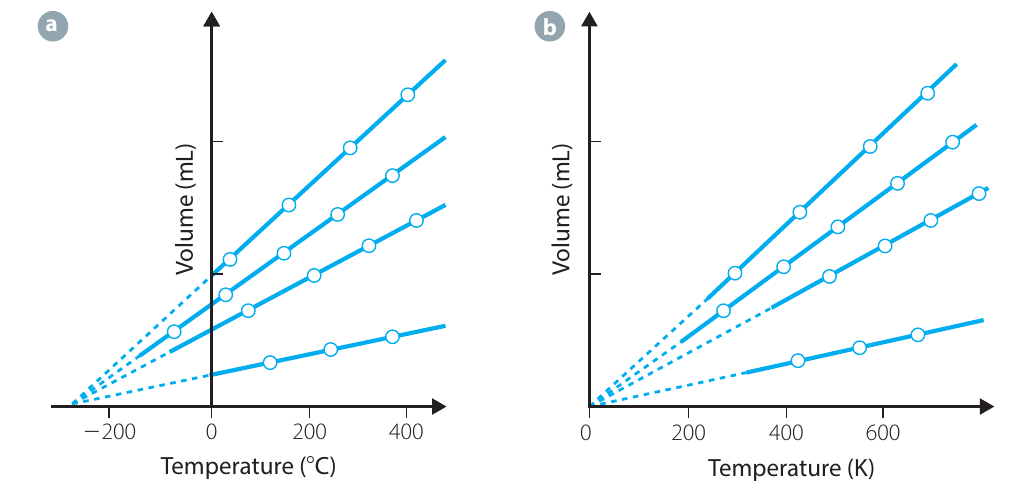
This led to the development of the Kelvin scale, where:
- K = (absolute zero)
- K =
- K =
The conversion formula is:
Note
One major advantage of the Kelvin scale is that all physically accessible temperatures have positive values. You cannot have a temperature below K - it's the absolute zero of temperature, the point at which all molecular motion theoretically ceases.
Mathematical expression
When we replot volume versus temperature using the Kelvin scale instead of Celsius, all the lines pass through the origin. This gives us Charles's Law:
where:
- = volume of the gas
- = absolute temperature (in kelvin)
- = a constant value
This tells us that at constant pressure, the volume of a fixed quantity of gas is directly proportional to its absolute temperature.
Note
The direct proportionality means that if you double the absolute temperature, you double the volume. This linear relationship only works when using the Kelvin scale - it would not work with Celsius or Fahrenheit!
Practical form of Charles's law
A more useful form for calculations is:
where:
- and = initial volume and temperature
- and = final volume and temperature
Each quotient equals the same constant . You can use any units for volume (as long as they're consistent), but temperature must always be in kelvin.
Important
Critical Reminder: Temperature MUST be in kelvin for Charles's Law calculations. Using Celsius will give completely incorrect results because Charles's Law depends on the direct proportionality that only exists when using absolute temperature.
Investigating Charles's law
You can investigate this relationship by sealing air in a syringe with a thermometer attached, then exposing it to different temperatures (ice bath, room temperature, hot water at various temperatures, boiling water). As temperature increases, the gas volume increases proportionally.
| Experimental condition | Temperature (°C) | Volume (mL) |
|---|---|---|
| Ice bath | ||
| Room temperature | ||
| Hot water A | ||
| Hot water B | ||
| Boiling water |
Example
Worked Example: Charles's Law Calculation
Problem: A sample of gas at kPa pressure had a volume of L at . What would its volume be at at the same pressure?
Solution:
Using :
First, convert temperatures to kelvin:
- K
- K
- L
Substituting values:
Answer: The volume decreases from L to L when temperature decreases from K to K.
Important
Exam Tip for Charles's Law
Always convert Celsius temperatures to kelvin before using Charles's Law equations. Forgetting this step is the most common mistake that will give you incorrect answers. Make this your first step in every Charles's Law problem!
The combined gas law
Combining Boyle's and Charles's laws
When both pressure and temperature change simultaneously, we need to combine both laws. This gives us the combined gas law:
where is a constant for a fixed quantity of gas.
Note
The combined gas law is essentially a merger of Boyle's Law and Charles's Law. It accounts for situations where we can't hold either temperature or pressure constant, which is common in real-world applications.
Practical form
The most useful form for calculations is:
This equation works because both sides equal the same constant . Pressure and volume can use any units (as long as they're consistent), but temperature must be in kelvin.
Example
Worked Example: Combined Gas Law Calculation
Problem: A certain quantity of gas had a volume of L at kPa and . What pressure is needed to compress it to mL at ?
Solution:
Using :
Given:
- kPa
- L
- mL = L (convert to same units)
- K
- K
Substituting values:
Answer: The pressure must increase to kPa to achieve the desired compression at the lower temperature.
Important
Exam Tip for Combined Gas Law
Substitute units along with numbers into the equation. This helps you verify that units cancel correctly to give the answer in the correct units. Also, always check that your answer makes physical sense based on the changes in conditions.
Practice problems
Here are some problems to test your understanding:
Boyle's law problems
| a | kPa | mL | kPa | ? |
| b | kPa | L | ? | L |
| c | kPa | mL | Pa | ? |
| d | Pa | L | ? | mL |
Charles's law problems
| TEMP | TEMP | |||
|---|---|---|---|---|
| a | mL | K | ? | K |
| b | L | K | mL | ? |
| c | mL | ? | ||
| d | mL | L | ? |
Note
When working through these problems, remember to:
- Check if temperatures need conversion to kelvin
- Ensure all units are consistent on both sides of the equation
- Verify your answer makes physical sense given the changes in conditions
Connection to Avogadro's law
While not the main focus of this note, it's worth mentioning that Avogadro's Law relates volume to the amount of gas (in moles). At constant temperature and pressure:
where is the number of moles of gas. This means that if you double the amount of gas, you double the volume (at constant temperature and pressure).
Note
Together, Boyle's Law, Charles's Law, and Avogadro's Law can be combined to form the Ideal Gas Law: , where is the universal gas constant. This powerful equation relates all the gas variables in one expression.
Key experimental apparatus
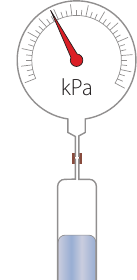
When testing Boyle's Law, scientists use apparatus such as a syringe connected to a pressure gauge. This allows simultaneous measurement of pressure and volume as the syringe plunger is adjusted.
Note
Modern digital sensors can provide more accurate measurements than traditional apparatus, allowing for better verification of the gas laws. Computer data-logging systems can record hundreds of data points to show the precise relationship between variables.
Remember!
Summary
Key Points to Remember:
-
Boyle's Law (): For a fixed amount of gas at constant temperature, pressure and volume are inversely proportional. Doubling pressure halves volume.
-
Charles's Law (): For a fixed amount of gas at constant pressure, volume is directly proportional to absolute temperature. Always use Kelvin for temperature calculations.
-
Temperature conversion: . Absolute zero is K = .
-
Combined Gas Law (): Use this when both pressure and temperature change. Temperature must be in kelvin.
-
Units: Pressure and volume can use any consistent units, but temperature must always be in kelvin for gas law calculations.
-
Check your work: Always verify that your answer makes physical sense based on the relationships described by each law.