Calculations Involving Volumes of Gases (HSC SSCE Chemistry): Revision Notes
📚Revision Notes
Calculations Involving Volumes of Gases
Introduction
When working with gases in chemical calculations, you need to convert between volume, number of moles, and mass. The key difference from other stoichiometry calculations is that you must use molar volume to convert between gas volumes and moles. The molar volume depends on the temperature and pressure conditions specified in the problem.
Note
Molar volume is the volume occupied by one mole of any gas at specific temperature and pressure conditions. Unlike molar mass (which varies for different substances), all gases have the same molar volume at the same conditions. This makes gas calculations uniquely straightforward once you know the conditions.
Converting between volume, moles and mass
Gas calculations follow a systematic pathway that connects three key quantities: volume, number of moles, and mass. Understanding how to move between these quantities is essential for solving gas problems.

The diagram above shows the bidirectional conversions you'll need:
- Volume to moles: Divide the volume by the molar volume
- Moles to volume: Multiply the number of moles by the molar volume
- Moles to mass: Multiply the number of moles by the molar mass
- Mass to moles: Divide the mass by the molar mass
Important
Memory Aid: "Divide to arrive, multiply to fly"
When converting TO moles (arriving at moles), you divide by molar volume or molar mass. When converting FROM moles (flying away from moles), you multiply by molar volume or molar mass.
Key molar volumes to remember
At standard conditions, gases have specific molar volumes that you must use in your calculations:
| Temperature | Pressure | Molar Volume |
|---|---|---|
Note
Exam tip: Always check which temperature and pressure conditions are given in the question, then use the corresponding molar volume. A common mistake is using the wrong molar volume for the given conditions.
Worked examples: Basic gas volume calculations
Let's work through two examples that demonstrate the fundamental conversions between volume, moles, and mass.
Example
Worked Example 1: Converting Volume to Mass
Question: What mass of gas is present in a flask containing carbon dioxide at and at a pressure of ?
Solution:
First, we need to calculate the number of moles of present. Since we're given conditions of and , we use a molar volume of .
Converting the volume to litres:
Next, we calculate the molar mass of carbon dioxide:
Finally, we convert moles to mass:
Key learning point: When given volume, first convert to moles using molar volume, then convert moles to mass using molar mass.
Example
Worked Example 2: Converting Mass to Volume
Question: What volume is needed to store ethane, , at and ?
Solution:
First, we need to calculate the molar mass of ethane:
Now we convert the mass to moles:
Since we're at and , we use a molar volume of :
Key learning point: When given mass, first convert to moles using molar mass, then convert moles to volume using the appropriate molar volume for the stated conditions.
Calculations involving chemical reactions
When a chemical reaction is involved, you need an additional step in your calculations. After converting your starting quantity to moles, you must use the balanced chemical equation to determine the moles of the substance you're interested in. This is similar to mass-mass stoichiometry calculations, but now you're working with gas volumes.
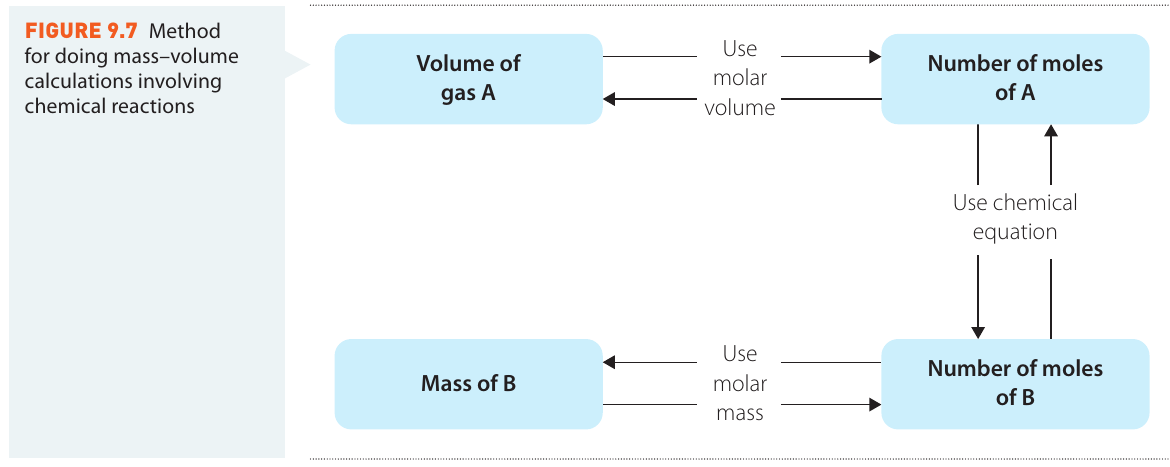
The flowchart above shows the complete pathway for calculations involving both gases and chemical reactions. Notice that the balanced chemical equation sits at the heart of the conversion, linking the moles of substance A to the moles of substance B.
Important
The Stoichiometry Step
The key difference between basic gas conversions and reaction-based calculations is the stoichiometry step. You must use the mole ratio from the balanced equation to convert between moles of different substances. This step comes after converting your starting material to moles but before converting to your final answer.
Worked examples: Gas calculations with chemical reactions
Let's examine two more complex examples that involve chemical reactions.
Example
Worked Example 3: Mass to Volume via Reaction
Question: Calculate the volume of carbon dioxide produced at and when sodium carbonate, , reacts with excess hydrochloric acid.
The balanced equation is:
Solution:
We start by working backwards through the flowchart - converting mass of sodium carbonate to moles.
Calculate the molar mass of sodium carbonate:
Convert the given mass to moles:
Now we use the balanced equation. Looking at the stoichiometry, we can see that mole of produces mole of :
Finally, we convert moles of to volume using the molar volume at ():
Key learning point: Follow the pathway systematically: mass → moles (using molar mass) → moles of product (using equation) → volume (using molar volume).
Example
Worked Example 4: Volume to Mass via Reaction
Question: Lithium hydroxide has been commonly used in spacecraft to absorb carbon dioxide from the air. The reaction is:
Calculate the mass of lithium hydroxide needed to absorb carbon dioxide at and pressure.
Solution:
First, we convert the volume of to moles using the molar volume at ():
Next, we use the balanced equation to find the moles of required. The stoichiometry shows that moles of react with mole of :
Now we calculate the molar mass of lithium hydroxide:
Finally, we convert moles to mass:
Key learning point: The stoichiometric ratio from the balanced equation is crucial. Here, we needed twice as many moles of as , so we multiplied by .
Essential formulas summary
Here are the key relationships you need for gas volume calculations:
Converting volume to moles:
where:
- = number of moles (mol)
- = volume of gas (L)
- = molar volume at specified conditions (L/mol)
Converting moles to mass:
where:
- = mass (g)
- = number of moles (mol)
- = molar mass (g/mol)
Note
For reactions: Use the mole ratio from the balanced equation to convert between moles of different substances. This is the bridge that connects your starting material to your product.
Summary
Key Points to Remember:
- Molar volume is temperature dependent: Use at and at (both at )
- Follow a systematic pathway: Convert between volume, moles, and mass in logical steps rather than trying to do everything at once
- The balanced equation is essential: When reactions are involved, you must use the stoichiometric ratios from the balanced equation to relate moles of different substances
- Check your units: Always convert volumes to litres before using molar volume, and ensure your final answer has appropriate units
- Division vs multiplication: Divide by molar volume or molar mass when converting TO moles; multiply when converting FROM moles