Solutions (HSC SSCE Chemistry): Revision Notes
📚Revision Notes
Nature, Concentration, and Volume of Solutions
Chemistry happens in solutions everywhere around us. The chemical reactions in our bodies, in plants and animals, and throughout our environment mostly occur in solutions. Many household products we use daily are solutions, and industrial chemistry relies heavily on solutions for manufacturing processes like producing caustic soda, extracting sugar, and purifying copper.
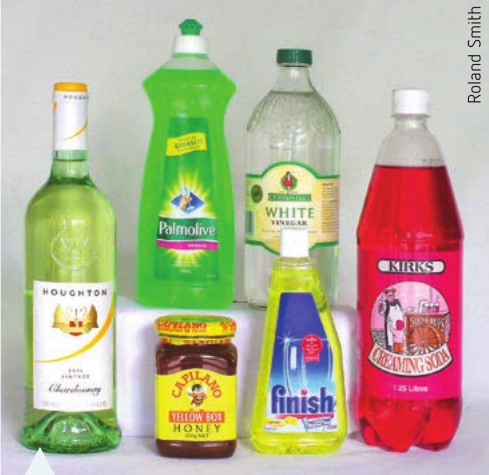
Understanding solutions means being able to measure quantities of substances in terms of volumes rather than just masses. This allows chemists to work with liquids more practically in laboratories and industry.
Nature of solutions
What is a solution?
A solution is a homogeneous mixture where one substance (the solute) dissolves completely in another substance (the solvent).
Note
Key Components of a Solution:
- Solvent: The substance that does the dissolving (usually present in larger amount)
- Solute: The substance that gets dissolved (usually present in smaller amount)
- Aqueous solution: A solution where water is the solvent
Solutions appear uniform throughout because the solute particles are evenly distributed at the molecular or ionic level. This uniformity distinguishes solutions from suspensions, where particles are larger and will eventually settle out.
How molecular substances dissolve
When molecular substances like sugar (sucrose) or urea dissolve in water, an interesting process occurs:
- The solid crystal structure breaks apart
- Individual molecules separate from each other
- These molecules spread uniformly throughout the water
- The molecules remain dispersed and don't clump back together
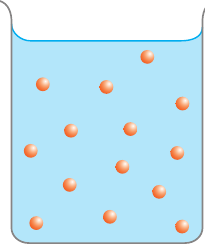
This happens because the interactions between solute molecules and water molecules are stronger than the forces holding the solute molecules together in the crystal. For example, when you dissolve sugar in tea, the sugar molecules don't just float around as tiny crystals - they completely separate into individual molecules that mix uniformly with the water molecules.
Similarly, when iodine dissolves in hexane, the iodine molecules disperse as individual molecules throughout the hexane solvent. Because the particles are so small (molecular level), they don't settle out. Solutions remain stable indefinitely unless you evaporate the solvent or cool the solution significantly.
How ionic substances dissolve
Ionic substances dissolve differently from molecular substances. When ionic compounds like sodium chloride (NaCl), baking soda (NaHCO₃), or Epsom salts (MgSO₄) dissolve in water:
- The ionic crystal structure breaks apart
- The compound separates into individual positive and negative ions
- These ions move freely and independently through the water
- The ions remain separated and don't recombine
For example, when sodium chloride dissolves in water, you get sodium ions () and chloride ions () moving independently throughout the solution. The ions don't exist as paired NaCl units anymore - they're completely separate.
Note
This dissolution occurs because the attractions between the ions and water molecules are stronger than the attractions between oppositely charged ions in the solid crystal.
Important
Key difference from suspensions: Solutions don't settle out because the particles (molecules or ions) are so small and evenly distributed. Suspensions contain larger particles that will eventually settle if left undisturbed.
Different measures of concentration
Understanding concentration
Concentration tells us how much solute is present in a specific amount of solvent or solution. Think of it like the strength of cordial - more cordial in the same amount of water means higher concentration (stronger taste).
There are many ways to express concentration, each useful for different situations. We can group them into volume-based and mass-based measures.
Volume-based concentration measures
These measures express concentration using volumes, which is practical for making solutions in the laboratory:
- Mass per volume:
- or of solution
- Example: means of solute in every of solution
- Volume per volume (for liquid solutes):
- or of solution
- Example: means of liquid solute in every of solution
- Percent weight per volume ():
- Mass of solute per of solution
- Example: means of solute in of solution
- Convenient for solid solutes like sodium chloride
- Percent volume per volume ():
- Volume of solute per of solution
- Example: means of solute in of solution
- Convenient for liquid solutes like ethanol
Mass-based concentration measures
These measures express concentration using masses:
- Percent by weight ():
- Mass of solute per of solution
- Example: means of solute in of solution
- When "%" is used alone, it usually means
- Parts per million (ppm):
- Grams of solute per million grams of solution
- For gases, it means molecules per million molecules
- Example: means of solute in (or ) of solution
- Useful for very dilute solutions
Dilute versus concentrated solutions
We use descriptive terms to indicate the general concentration level:
- Dilute solution: Contains relatively low concentration of solute
- Typically less than or less than
- Example: Weak cordial, dilute acid solutions
- Concentrated solution: Contains relatively high concentration of solute
- Typically greater than
- Example: Strong cordial, concentrated acid solutions
- Moderately dilute/concentrated: Used for intermediate concentrations
Why use different concentration measures?
Each concentration measure has practical advantages for specific situations:
Note
Commerce and industry: Mass per unit volume ( or ) works well because:
- The main concern is how much solute is present
- To obtain a desired mass of solute, you simply measure the necessary volume of solution
- Measuring volumes is usually easier and faster than measuring masses
Liquid solutes: Volume per unit volume () is preferred because:
- We naturally think of liquids in terms of volume rather than mass
- It's more intuitive (e.g., alcohol content in wine)
Environmental contexts: Parts per million (ppm) is most useful because:
- Environmental concentrations are usually very low
- Using or would give very small, awkward numbers
- For example, 1.5 ppm is more convenient than 0.000 15% or 0.0015 g L⁻¹
Worked examples with concentration calculations
Example
Worked Example 1: Converting concentration units for potassium permanganate
Question: of potassium permanganate () was dissolved in water and made up to exactly . Calculate the concentration in:
- (i) of solution
- (ii) of solution
Solution:
We have of in of solution.
For part (i):
For part (ii):
Example
Worked Example 2: Calculating percentage by weight for copper sulfate
Question: copper sulfate was dissolved in water. Calculate the of copper sulfate in this solution.
Solution:
means mass of solute per of solution.
First, calculate total mass of solution:
Then calculate the percentage:
Example
Worked Example 3: Making a saline solution
Question: What mass of sodium chloride must be dissolved in water to make a solution (common hospital saline)? Assume the solution volume remains .
Solution:
A solution contains NaCl in of solution.
Using proportion:
Example
Worked Example 4: Alcohol content in wine
Question: What volume of alcohol (ethanol) is present in of a solution (typical red wine)?
Solution:
means of alcohol in of solution.
Using proportion:
To 2 significant figures:
Example
Worked Example 5: Converting ppm to percentage
Question: A solution contains mercury(II) ion. Express this as .
Solution:
means mercury(II) ion per million grams () of solution.
means grams per solution.
Using proportion:
Therefore:
Measuring volumes of solutions
Laboratory glassware for volume measurement
Different types of laboratory equipment provide different levels of accuracy. Choosing the right equipment depends on how precise your measurement needs to be.
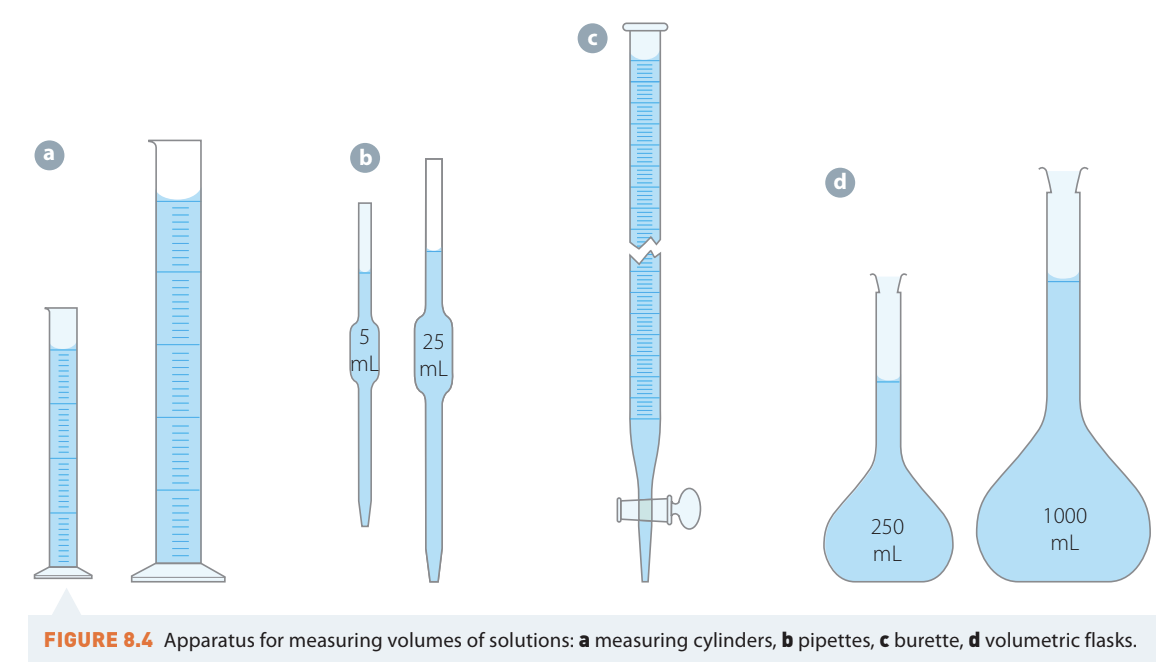
Measuring cylinders:
- Used for approximate volume measurements
- Accuracy: ±5% (relatively low precision)
- Common sizes: , , ,
- Best for: Quick measurements where exact volume isn't critical
Pipettes:
- Deliver fixed, accurate volumes
- Accuracy: ±0.2% to ±0.5% (high precision)
- Common sizes: , , (also , , available)
- Best for: Transferring precise volumes from one container to another
Burettes:
- Deliver variable accurate volumes
- Accuracy: ±0.2% to ±0.5% (high precision)
- Typical range: to
- Best for: Adding precise volumes gradually, especially in titrations
Volumetric flasks:
- Contain fixed, accurate volumes when filled to the mark
- Accuracy: ±0.2% to ±0.5% (high precision)
- Common sizes: , , , (also and available)
- Best for: Making solutions of known concentration
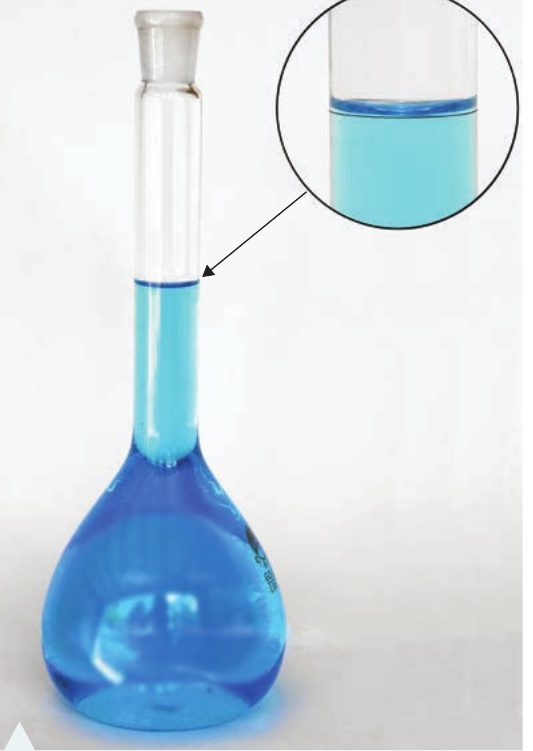
Reading the meniscus
The meniscus is the curved surface of a liquid in a container. When reading volumes in glassware, always read from the bottom of the meniscus at eye level.
Note
Correct technique:
- Position your eye level with the graduation mark
- Look at where the bottom of the meniscus sits
- The meniscus should touch the graduation line exactly
- Read the volume at this point
This technique ensures accurate and consistent measurements.
Making accurate solutions
To prepare an aqueous solution with accurately known concentration (better than ):
Step 1: Measure the required amount of solute
- For solid solutes: Use a sensitive balance to weigh accurately
- For liquid solutes: Use a pipette to measure volume accurately
Step 2: Transfer to volumetric flask
- Add the solute to an appropriately sized volumetric flask
- Ensure all solute is transferred (rinse any container used)
Step 3: Dissolve in water
- Add water to the flask (about half full)
- Swirl to dissolve the solute completely
- Let the solution cool if needed (dissolution can generate heat)
Step 4: Fill to the mark
- Carefully add more water until the meniscus bottom sits on the graduation mark
- Use a wash bottle for final drops to control addition
- Mix thoroughly by inverting the flask several times
Important
This method gives you concentration in mass or volume per unit volume of solution.
Alternative method (for concentration per unit volume of solvent):
- Measure solvent using volumetric flask or pipette
- Mix solute and solvent in a beaker
- Less common because it's less convenient
Accuracy and significant figures
The type of glassware you use indicates the accuracy of your measurement:
- Using a pipette: Volume like implies (3 significant figures)
- Using a burette: Volume like implies (3 significant figures)
- Using a volumetric flask: Volume like implies (4 significant figures)
- Using a measuring cylinder: Volume like might only be (2 significant figures)
Note
Exam tip: When you state that volumetric glassware (pipette, burette, or volumetric flask) was used, this automatically tells the reader that the volume is accurate to ±0.2-0.5%, even if you write the number with fewer digits.
Summary
Key Points to Remember:
-
Solutions are homogeneous mixtures where the solute is completely and evenly dispersed throughout the solvent at the molecular or ionic level. They don't settle out like suspensions.
-
Concentration can be expressed many ways including , , , , , and ppm. Choose the measure that best suits your situation.
-
Different concentration measures serve different purposes: mass per volume for industry, volume per volume for liquid solutes, and ppm for very dilute environmental samples.
-
Laboratory glassware has different accuracy levels: measuring cylinders () for approximate work; pipettes, burettes, and volumetric flasks () for accurate work.
-
Always read the meniscus from the bottom at eye level to ensure accurate volume measurements in all volumetric glassware.