Parts of a Galvanic Cell (HSC SSCE Chemistry): Revision Notes
📚Revision Notes
Parts of a Galvanic Cell
What is a galvanic cell?
A galvanic cell (also called a voltaic cell) is a device that converts chemical energy into electrical energy. This happens through a spontaneous redox reaction that produces an electric current. Familiar examples include car batteries, torch batteries, and calculator batteries.
Note
The key feature of a galvanic cell is that it generates electricity from a chemical reaction occurring in a controlled way, rather than all at once in a single container. This controlled release of energy is what makes galvanic cells useful for powering devices.
Essential components of a galvanic cell
Every galvanic cell contains three essential components that work together to produce electricity:
Electrodes
An electrode is a conductor that connects the external electrical circuit to the solution inside the galvanic cell. The term can mean two things:
- The metal strip itself (such as a copper strip or zinc strip)
- The combination of the metal and its associated ions in solution (such as the / electrode or the / electrode)
Important
When we refer to an electrode in the second sense, we call it a half cell. This is because each electrode represents half of the complete redox reaction occurring in the cell. Understanding this dual meaning of "electrode" is essential for discussing galvanic cells properly.
Electrolyte solutions
The solutions in galvanic cells are called electrolyte solutions. An electrolyte is any substance that conducts electricity when dissolved in water or melted. These solutions contain ions that can move freely, allowing electric current to flow through the liquid.
Note
The ability of ions to move freely through the solution is what allows electrical current to flow. Without this ion mobility, the galvanic cell could not function properly.
For example, in a typical galvanic cell, copper sulfate solution, zinc sulfate solution, and potassium nitrate solution all act as electrolytes because they contain mobile ions.
Salt bridge
A salt bridge is a device that provides electrical contact between the two electrode solutions without allowing them to mix completely. It can take different forms:
- A U-tube filled with an electrolyte solution
- A strip of filter paper soaked in an electrolyte solution
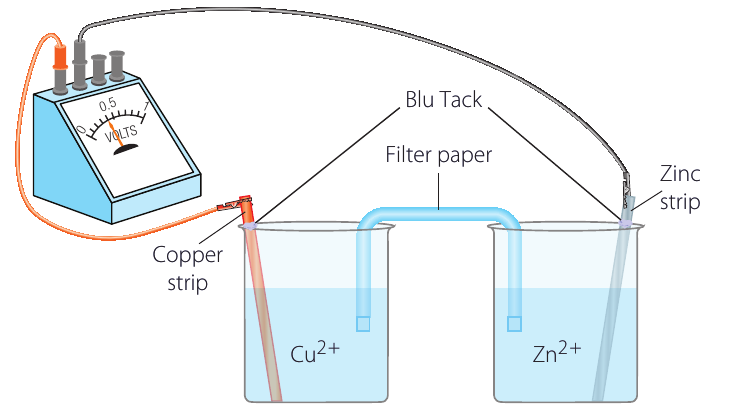
Important
The electrolyte used in the salt bridge must not react with the ions in either electrode solution. This is a critical requirement for proper cell operation.
Example
Common Salt Bridge Electrolytes:
Potassium nitrate () is commonly used because and ions don't form precipitates with most other ions.
Sodium chloride can also work, but not if silver ions are present (as would precipitate, blocking the salt bridge and stopping the cell from functioning).
Purpose of the salt bridge
The salt bridge plays a critical role in galvanic cell operation. Without it, the voltage drops to zero and no current flows. Here's why it's essential:
Important
The Charge Imbalance Problem:
When the electrode reactions occur, one solution would gain positive charge (from metal ions forming) while the other would gain negative charge (from positive ions being removed). This charge imbalance is impossible in real solutions - the reaction would quickly stop if charges accumulated.
The salt bridge solves this problem by allowing ions to migrate between the two solutions, maintaining electrical neutrality in both electrode compartments.
The salt bridge allows negative ions to move toward the electrode producing positive ions, and positive ions to move in the opposite direction, keeping both solutions electrically neutral.
Electrode processes
The chemical reactions occurring at each electrode are called electrode processes or electrode reactions. These are half-reactions that show either oxidation or reduction occurring at that electrode.
Example
Electrode Reactions in a Copper-Zinc Cell:
At the copper electrode:
At the zinc electrode (if zinc is being reduced):
Each of these is a half-reaction representing half of the complete redox process.
How a galvanic cell produces electricity
When a galvanic cell operates, four key processes occur simultaneously:
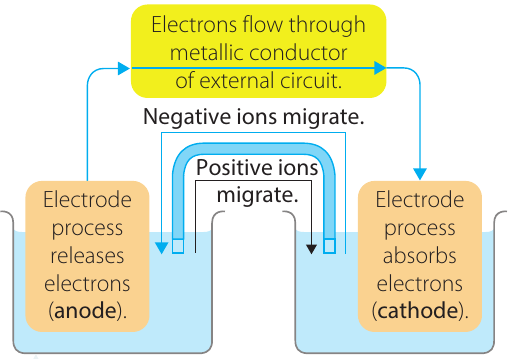
1. Electron release: One electrode reaction releases electrons. These electrons flow out of the metal electrode into the external circuit (such as the wire connecting to a voltmeter or light bulb).
2. Electron flow through external circuit: The electrons travel through the metallic conductor of the external circuit from one electrode to the other. This flow of electrons through the wire is what we call electric current in the circuit.
3. Electron absorption: The electrode reaction at the other electrode absorbs these electrons from the external circuit.
4. Ion migration: Ions migrate through the solutions and the connecting salt bridge to maintain electrical neutrality in both electrode compartments.
Understanding current flow
Important
Current Flow in Different Materials:
Electric current flows differently through different materials:
In metallic conductors (wires, electrodes): Current is a flow of electrons moving through the metal.
In conducting solutions: Current is the migration of ions. Negative ions move through the solution in one direction, while positive ions move in the opposite direction.
The connection between electron flow and ion movement happens at the electrode surface, where the electrode reactions occur.
Galvanic cell terminals
The negative terminal
The negative terminal of a galvanic cell is the electrode from which electrons flow out into the external circuit. Oxidation occurs at this electrode, providing the electrons that flow through the circuit. This is where a substance loses electrons.
The positive terminal
The positive terminal of a galvanic cell is the electrode that draws electrons back from the external circuit. Reduction occurs at this electrode, as the reaction here accepts the electrons. This is where a substance gains electrons.
The electron pump analogy
Note
The Electron Pump:
A galvanic cell works like an "electron pump." It pumps electrons out of the negative terminal, through the external circuit (powering devices along the way), and draws them back into the positive terminal. The cell can do this because a spontaneous redox reaction is occurring inside it, providing the energy to move the electrons.
Anode and cathode
Two important terms describe electrodes based on the type of reaction occurring:
Anode
The anode is the electrode at which oxidation occurs. In a galvanic cell, the anode is the negative terminal because it releases electrons through oxidation.
Memory aid: AN OX – ANode is where OXidation occurs.
Cathode
The cathode is the electrode at which reduction occurs. In a galvanic cell, the cathode is the positive terminal because it accepts electrons for reduction reactions.
Memory aid: RED CAT – REDuction occurs at the CAThode.
Important
Memory Aids for Electrode Types:
- AN OX – ANode is where OXidation occurs
- RED CAT – REDuction occurs at the CAThode
These memory aids are invaluable for remembering which reaction occurs at which electrode!
Summary
Electrode Summary:
| Electrode reaction | Name of electrode | Sign of electrode |
|---|---|---|
| Oxidation | Anode | Negative (−) |
| Reduction | Cathode | Positive (+) |
Summary
Key Points to Remember:
-
A galvanic cell converts chemical energy into electrical energy through a spontaneous redox reaction
-
The three essential components are:
- Electrodes (metal conductors/half cells)
- Electrolyte solutions (conducting ionic solutions)
- Salt bridge (allows ion migration between solutions)
-
The salt bridge maintains electrical neutrality by allowing ions to migrate between the two electrode solutions
-
The anode is where oxidation occurs (negative terminal), and the cathode is where reduction occurs (positive terminal)
-
A galvanic cell acts as an "electron pump," pushing electrons out of the negative terminal and drawing them back into the positive terminal through the external circuit