Types of Galvanic Cell (HSC SSCE Chemistry): Revision Notes
📚Revision Notes
Types of Galvanic Cell
Introduction to electrode types
There are many different ways to construct galvanic cells using various electrode configurations. Understanding these different types helps us predict how cells will behave and generate electricity. Galvanic cells typically use three main types of electrodes, which can be combined in pairs to create functioning cells.
Three main types of electrodes
Electrodes are the components that connect the external electrical circuit to the chemical reactions occurring in the galvanic cell. They can be constructed in three main ways:
Metal in metal ion solution
This type consists of a piece of metal dipping into a solution containing ions of that metal. The metal acts as both the conductor and the reactant.
Note
Metal in Metal Ion Electrodes
This is the simplest electrode type where a metal directly participates in the redox reaction. The metal surface provides a site for electron transfer while simultaneously being either oxidized or reduced.
Examples:
- A copper rod in copper sulfate solution ()
- A silver wire in silver nitrate solution ()
- A zinc strip in zinc sulfate solution ()
The metal can either lose electrons (oxidation) or gain electrons (reduction), depending on which other electrode it is paired with.
Inert conductor in mixed oxidation state solution
This configuration uses an inert conductor (such as platinum wire or a graphite rod) that doesn't react itself. The conductor simply provides a surface for electron transfer. It dips into a solution containing both oxidised and reduced forms of the same element.
Note
Inert Electrode Function
The inert conductor (typically platinum or graphite) doesn't participate chemically in the reaction. Instead, it serves as a passive electron pathway, allowing electrons to enter or leave the solution as ions change oxidation states.
Example:
- Platinum wire in a solution containing both and ions
The platinum doesn't participate in the reaction but allows electrons to flow in or out of the solution as iron ions change oxidation state.
Gas electrode
A gas electrode involves a gas bubbling over an inert conductor (platinum wire) that is immersed in a solution. The solution contains either the oxidised or reduced form of the gas.
Examples:
- Chlorine gas bubbling over platinum wire in chloride solution ()
- Hydrogen gas bubbling over platinum wire in acidic solution ()
The gas molecules can gain or lose electrons at the platinum surface, creating a functional electrode.
Creating galvanic cells by combining electrodes
Any two different electrodes can be combined to create a functioning galvanic cell. The key is ensuring the two electrodes have different tendencies to gain or lose electrons, creating a voltage difference between them.
Important
Critical Requirement for Galvanic Cells
The two electrodes must have different reduction potentials. This difference creates the driving force that causes electrons to flow through the external circuit, generating electrical current.
Worked example: Zinc and iron ion cell
Let's examine a galvanic cell that combines a zinc metal electrode with an iron ion electrode to understand how these cells function.
Example
Worked Example: Analysing a Zinc-Iron Galvanic Cell
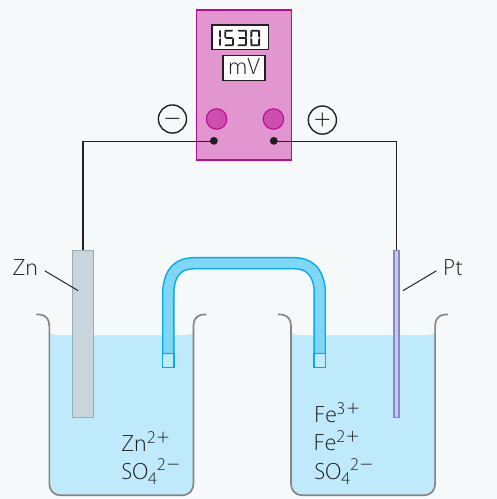
Cell setup
This cell combines:
- A zinc rod dipping into zinc sulfate solution (providing ions)
- A platinum wire dipping into a solution containing both and ions
- A salt bridge connecting the two solutions
- A voltmeter showing the platinum wire is positive
Electrode reactions
At the zinc electrode (negative terminal):
The zinc metal loses electrons (oxidation), releasing zinc ions into solution. This makes the zinc electrode negative.
At the platinum wire electrode (positive terminal):
Iron(III) ions gain electrons (reduction), converting to iron(II) ions. This makes the platinum electrode positive.
Overall cell reaction
To find the overall reaction, we balance the electrons in both half-reactions. The iron reaction must be doubled:
This shows that for every zinc atom oxidised, two iron(III) ions are reduced.
Direction of electron flow
Electrons flow from the zinc rod through the external circuit (wires and voltmeter) to the platinum wire. Electrons always flow from negative to positive in the external circuit, attracted to the positive electrode.
Direction of ion flow
Inside the cell, ions move through the salt bridge to maintain electrical neutrality:
- Negative ions (such as ) flow from the iron solution through the salt bridge toward the zinc solution
- Positive ions flow in the opposite direction
This ion movement is essential. At the zinc electrode, positive charge increases as ions form, so negative ions must flow in to balance this. At the iron electrode, positive charge decreases as ions are reduced, so negative ions must flow out.
Identifying anode and cathode
- The anode is the zinc electrode (where oxidation occurs)
- The cathode is the platinum electrode (where reduction occurs)
Memory aid: "An Ox" - the anode is where oxidation happens. "Red Cat" - reduction happens at the cathode.
Analysing galvanic cells
When studying any galvanic cell, we focus on three main aspects that help us understand how the cell operates and generates electricity:
Note
Three Key Aspects of Galvanic Cell Analysis
-
The electrode reactions and overall reaction - What chemical changes are occurring at each electrode and in the cell overall?
-
Which electrode is positive and which is negative - This determines the direction of electron flow and which reactions are occurring where.
-
The direction of electron and ion flow - Electrons flow through the external circuit; ions flow through the solution and salt bridge.
The external circuit refers to the electrical wiring, voltmeter, light bulb, motor, or any device the cell powers.
Galvanic cells without salt bridges
Not all galvanic cells require a salt bridge. Sometimes a single electrolyte solution can service both electrodes, making a salt bridge unnecessary.
Example
Worked Example: Copper-Chlorine Cell Without Salt Bridge
This cell demonstrates a configuration without a salt bridge.
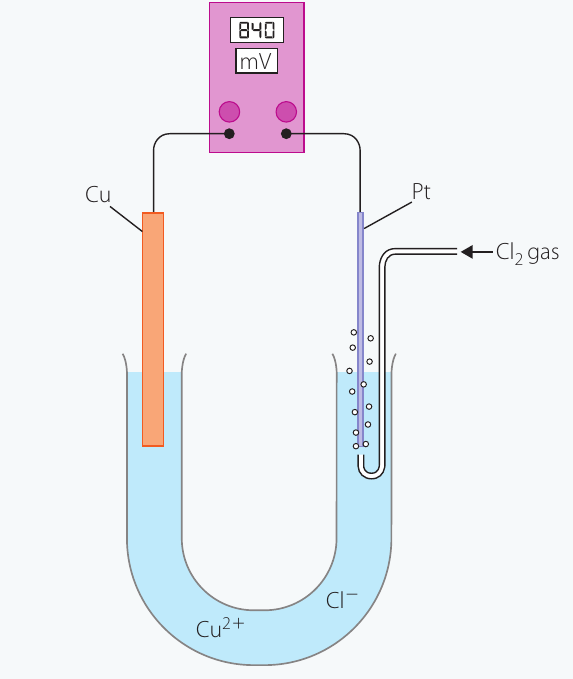
Cell setup
This cell uses a U-tube design containing copper chloride solution:
- A copper rod dips into the left arm (creating a electrode)
- Chlorine gas bubbles over a platinum wire in the right arm (creating a electrode)
- The platinum wire is positive
- One solution serves both electrodes
Electrode reactions
At the chlorine electrode (positive terminal):
Chlorine molecules gain electrons (reduction), forming chloride ions. This consumption of electrons makes the platinum wire positive.
At the copper electrode (negative terminal):
Copper metal loses electrons (oxidation), releasing copper ions into solution. This release of electrons makes the copper electrode negative.
Overall cell reaction
Adding the balanced half-reactions gives:
Direction of electron and ion flow
Electrons flow from the copper rod through the external circuit to the platinum wire.
Ions move through the solution to maintain electrical neutrality:
- Negative ions (chloride) flow from the chlorine electrode toward the copper electrode
- Positive ions (copper) flow from the copper electrode toward the chlorine electrode
Even without a salt bridge, ion movement through the solution is essential for maintaining electrical neutrality.
Identifying cathode and anode
- The cathode is the chlorine electrode (where reduction occurs)
- The anode is the copper electrode (where oxidation occurs)
Why use a U-tube design?
The U-tube separates the chlorine gas from the copper metal. If chlorine gas contacted the copper directly, the overall reaction would occur immediately at that point without generating electricity. A fundamental principle of galvanic cells is that oxidation and reduction must occur at different locations. The flow of electrons from the oxidation site to the reduction site creates the electrical current.
Important
Why Separation is Critical
If the reactants are in direct contact, the redox reaction occurs immediately without producing usable electrical energy. The spatial separation of oxidation and reduction reactions forces electrons to travel through an external circuit, where they can do useful work (power a device, light a bulb, etc.).
Important terminology
Understanding the precise terminology used in electrochemistry is essential for analyzing and discussing galvanic cells effectively.
Galvanic cell (voltaic cell)
A device in which a chemical reaction generates electricity by separating the oxidation and reduction parts of a redox reaction.
Electrode
This term has two meanings:
- The conductor connecting the external circuit to the cell solution
- The combination of conductor and associated ions where electrons enter or leave the cell (also called a half-cell)
Electrolyte
A substance that conducts electricity when dissolved in solution or in molten form. In galvanic cells, electrolytes allow ion movement through solutions.
Salt bridge
A device providing electrical contact between two solutions in a galvanic cell. It allows ion migration to maintain electrical neutrality.
Electrode reactions (electrode processes)
The chemical reactions occurring at each electrode. These are always redox reactions - one electrode undergoes oxidation, the other undergoes reduction.
Anode
The electrode at which oxidation occurs (loss of electrons). In a galvanic cell, this is the negative terminal.
Cathode
The electrode at which reduction occurs (gain of electrons). In a galvanic cell, this is the positive terminal.
Summary
Key Points to Remember:
- Galvanic cells generate electricity by separating oxidation and reduction reactions at different electrodes
- Electrons always flow from negative to positive through the external circuit
- Ions migrate through solutions and salt bridges to maintain electrical neutrality
- The anode is where oxidation occurs (electrons are released) - this is the negative terminal
- The cathode is where reduction occurs (electrons are consumed) - this is the positive terminal
- Not all cells need salt bridges - some use a single electrolyte for both electrodes
- The key to any galvanic cell is keeping the oxidation and reduction sites separated so electrons must flow through an external circuit
- Memory aid: "An Ox, Red Cat" - Anode = Oxidation, Cathode = Reduction