Activity Series (HSC SSCE Chemistry): Revision Notes
📚Revision Notes
Activity Series
Introduction to the activity series
The activity series is a list that arranges metals in order of their chemical reactivity, from most reactive to least reactive. Scientists develop this series by observing how different metals react with various substances such as water, dilute acids, oxygen, and solutions containing metal ions.
Understanding the activity series is crucial for predicting which chemical reactions will occur between metals and other substances. It helps you determine whether a displacement reaction will take place and which products will form.
Note
The activity series is one of the most important tools in chemistry for predicting metal behavior. By knowing where a metal sits in this series, you can immediately predict its reactivity with a wide range of substances.
Developing the activity series
Reactivity with different substances
Scientists tested metals with different substances and observed varying patterns of reactivity:
- With water:
- With dilute acid:
- With oxygen:
- With displacement reactions:
Note
Metals shown within curly brackets have equal reactivity according to that particular test. These metals cannot be separated into a definite order using that specific test alone, which is why additional methods are needed.
Combining reactivity sequences
When scientists combine the results from these different tests, they obtain a more complete picture of metal reactivity. The initial combined sequence from these experiments gives:
Extending this to include more metals produces:
Important
Notice how combining different tests still leaves some metals with equal reactivity (shown in curly brackets). This shows that simple reactivity tests alone are not sufficient to create a complete ordering of all metals. More precise measurements are needed.
Standard electrode potentials
To separate metals that appear to have equal reactivity, chemists use measurements called standard electrode potentials. These precise measurements help distinguish between metals that show similar behaviour in simple tests. This refinement produces the relationships:
Note
Standard electrode potentials are measured under carefully controlled conditions in electrochemical cells. These measurements are far more precise than simple observation tests and can distinguish between metals that appear equally reactive in basic experiments.
The complete activity series
Combining all experimental data and electrode potential measurements gives the complete activity series for common metals:
This series lists metals in order of decreasing reactivity from left to right. The most reactive metals (like potassium) are on the left, while the least reactive metals (like gold) are on the right.
Important
Memorize this series! You will use it frequently to predict chemical reactions. A helpful memory aid is to remember the most reactive metals (K, Na, Li, Ca, Mg) and the least reactive ones (Cu, Ag, Pt, Au), then work your way through the middle.
Understanding the activity series
Hydrogen's role in the series
Hydrogen () is included in the activity series even though it is not a metal. Its position is crucial because:
- Metals to the left of hydrogen can displace hydrogen gas from dilute acid solutions
- Metals to the right of hydrogen cannot displace hydrogen from dilute acids
Example
Worked Example: Iron Reacting with Dilute Acid
Iron is to the left of hydrogen in the activity series, so it will react with dilute acid to produce hydrogen gas:
This reaction can be viewed as a displacement reaction where iron displaces hydrogen from a solution containing hydrogen ions. The iron atoms lose electrons (are oxidized) while the hydrogen ions gain electrons (are reduced).
Displacement reactions
The activity series allows you to predict displacement reactions. The rule is simple:
Important
Key Displacement Rule: A more reactive metal (further left) will displace a less reactive metal (further right) from an aqueous solution of its ions.
Key principle: Metal A will displace any metal B that appears to its right in the activity series from a solution containing ions of metal B.
Example
Example 1: Iron and Copper
Iron will displace copper from copper sulfate solution because iron is to the left of copper in the series.
When you add iron nails to blue copper sulfate solution, you observe:
- The blue color fades as copper ions are removed from solution
- A brown coating of copper metal forms on the iron surface
- The solution becomes pale green due to iron(II) ions forming
Example
Example 2: Magnesium and Lead
Magnesium will displace lead from lead nitrate solution:
In this reaction:
- Solid magnesium atoms give up electrons to become magnesium ions (oxidation)
- Lead ions gain electrons to become solid lead metal (reduction)
- The magnesium is the more reactive metal, so it displaces the less reactive lead
Predicting reactions
To predict whether a reaction will occur:
- Identify the position of both metals in the activity series
- The metal on the left (more reactive) will displace the metal on the right (less reactive)
- If the metal is already more reactive, no reaction occurs
Note
Exam tip: Always check the positions of metals in the activity series before predicting displacement reactions. The more reactive metal must be added as a solid to displace the less reactive metal from its solution.
Reactions of metals summarised
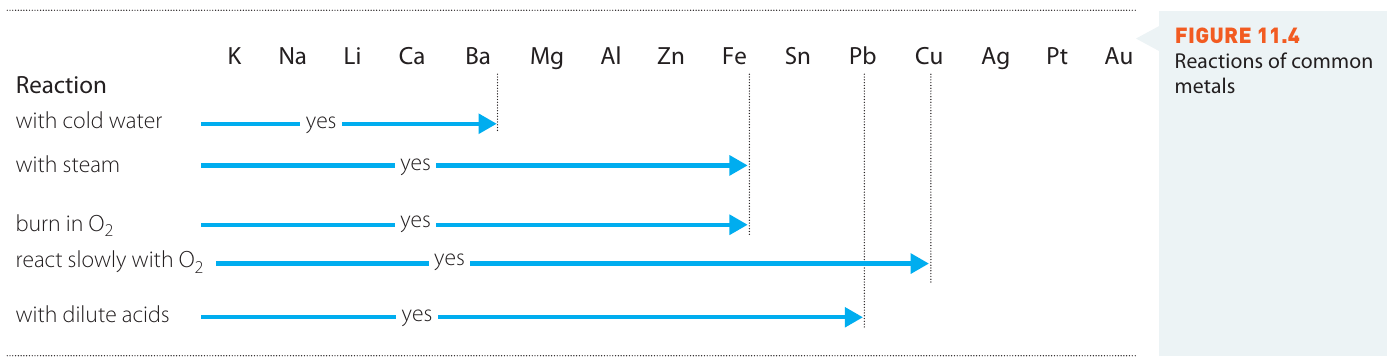
The following diagram shows which metals react with cold water, steam, oxygen, and dilute acids:
Note
Key observations from the diagram:
- Cold water: Only the most reactive metals (K, Na, Li, Ca, Ba) react with cold water
- Steam: A wider range of metals (from Li to Fe) can react with steam
- Burning in oxygen: Metals from Li to Fe burn readily in oxygen when heated
- Slow reaction with oxygen: Metals from Mg to Pb react slowly with oxygen over time
- Dilute acids: All metals from Li to Pb react with dilute acids, but metals to the right of hydrogen (Cu, Ag, Pt, Au) do not react
This visual summary helps you quickly determine which types of reactions are possible for each metal.
Note
Exam tip: When answering questions about metal reactions, consider using the activity series to justify your predictions. For example, "Zinc will react with dilute hydrochloric acid because zinc is to the left of hydrogen in the activity series."
Remember!
Summary
Key Points to Remember:
-
The activity series lists metals in order of decreasing reactivity from left to right: K > Na > Li > Ba > Ca > Mg > Al > Zn > Fe > Sn > Pb > H > Cu > Ag > Pt > Au
-
A more reactive metal (further left) will displace a less reactive metal (further right) from a solution of its ions
-
Hydrogen's position is key: metals to the left of H react with dilute acids, while metals to the right do not
-
The activity series is built from experimental observations of how metals react with water, acids, oxygen, and other metal ions
-
Use the series to predict displacement reactions and determine which metals will react with specific substances