Precipitation Reactions (HSC SSCE Chemistry): Revision Notes
📚Revision Notes
Precipitation Reactions
What are precipitation reactions?
A precipitation reaction occurs when you mix two solutions together and a solid substance forms and falls out of the mixture. The solid that forms is called a precipitate.
Note
The word "precipitate" literally means "to fall out" of solution, which is exactly what happens - the solid particles settle at the bottom of the container or make the solution cloudy.
These reactions are important in chemistry because they help us identify unknown substances, purify compounds, and understand how ions interact in solution.
Investigation: Observing precipitation reactions
This practical investigation allows you to observe precipitation reactions between different ions and identify patterns in which combinations form precipitates.
Aim
To observe examples of precipitation reactions involving:
- Anions (negative ions): chloride (), sulfate (), carbonate (), and hydroxide ()
- Cations (positive ions): calcium (), magnesium (), copper (), zinc (), and silver ()
Materials needed
- Dropper bottles of solutions:
- Sodium chloride
- Sodium sulfate
- Sodium carbonate
- Sodium hydroxide
- Calcium nitrate
- Magnesium nitrate
- Copper nitrate
- Zinc nitrate
- Silver nitrate
- Overhead projector sheet
- Fine-line permanent marker (red colour works best)
Risk assessment
Important
Safety First: Risk Assessment
Before starting any chemical investigation, you must identify potential hazards and plan how to work safely:
| What are the risks in doing this investigation? | How can you manage these risks to stay safe? |
|---|---|
| Chemicals could splash on your skin or into your eyes | Wear safety glasses at all times. Wash skin immediately if a splash occurs |
| Some chemicals cannot be disposed of down the sink | Refer to safety data sheets or use the RiskAssess program to identify proper disposal methods |
Method
- Draw a grid on an overhead projector sheet with the anions written across the top and cations down the side
- Place the grid against a dark background (such as a dark laboratory bench or black paper) to make any precipitates easier to see
- Place one drop of each appropriate solution on the grid - each square should contain two drops (one solution on top of the other)
- Record your observations carefully, noting any colour changes or solid formation
Note
Why This Method Works
- Sodium salts are used as the source of anions because all sodium compounds are soluble - this ensures the anions are available in solution
- Nitrate salts are used as the source of cations because all nitrates are soluble - this ensures the cations are available in solution
- A dark background is used because it makes white or lightly coloured precipitates much easier to see
- The grid method allows you to test many combinations efficiently using only small quantities of chemicals
When analysing your results, you would write both balanced chemical equations and net ionic equations for each precipitation reaction that occurred.
Understanding how precipitation works
Ionic solutions
To understand precipitation reactions, you need to know what happens when ionic compounds dissolve in water. When an ionic compound dissolves, it separates into individual positive ions (cations) and negative ions (anions) that move freely and randomly throughout the water. For example:
- Zinc sulfate solution contains ions and ions moving independently
- Magnesium nitrate solution contains ions and ions moving independently
When you mix these two solutions, the resulting mixture contains all four types of ions (, , , and ) moving randomly throughout the liquid.
Note
This mixture would be identical to one made by mixing zinc nitrate and magnesium sulfate solutions - both contain the same four ion types!
When precipitates form
Precipitation happens when ions collide and form an insoluble compound - a substance that cannot stay dissolved in water.
Example
Worked Example: Formation of Barium Sulfate Precipitate
When you mix barium nitrate and zinc sulfate solutions, a heavy white precipitate forms. Here's what happens:
Step 1: Identify the ions in solution
- Barium nitrate provides ions and ions
- Zinc sulfate provides ions and ions
Step 2: Determine which ions react
- When and ions collide, they form barium sulfate ()
- Barium sulfate is insoluble, so it precipitates as a solid
Step 3: Write the precipitation reaction
The image above shows different coloured precipitates that can form in precipitation reactions:
- (a) White precipitate of silver chloride
- (b) Blue precipitate of copper hydroxide
- (c) Yellow precipitate of lead iodide
- (d) Brown precipitate of iron(III) hydroxide
Spectator ions
In the barium sulfate example above, the and ions are called spectator ions. They are present in the solution during the reaction, but they don't participate in the actual chemical change. Like spectators at a sporting event, they watch but don't play!
The same precipitation of barium sulfate occurs regardless of which spectator ions are present. For example, these mixtures all produce the same precipitate:
- Barium chloride and sodium sulfate
- Barium hydroxide and potassium sulfate
- Barium bromide and sulfuric acid
Types of chemical equations
There are three different ways to write equations for precipitation reactions. Each type is useful in different situations, so it's important to understand when to use each one.
Net ionic equations
A net ionic equation shows only the ions that actually undergo a chemical change, without specifying which compounds they came from. This type focuses on the essential chemistry.
Example
Example: Net Ionic Equation for Copper Hydroxide Formation
If you want to show that copper ions react with hydroxide ions to form copper hydroxide precipitate:
This equation is true regardless of whether the copper ions came from copper chloride, copper nitrate, or copper sulfate. It emphasises the fundamental reaction.
Complete formula equations (neutral species equations)
A complete formula equation shows the actual chemical compounds that were mixed together. This type makes it clear which specific substances you used.
Example
Example: Complete Formula Equation for Copper Hydroxide Formation
To show that you made copper hydroxide by mixing copper chloride with sodium hydroxide:
This equation tells you the exact starting materials and products.
Complete ionic equations
A complete ionic equation shows all the ions present in the reaction mixture, both those reacting and the spectator ions. This type emphasises the ionic nature of the reaction.
For the same reaction:
This clearly shows that and are spectator ions (they appear on both sides unchanged).
Which type should you use?
There's no single "best" type - choose the equation that's most appropriate for what you're trying to communicate:
- Use net ionic when you want to show the fundamental chemistry
- Use complete formula when you need to specify which compounds were used
- Use complete ionic when you want to emphasise the ionic nature and identify spectator ions
Important
Always Include State Symbols in Your Equations
- (s) for solid
- (l) for liquid
- (g) for gas
- (aq) for aqueous solution (dissolved in water)
For complete ionic equations, you don't need to write (aq) after every ion if it's clear from context that they're in aqueous solution.
Solubility rules
What does soluble mean?
Before we can predict precipitation reactions, we need to understand the terms used to describe solubility:
Important
Solubility Definitions
- Soluble: The compound dissolves to more than in water
- Insoluble: The compound dissolves to less than in water
- Sparingly soluble: The compound dissolves to between (examples include lead chloride, calcium sulfate, silver sulfate, and calcium hydroxide)
Solubility rules for common ionic compounds
The following table summarises which types of ionic compounds are soluble and which are insoluble. This is essential information for predicting precipitation reactions.
| Compounds that are soluble | Compounds that are insoluble |
|---|---|
| • Group 1 and compounds • Nitrates • Chlorides (except and ) • Sulfates (except , , , , ) | • Carbonates (except Group 1 and ) • Hydroxides (except Group 1, , , , ) • Oxides (except Group 1, , , , ) |
Note
Key Patterns to Remember
- Group 1 metals (sodium, potassium, etc.) and ammonium compounds are always soluble
- Nitrates are always soluble
- Most chlorides are soluble, but silver and lead chlorides are not
- Most sulfates are soluble, but barium, strontium, and calcium sulfates have limited solubility
- Most carbonates, hydroxides, and oxides are insoluble, except those of Group 1 metals
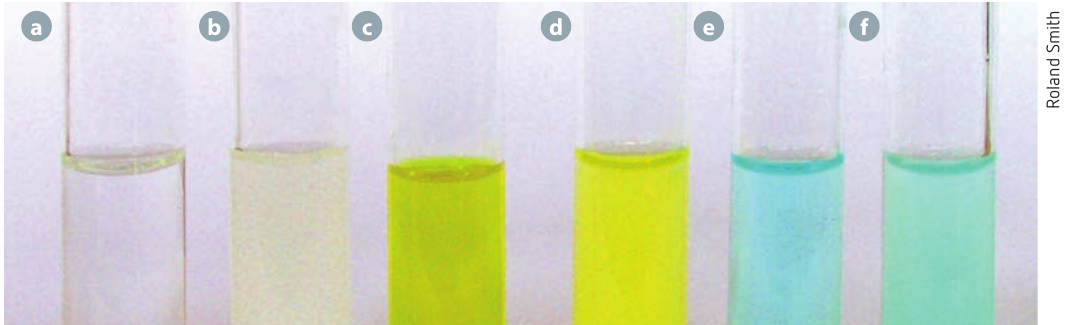
Clear, coloured, and turbid solutions
It's important to distinguish between different types of solutions and suspensions:
- Colourless solution: Completely transparent with no colour (like water)
- Coloured solution: Transparent but with colour (you can see through it clearly)
- Turbid suspension: Cloudy or milky appearance - not fully transparent (contains suspended solid particles)

The image above shows the difference between solutions and suspensions:
- (a) Colourless, clear solution of sodium chloride
- (b) White, turbid suspension containing silver chloride precipitate
- (c) Yellow, clear solution of potassium chromate
- (d) Yellow, turbid suspension containing lead iodide precipitate
- (e) Blue, clear solution of copper sulfate
- (f) Blue-green, turbid suspension containing copper hydroxide precipitate
Important
Exam Tip: Recognising Precipitation
If mixing two clear solutions (whether colourless or coloured) produces cloudiness or turbidity, then a precipitate has formed. The cloudiness is caused by tiny solid particles suspended in the liquid.
Predicting precipitation reactions
You can use the solubility rules to predict whether a precipitate will form when two solutions are mixed. Here's the systematic approach:
Step-by-step method
- Identify all the ions present when the two solutions are mixed
- Determine which new compounds could potentially form from these ions
- Check the solubility table to see if any of the potential products are insoluble
- If an insoluble compound can form, a precipitate will occur
Worked examples
Let's work through two examples to see how this method works in practice:
Example
Worked Example 1: Predicting Lead Sulfate Precipitation
Question: What precipitate (if any) will form when aqueous solutions of sodium sulfate and lead nitrate are mixed?
| Answer | Logic |
|---|---|
| Ions present are , , and | Identify the ions that will be in the mixed solutions before any reaction occurs |
| Could form and | Work out which compounds could be formed, apart from the starting ones |
| From the solubility table, is insoluble. Therefore, a precipitate of lead sulfate will form | Decide which (if either) of these is insoluble and could precipitate out |
Example
Worked Example 2: No Precipitation Occurs
Question: When solutions of ammonium chloride and magnesium nitrate are mixed, what (if anything) will precipitate?
| Answer | Logic |
|---|---|
| Ions present are , , and | Identify the ions that will be in the mixed solutions before any reaction occurs |
| Could form and | Work out which compounds could be formed |
| From the solubility table, both compounds are soluble, so no precipitate will form. There will be no reaction | Decide which (if either) of these is insoluble and could precipitate out |
Key points for exam success
- Always start by identifying all four types of ions in the mixture
- Consider all possible ionic compound combinations (not just the starting ones)
- Check each possible product against the solubility rules
- Remember that if all possible products are soluble, no reaction occurs
- Write your final equation with correct state symbols: (aq) for aqueous, (s) for solid
Summary
Key Takeaways: Precipitation Reactions
-
Precipitation reactions occur when mixing two solutions causes an insoluble solid to form and separate from the solution.
-
Spectator ions are present during the reaction but don't participate in the chemical change - like spectators watching a game.
-
Three types of equations can represent the same reaction: net ionic (shows only reacting ions), complete formula (shows actual compounds used), and complete ionic (shows all ions including spectators).
-
Solubility rules are your key tool for predicting precipitations: Group 1 and ammonium compounds are always soluble, nitrates are always soluble, and most carbonates and hydroxides are insoluble.
-
Turbidity (cloudiness) in a previously clear solution indicates that a precipitate has formed, even if you can't see settled solid at the bottom.