Ecologically Sustainable Development (HSC SSCE Economics): Revision Notes
📚Revision Notes
Ecologically Sustainable Development
Understanding environmental sustainability in economics
Traditional economic thinking assumed natural resources were virtually unlimited. If demand for a product increased, supply would simply expand to meet it. However, this view has fundamentally changed over recent decades as environmental challenges have become impossible to ignore.
Note
The shift from assuming unlimited resources to recognizing environmental limits represents one of the most significant changes in economic thinking over the past several decades. This paradigm shift acknowledges that economic activity cannot continue indefinitely without regard for environmental consequences.
Environmental sustainability focuses on protecting and enhancing the natural environment—everything in our physical world including land, water, climate, and all living species. This means safeguarding air, water and soil quality, preserving ecosystems and biodiversity, using resources responsibly, and reducing the harmful environmental effects of economic activity.
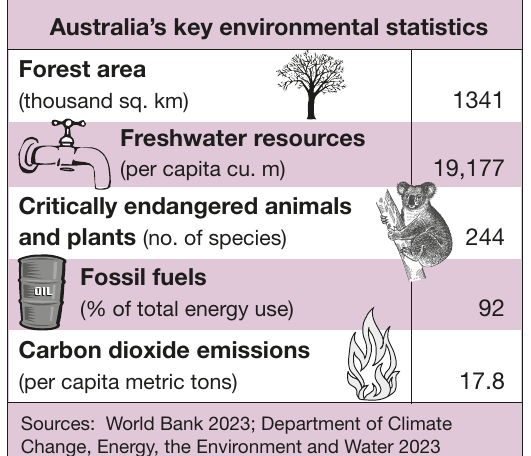
Australia faces several critical environmental challenges:
- Reducing greenhouse gas emissions that drive climate change
- Securing adequate water supplies for households, agriculture and industry
- Protecting forests, waterways and ecosystems from degradation
Historically, Australia's economic activities in farming, mining and manufacturing have caused significant environmental damage, including land degradation, resource depletion, species extinction, and water pollution. Current government policies aim to address these impacts to improve quality of life and preserve the environment for future generations.
Important
The OECD warns that without stronger action, environmental degradation will undermine the development progress and wellbeing improvements achieved over the past 50 years. Climate change, biodiversity loss, resource constraints and air pollution pose systemic risks to current and future generations.
The economic case for environmental action
While environmental protection may involve short-term economic costs, sustainable long-term growth actually depends on maintaining a healthy environment. Taking action to protect the environment can therefore support economic growth over the medium to long term.
A 2020 Deloitte Access Economics report estimated that failing to act on climate change could cost the Australian economy $3.4 trillion and 880,000 jobs by 2070. Conversely, transitioning to net zero carbon emissions could increase GDP by 2.6% by 2070, adding $680 billion and creating over 250,000 jobs.
Note
The Economic Opportunity in Environmental Action
These findings demonstrate that environmental economics is not just about costs—it represents genuine economic opportunities when integrated properly into policy and business decisions. The potential gains from climate action far outweigh the costs of inaction, making environmental protection both an ethical imperative and a sound economic strategy.
What is ecologically sustainable development?
Environmental economics emphasizes pursuing a sustainable level of growth that accounts for environmental impacts. Without considering the hidden costs of economic activity, rapid growth can lead to resource depletion, pollution and declining quality of life.
Important
Defining Ecologically Sustainable Development
Ecologically sustainable development (ESD) means using and managing resources in ways that maintain ecological processes and quality of life for present and future communities. Rather than pursuing maximum short-term growth, ESD aims for a level of economic activity compatible with long-term environmental preservation.
The impact on production capacity
Overusing or exploiting natural resources for short-term growth can permanently deplete these resources and damage the environment. This reduces productivity in affected economic sectors, particularly primary industries that depend on natural resources as production inputs.
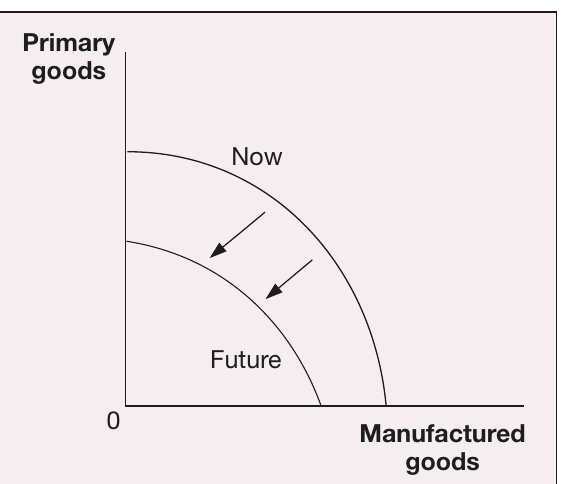
When resource consumption depletes an economy's natural base, it reduces future potential output over the long term. This can be represented by an inward shift of the production possibility frontier, as shown below:
Example
Understanding the Production Possibility Shift
The diagram illustrates how unsustainable resource use today constrains the economy's ability to produce goods in the future. The production possibility curve shifts inward, meaning the economy can produce less of both primary and manufactured goods.
Consider this scenario:
- Before depletion: An economy can produce 100 units of primary goods and 80 units of manufactured goods
- After unsustainable use: The same economy can only produce 70 units of primary goods and 60 units of manufactured goods
- Result: The entire production capacity has permanently contracted due to resource depletion
Historical lessons in unsustainable development
Some historians argue that severe natural resource depletion contributed to the collapse of past civilizations. When deforestation and soil erosion made it impossible to sustain food supplies, populations could not be supported.
Note
Historical Examples of Environmental Collapse
Examples of civilizations that experienced severe decline due to environmental degradation include:
- The Roman Empire: Widespread deforestation and soil erosion
- The Mayan civilization: Exhaustion of agricultural land and water resources
- Easter Island: Complete deforestation leading to societal collapse
These represent extreme cases of ecologically unsustainable development, where environmental degradation led to societal collapse and serve as cautionary tales for modern economies.
Balancing growth and environmental protection
The fundamental purpose of achieving both economic growth and environmental protection is improving quality of life. Satisfying more material wants provides diminished benefit if it comes at the expense of environmental damage, resource depletion, or harm to human health.
Environmental harm also reduces quality of life for future populations by depleting natural resources and therefore limiting future economic growth potential. This connects to a major principle of ESD: fairness between generations.
Important
Intergenerational Equity: A Core Principle
Intergenerational equity describes using resources in ways that do not limit the quality of life for future generations. Current populations should not exhaust resources or damage ecosystems in ways that prevent future generations from meeting their own needs and enjoying similar standards of living.
This principle recognizes that we are temporary stewards of the Earth's resources, not their ultimate owners. Our decisions today have lasting consequences for those who come after us.
Key principles of ecologically sustainable development
ESD operates according to several core principles that guide policy and decision-making:
Integration of goals: Economic and environmental objectives should be combined in all policies and activities, rather than treated as competing priorities. Development decisions must consider both economic and environmental outcomes.
Appropriate valuation: Environmental assets and ecosystem services must be properly valued in economic terms. Markets often fail to account for environmental costs and benefits, so explicit valuation mechanisms are needed.
Precautionary management: Environmental risks should be managed cautiously. Where there is potential for serious or irreversible environmental damage, lack of full scientific certainty should not be used as a reason to postpone preventative measures.
Fairness in allocation: Costs and benefits should be distributed fairly both within the current generation and between current and future generations. Those who benefit from resource use should bear appropriate costs, and resource use should not unfairly burden future populations.
Global perspective: Environmental issues often have transboundary and global effects. Climate change, ocean pollution and biodiversity loss require consideration of impacts beyond national borders.
Note
The Precautionary Principle in Practice
The precautionary management principle is particularly important when dealing with environmental risks. It shifts the burden of proof—instead of waiting for conclusive evidence of harm before acting, it advocates for preventative action when serious risks are identified. This approach recognizes that by the time environmental damage is fully proven, it may be too late to reverse it.
Australia's national strategy for ESD
Australia's National Strategy for Ecologically Sustainable Development (NSESD) was first developed in 1992 and continues to guide government environmental policy. The strategy has three core objectives:
Enhanced wellbeing: Following a path of economic development that safeguards welfare for future generations while improving current wellbeing and welfare.
Equity: Providing fairness both within the current generation and between current and future generations in resource access and environmental quality.
Environmental protection: Protecting biological diversity and maintaining essential ecological processes and life-support systems that underpin all economic activity.
Note
Implementation of ESD in Government
The pursuit of ESD has been embedded in Australian government operations as a significant policy objective. Government departments must report on environmental matters in annual reports, and ESD principles guide initiatives such as the Nature Positive Plan to reform environmental regulation. This integration ensures that environmental considerations are not treated as an afterthought but are central to government decision-making.
International commitments
Australia has endorsed the United Nations' 2030 Agenda for Sustainable Development, which integrates social, environmental and economic dimensions of sustainability. The Department of Climate Change, Energy, the Environment and Water leads progress toward Sustainable Development Goals related to:
- Clean water and sanitation
- Affordable and clean energy
- Responsible consumption and production
- Climate action
- Life below water (marine ecosystems)
- Life on land (terrestrial ecosystems)
These international commitments demonstrate that environmental sustainability is not just a domestic concern but requires global cooperation and coordinated action across nations.
Summary
Key Points to Remember:
- Ecologically sustainable development means pursuing economic activity at a level compatible with long-term environmental preservation, not just maximum short-term growth
- Intergenerational equity is the principle that current resource use should not limit quality of life for future generations
- Unsustainable resource use causes the production possibility frontier to shift inward, permanently reducing the economy's productive capacity
- Short-term environmental protection costs can deliver long-term economic benefits through sustained growth, job creation and avoiding catastrophic damage costs
- ESD principles include integrating economic and environmental goals, properly valuing environmental assets, managing risks cautiously, ensuring fairness across generations, and considering global effects
- Australia's commitment to ESD is demonstrated through the National Strategy for Ecologically Sustainable Development and participation in international sustainable development goals