Australia's Exchange Rate (HSC SSCE Economics): Revision Notes
📚Revision Notes
Australia's Exchange Rate
The role of the exchange rate
The exchange rate serves as a critical connection between Australia and the global economy. It acts as the channel through which all trade and financial transactions with other countries flow. Because of this central role, movements in the exchange rate have substantial effects on:
- International competitiveness: How Australian goods and services compare in price to foreign alternatives
- External stability: The health of Australia's economic relationships with the rest of the world
The exchange rate essentially determines how many units of foreign currency one Australian dollar can buy, or vice versa. This price influences every import and export transaction, as well as financial flows into and out of the country.
Exchange rate volatility
Australia's exchange rate has experienced considerable volatility, particularly compared to many other developed economies. This instability stems largely from Australia's heavy dependence on commodity exports. When commodity prices fluctuate globally, the Australian dollar tends to move in the same direction.
Note
Despite Australia accounting for only 1% of global trade, the Australian dollar ranks as the world's fifth-most traded currency. This high trading volume partly reflects the currency's volatility, which attracts speculators seeking to profit from short-term price movements.
It sits behind only the:
- US dollar
- Euro
- Japanese yen
- British pound sterling
Recent exchange rate movements
The Australian dollar has undergone dramatic swings in recent years:
- 2011: Peaked at US$1.10
- March 2020: Fell to US$0.56 (during COVID-19 onset)
- February 2021: Recovered to US$0.80
- October 2022: Dropped to US$0.62
- February 2023: Rose to US$0.71
- September 2023: Declined to US$0.64
These movements illustrate the currency's responsiveness to both global economic conditions and domestic factors.
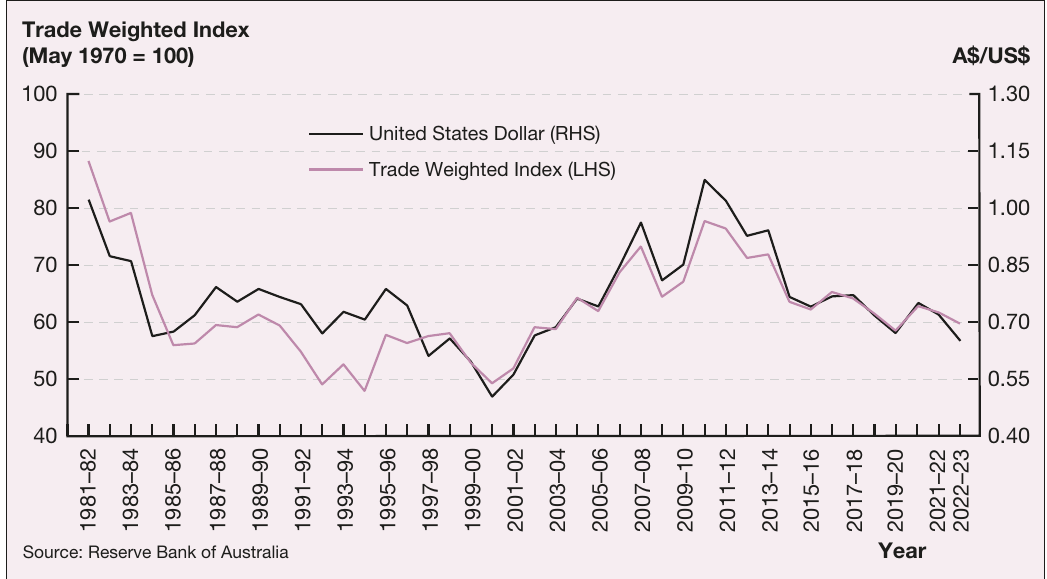
The chart above displays two key measures of the Australian dollar's value:
- Trade Weighted Index (TWI): Measures the AUD against a basket of currencies from Australia's major trading partners, weighted by trade significance. The baseline is May 1970 = 100.
- AUD/USD exchange rate: The bilateral rate between the Australian and US dollars.
Note
Both measures tend to move together, though the TWI provides a more comprehensive picture of Australia's overall currency strength since it captures movements against all major trading partners rather than just one bilateral rate.
Historical patterns and drivers
Early 2000s: The commodity price boom
At the turn of the century, commodity prices sat at historically low levels. The emerging "internet economy" led global investors to favour technology-focused nations over resource-based economies like Australia. This resulted in a relatively weak Australian dollar.
The situation transformed after 2003 when commodity prices began climbing sharply. The key driver was surging Chinese demand for natural resources as China's economy expanded rapidly. This commodity boom pushed the Australian dollar steadily higher until 2011.
Factors supporting the 2003-2011 appreciation
Several elements combined to strengthen the Australian dollar during this period:
- Rising terms of trade: Australia's export prices increased faster than import prices
- Strong export performance: Commodity sales to China and other growing economies surged
- Sustained economic growth: Australia's economy performed well relative to other developed nations
- Interest rate differential: Australian interest rates exceeded those in many other developed economies, attracting foreign capital
The 2010s: Gradual depreciation
After peaking in 2011, the Australian dollar weakened throughout the 2010s. The main causes included:
- Falling terms of trade as commodity prices declined from historic highs
- Slower domestic economic growth compared to previous decades
- Reduced interest rate advantage as the Reserve Bank cut rates
Note
This depreciation actually assisted many Australian businesses, particularly those outside the mining sector that had struggled during the high-dollar period when their exports became uncompetitively expensive.
COVID-19 and recent movements
The pandemic initially triggered a sharp depreciation as global uncertainty surged. However, the dollar recovered as:
- Demand for commodity exports rebounded
- The Australian economy proved relatively resilient
The weakness in 2022-2023 reflected a new dynamic: global interest rates rose faster than Australian rates, prompting capital outflows and currency depreciation.
The exchange rate as a stabilising mechanism
While exchange rate volatility can create challenges, the floating exchange rate operates as a powerful automatic stabiliser for the Australian economy. It helps the country adjust to changing global economic conditions without requiring direct government intervention.
How the stabilising mechanism works
Important
The Automatic Stabilisation Process
When Australia faces weaker economic conditions or global growth slows:
- The exchange rate typically depreciates
- Australian exports become cheaper for foreign buyers
- Imports become more expensive for Australian consumers and businesses
- This boosts international competitiveness
- Export volumes tend to increase
- Import-competing domestic industries become more competitive
- Economic activity receives support
The reverse process occurs during strong economic periods, with appreciation helping to moderate inflationary pressures and rebalance economic activity.
Real-world example
Example
Worked Example: The Mining Boom Adjustment
After the terms of trade fell from 2011 onwards, the depreciating Australian dollar made exporters and import-competing sectors more competitive.
During the mining boom (high AUD):
- Non-mining exporters struggled with expensive products internationally
- Many businesses found it difficult to compete globally
- Economic activity concentrated in the mining sector
After depreciation (lower AUD):
- Non-mining exports became more price-competitive
- Import-competing industries gained advantage
- Economic growth diversified across broader range of industries
The lower dollar in recent years has supported competitiveness across a broader range of export industries, helping to diversify economic growth beyond just commodities.
Impact on external stability
Despite its stabilising benefits, exchange rate movements can create significant challenges for Australia's external stability. Changes in the exchange rate affect two critical components of external health:
1. Balance of payments effects
Exchange rate movements alter Australia's international competitiveness, which influences:
- Export volumes and values: A lower dollar makes Australian goods cheaper abroad, potentially boosting export earnings
- Import volumes and values: A lower dollar makes foreign goods more expensive, potentially reducing import spending
- The current account balance: The net effect on exports minus imports
2. Foreign debt servicing costs
A substantial portion of Australia's foreign debt is denominated in foreign currencies. When the Australian dollar depreciates:
- The AUD value of foreign currency-denominated debt increases
- Interest payments on this debt become more expensive in AUD terms
- The overall cost of servicing foreign liabilities rises
Important
Sharp exchange rate swings can cause significant volatility in both these key external stability indicators, creating policy challenges and economic uncertainty. This is particularly problematic for Australia given its large foreign debt position.
The vicious cycle risk
A sudden or large depreciation can potentially trigger a self-reinforcing downward spiral:
Important
The Depreciation Vicious Cycle
- Initial depreciation: The dollar falls due to some economic shock or loss of investor confidence
- Fear of further falls: Foreign investors become concerned about additional volatility
- Investment hesitation: Capital inflows slow or reverse as investors avoid a falling currency
- Speculator targeting: Financial speculators identify the currency as a profitable short-selling opportunity
- Accelerated decline: Speculative selling pushes the currency down further
- Confidence crisis: The downward momentum feeds on itself
This cycle typically continues until sufficient investors conclude the currency has become undervalued and begin purchasing it again. However, the interim period can involve significant economic disruption and uncertainty.
The impact of global interest rate movements
Global interest rate trends have exerted substantial influence on the Australian exchange rate, particularly over the past two decades.
The low interest rate era (2008-2020)
Following the Global Financial Crisis of 2008, major central banks around the world slashed interest rates to historically low levels. This environment persisted and intensified after the COVID-19 pandemic began in 2020.
Effects on Australia
Falling global interest rates created indirect but important consequences for the Australian economy:
- Downward pressure on the equilibrium interest rate: The neutral interest rate (consistent with balanced monetary policy) for Australia declined
- Currency appreciation pressure: As other countries loosened monetary policy, their currencies weakened relative to the AUD
- Reduced export competitiveness: A stronger Australian dollar made exports more expensive
- Lower inflation: Reduced import prices and weaker export performance placed downward pressure on domestic inflation
Reserve Bank response
The Reserve Bank reduced Australian interest rates progressively through the decade, from 4.75% to just 0.1% by November 2020. This helped maintain some interest rate advantage and supported the economy.
Note
External account benefits
One significant advantage for external stability was reduced debt servicing costs. Given Australia's net foreign debt exceeds $1 trillion, each percentage point decrease in benchmark interest rates substantially reduced the cost of servicing foreign liabilities.
The rising interest rate period (2022-2023)
The low interest rate era ended as the global economy recovered from the pandemic and confronted the highest inflation rates in nearly half a century.
Global interest rate increases
Central banks worldwide began raising interest rates from the near-zero levels maintained during COVID-19. These increases aimed to combat surging inflation, with rates rising rapidly across major economies.
Australian interest rate response
The Reserve Bank commenced raising Australian interest rates in May 2022, continuing increases until rates reached their highest level in over a decade by mid-2023.
Exchange rate impact
A critical dynamic emerged: overseas interest rates rose more quickly than Australian rates. This differential caused:
- Capital outflows: Funds moved offshore seeking higher returns
- Currency depreciation: The Australian dollar weakened as demand for foreign currencies increased
- Reduced attractiveness: The narrowing interest rate advantage made Australian assets less appealing to foreign investors
Debt servicing cost explosion
Important
Dramatic Impact on Debt Servicing
The combination of higher global interest rates and a lower Australian dollar produced dramatic effects on debt servicing:
- 2021-22: Debt servicing costs were approximately $18 billion
- 2022-23: Costs nearly doubled to $33 billion
This sharp increase highlighted the vulnerability of Australia's large foreign debt position to both interest rate and exchange rate movements.
Summary
Key Points to Remember:
- The exchange rate connects Australia to the global economy and significantly affects international competitiveness and external stability
- The AUD is the world's fifth-most traded currency, experiencing high volatility due to Australia's commodity dependence
- The floating exchange rate acts as an automatic stabiliser, helping the economy adjust to global changes through appreciation during booms and depreciation during slowdowns
- Exchange rate movements impact external stability through effects on the balance of payments and foreign debt servicing costs
- Sharp depreciations can trigger vicious cycles where falling confidence leads to further falls
- Global interest rate trends strongly influence the AUD – low global rates (2008-2020) supported Australian rates and reduced debt costs, while rising global rates (2022-2023) drove capital outflows and doubled debt servicing costs