The Non-Accelerating Inflation Rate of Unemployment (HSC SSCE Economics): Revision Notes
📚Revision Notes
The Non-Accelerating Inflation Rate of Unemployment
Understanding NAIRU
The Non-Accelerating Inflation Rate of Unemployment (NAIRU) is a critical concept for understanding how unemployment and inflation interact in an economy. It represents the lowest level of unemployment an economy can sustain without triggering accelerating inflation.
Important
Key Definition
NAIRU refers to the level of unemployment at which there is no cyclical unemployment. In other words, it is the unemployment rate when the economy reaches full employment.
The theory suggests that some unemployment is inevitable in a functioning economy. Attempting to push unemployment below this natural threshold through economic stimulus will backfire, creating inflationary pressure rather than lasting job creation.
Note
Think of NAIRU as an economic "speed limit" for unemployment reduction. Just as driving too fast causes problems, pushing unemployment too low causes the economy to "overheat" through inflation.
What makes up the NAIRU?
The NAIRU consists of four types of unemployment:
- Frictional unemployment: Workers temporarily between jobs as they search for better positions
- Seasonal unemployment: Job losses tied to seasonal patterns in certain industries
- Structural unemployment: Workers whose skills no longer match available jobs due to economic changes
- Hard-core unemployment: Long-term unemployed who face significant barriers to employment
Important
Critical Point: What's Missing?
Notice that cyclical unemployment is absent from this list. This is because the NAIRU represents the natural rate when the economy is at full capacity, with no recession or boom distorting employment levels.
NAIRU and labour market dynamics
The NAIRU acts as an important benchmark for understanding labour market conditions:
When unemployment is above the NAIRU:
- The labour market has spare capacity
- Many qualified workers are available to fill vacancies
- Policymakers can safely stimulate economic growth
- The goal should be reducing unemployment toward the NAIRU
When unemployment is at or below the NAIRU:
- The labour market is tight
- Few unemployed workers are available with the right skills
- Economic stimulus creates wage pressures instead of job growth
- Inflation begins to accelerate
Note
This relationship between unemployment and inflation is illustrated by the Phillips Curve, which shows the trade-off between these two economic indicators. The Phillips Curve helps visualize why pushing below the NAIRU creates inflationary pressures.
Policy implications
Understanding the NAIRU has major consequences for economic policy design.
Growth-focused policies successfully reduce unemployment, but only to a certain threshold. Once unemployment reaches the NAIRU, further stimulus becomes counterproductive. Instead of creating jobs, it simply drives up wages and prices as employers compete for a limited pool of available workers.
Important
Why This Matters for Policymakers
A lower NAIRU expands the economy's capacity to grow without triggering inflation. This makes reducing the NAIRU a valuable long-term policy objective that offers more sustainable economic benefits than short-term stimulus alone.
Reducing the NAIRU over time
The NAIRU can be lowered through structural policies that address the underlying causes of frictional, seasonal and structural unemployment:
- Retraining and re-skilling programs: Help structurally unemployed workers gain relevant skills for modern job markets
- Labour mobility improvements: Make it easier for workers to relocate interstate or change industries
- Accessibility measures: Remove workplace barriers for people with disabilities or health conditions
- Education system reforms: Ensure workers develop skills that match evolving labour market demands
These policies work gradually over years, shifting the NAIRU downward and allowing the economy to sustain lower unemployment rates without inflationary consequences.
Note
Unlike short-term demand management policies that can quickly reduce cyclical unemployment, NAIRU reduction requires long-term structural reforms. The payoff, however, is permanent: a lower NAIRU means the economy can sustain higher employment levels indefinitely.
Estimating the NAIRU: challenges and trends
Calculating the NAIRU is highly complex for several reasons:
- There is no straightforward way to directly measure it
- NAIRU calculations attempt to filter out cyclical effects, even though both unemployment and inflation are heavily influenced by economic cycles
- The NAIRU itself shifts over time as labour market structures change
- Recent estimates can be made less reliable by volatility in unemployment and inflation data
Despite these challenges, economists regularly estimate the NAIRU to guide policy decisions.
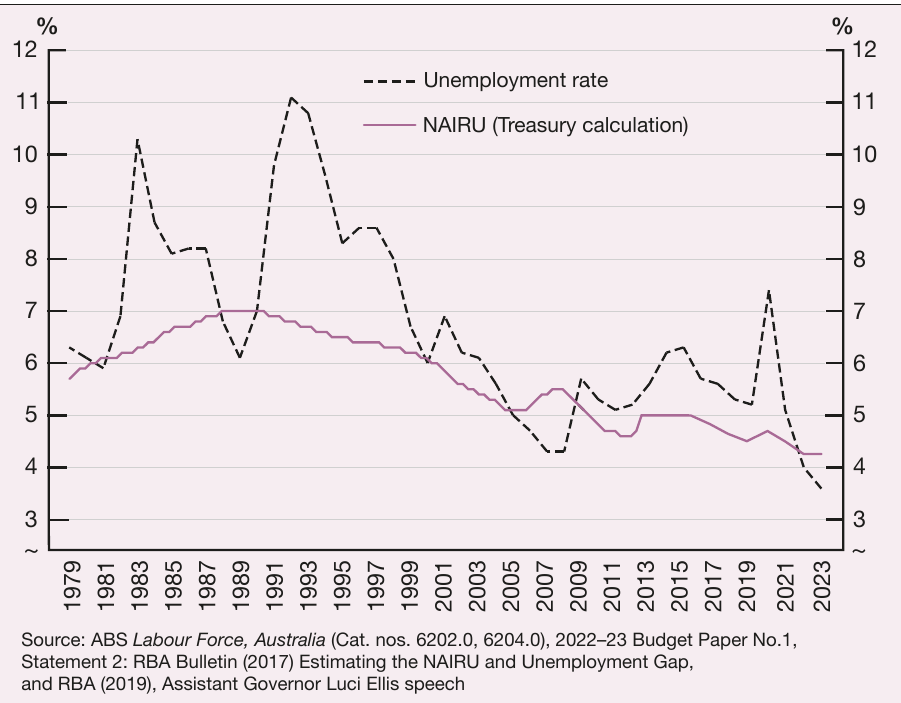
Note
The graph above shows that Australian estimates of the NAIRU have trended downward over recent decades. While unemployment has fluctuated significantly through various economic cycles, the underlying natural rate has gradually declined from around 5% to approximately 4.25%.
Recent Australian estimates
Treasury estimates of Australia's NAIRU have fallen substantially:
- Historical estimates: Around 5% for much of the 1990s and 2000s
- 2021 estimate: Between 4.5% and 5% for the five years before COVID-19
- 2023-24 Budget estimate: 4.25%
The downward revision reflects declining wage and inflationary pressures in recent years. However, Treasury has noted that volatility in both the labour market and inflation following COVID-19 has made NAIRU calculations more difficult and uncertain.
Exam guidance
Important
Exam Success Tips
When analysing unemployment policy, always consider:
- Whether current unemployment is above, at, or below the estimated NAIRU
- The likely inflation consequences of stimulus policies at different unemployment levels
- The distinction between short-term cyclical policies and long-term structural policies for reducing the NAIRU
Command word tip: For 'evaluate' questions about unemployment policy, the NAIRU concept provides a framework for discussing both benefits (reducing cyclical unemployment) and limitations (inflation risk when unemployment is already low).
Remember!
Summary
Key Points to Remember:
- NAIRU represents full employment with zero cyclical unemployment, but includes frictional, seasonal, structural and hard-core unemployment
- Unemployment above NAIRU indicates spare capacity and room for economic stimulus
- Unemployment below NAIRU creates wage pressures and accelerating inflation
- Short-term growth policies reduce unemployment only down to the NAIRU level
- Long-term structural policies (retraining, mobility, accessibility) can lower the NAIRU itself
- Australia's estimated NAIRU has fallen to approximately 4.25% but remains difficult to calculate precisely
- The Phillips Curve illustrates the trade-off between unemployment and inflation at different points relative to the NAIRU