Outlaw Motorcycle Gangs in Australia (HSC SSCE Legal Studies): Revision Notes
📚Revision Notes
Outlaw Motorcycle Gangs in Australia
Introduction to OMCGs
Outlaw motorcycle gangs (OMCGs) are organisations whose members use the structure of a motorcycle club as a front for criminal activity. These groups have been involved in numerous incidents across Australia that have drawn significant media attention, sparked law enforcement action, and prompted legislative responses.
The activities of OMCGs pose a serious threat to public safety and community wellbeing. Members of these organisations have been implicated in violent crimes, drug manufacture and distribution, and other serious criminal enterprises. The visibility of these crimes has made OMCGs a major focus of law enforcement agencies and policymakers throughout Australia.
The Anthony Zervas case
A landmark incident occurred in March 2009 at Sydney Airport, when -year-old Anthony Zervas was brutally killed. The attack involved members of the Sydney-based Comanchero motorcycle club targeting members of the internationally known Hells Angels club. Zervas was returning to Sydney from Melbourne with his brother and a friend, both Hells Angels members. The assault was savage—Zervas was bashed with a metal bollard and stabbed multiple times in the chest and abdomen.
Important
This incident unfolded in front of numerous innocent bystanders at a major transport hub, shocking the Australian public and demonstrating the brazen nature of OMCG violence.
The Mahmoud 'Mick' Hawi case
In 2011, Mahmoud 'Mick' Hawi received a -year jail sentence for the murder of Zervas. The sentencing judge noted that Hawi displayed 'flagrant disregard' for the law and showed no consideration for the traumatic memories forced upon innocent bystanders who witnessed the brutal attack.
However, the case took a controversial turn in 2014 when Hawi was released from jail and granted a retrial. The appeal court judge determined that it could not be established beyond reasonable doubt that Hawi was solely responsible for Zervas's death. The court upheld Hawi's appeal and permitted him to plead to the lesser charge of manslaughter.
Note
This legal development coincided with new legislation in New South Wales. The Bail Act 2013 (NSW) had been introduced to reduce the number of accused individuals held on remand and to uphold the principle of presumption of innocence. Under this legislation, Hawi was released on bail, sparking public outcry. Community members protested on the grounds that convicted murderers posed a danger to society if not incarcerated.
Despite being granted bail, Hawi was re-sentenced to jail in 2015 for three years for the manslaughter of Zervas. The judge commented that Hawi had shown remorse for Zervas's death and was capable of rehabilitation.
Ongoing public debate
The Zervas incident continues to fuel public debate about the dangers associated with OMCGs in Australia. Key concerns include:
- The potential for all-out war between rival motorcycle gangs
- Drive-by shootings
- The manufacture and distribution of methamphetamine ('ice')
- Illegal use of firearms
Many Australian states have responded by amending legislation to ban OMCGs from existing and to reduce their presence and profile in public places.
The Australian Crime Commission's assessment
According to the Australian Crime Commission (ACC), a federal statutory body established to investigate and combat serious crime, OMCGs represent a 'real and present danger to the Australian community'. The ACC estimates that approximately active OMCGs operate in Australia, with around 'patched' members. These groups have established strong and complex criminal networks operating in many illicit markets throughout the country.
Note
Reports indicate that the main areas of OMCG criminal operations include:
- Manufacturing and distributing illicit drugs
- Money laundering (disguising money obtained from illegal activities to make it appear legal)
- Extortion (obtaining money or property from a person or group by force, intimidation or illegal power)
International presence
OMCGs are not unique to Australia—they exist in many countries worldwide. Some of the best-known international OMCGs include the Hells Angels and the Bandidos. In New South Wales alone, an estimated groups operate, including well-known organisations such as the Comancheros, the Finks, the Rebels, and the Gypsy Jokers.
Organised crime
Organised crime refers to illegal activities organised by criminal groups or enterprises, most commonly for the purpose of generating financial profit. Understanding organised crime provides important context for examining OMCGs, as these motorcycle gangs represent one form of organised criminal enterprise.
Well-known organised crime groups
The most recognisable organised crime groups globally include:
- The Mafia (Sicily and the USA)
- The Japanese Yakuza
- Mexican drug cartels
Popular culture has brought these groups into public consciousness through television programmes like The Sopranos and films like The Godfather. In Australia, television series such as Underbelly and Bikie Wars recounted the gangland wars in Melbourne during the 1990s and the Milperra (bikie) Massacre in 1984 in Sydney.
Historical context
Organised crime has a long history worldwide. Throughout history, pirates, highwaymen, and bandits have attacked trade routes and roads to steal and profit from transported goods. Australians are familiar with the stories of the Kelly Gang in 19th-century Australia. Smuggling and organised drug-trafficking rings remain common in many countries. Some current criminal organisations in Italy and Japan can be traced back many centuries.
Contemporary criminal activities
Today, organised criminal groups operate in various areas of illegal business, including:
- Drug manufacture and distribution
- Extortion and money laundering
- Prostitution
- People smuggling
- Environmental crimes such as dumping toxic waste
- Counterfeiting of money
- Digital piracy (unauthorised reproduction and distribution of digital music, software, videos or other material, often for profit)
- Illegal bookmaking (the activity of calculating odds on sporting and other events and taking bets) and gambling
Important distinction
OMCGs have been identified in Australia as operating in some of the organised crime areas listed above. However, it is crucial to note that simply belonging to, participating in, or associating with one of these groups does not necessarily mean that a person has committed any crime.
Important
Only a small number of individuals within such a group, rather than the organisation as a whole, may be involved in illegal activities. There is a serious danger that all members might be 'tarred with the same brush' without justification or fair process. With motorcycle gangs in particular, this can be a significant problem. Simply being a member of one of the many legitimate motorcycle gangs may arouse unfounded suspicion from the public, or even the police, that an individual is involved in wrongdoing.
Motorcycle clubs
History and development
Motorcycle clubs are not a new phenomenon. The first motorcycle was invented in 1885 in Stuttgart, Germany, and motorcycles became commercially available by 1894. One of the oldest motorcycle clubs, the Yonkers Motorcycle Club, was founded in Yonkers, New York in 1903.
Note
There is nothing inherently wrong or criminal about belonging to a motorcycle club. Many people join motorcycle clubs to share a common interest in motorcycles, for recreational riding, or for competition. Members of clubs come from all walks of life.
The American Motorcyclist Association
Today, the largest motorcycling organisation worldwide is the American Motorcyclist Association (AMA), founded in 1924. The AMA represents people with an interest in motorcycling—or as the organisation describes it, 'freedom on two wheels'. The AMA currently claims close to members and promotes various motorcycling events in the United States and around the world. The AMA also acts as an advocate for motorcyclists before governments, local and international law-makers, and the general public.
Motorcycle clubs in Australia
Hundreds of motorcycling organisations exist in Australia. Clubs in New South Wales include the Ulysses Club, the Ambassadors, and the Vietnam Veterans. The organisational structures of clubs vary, but they often feature:
- Elected officers and directors
- Annual fees
- Regular publications
- Social events
- Recreational or competition rallies
One of the biggest motorcycling events in Australia is the Australian Motorcycle Grand Prix, an international event held annually on Phillip Island, Victoria.
Outlaw motorcycle gangs
Scale and significance
Outlaw motorcycle gangs represent only a very small percentage of motorcycle groups. However, their impact on public safety and their criminal activities make them a significant concern for law enforcement and the broader community.
Historical origins
Some OMCGs have a long history. One of the largest international clubs, the Hells Angels, was first formed in 1948 in Fontana, California. OMCGs began to emerge in Australia in the 1960s and spread quickly across all states.
Note
The history of OMCGs differs from that of mainstream motorcycling clubs, and their roots can be traced back to the late 1940s, following the end of the Second World War. A number of motorcycling clubs began to emerge in the United States when servicemen returned from the war. They formed clubs to mix with other returned servicemen, share their interest in motorcycling, and possibly escape the routine of returning to full-time work.
The Hollister riots and the '1%' identity
One of the first criminal incidents attributed to OMCGs occurred on 4 July 1947, US Independence Day, when the AMA sponsored a series of motorcycle races in the small town of Hollister, California. One of the motorcycle groups involved was reported to have initiated drag racing on the main streets of town, as well as drunken brawling.
When one rider was arrested and locked in a police cell, an estimated riders challenged the local seven-man police force to release their friend. The event became known as the Hollister riots.
Important
In a now famous statement, an AMA spokesperson clarified that it was only ' per cent' of the riders who had caused the trouble that weekend, and that the other per cent were law-abiding citizens. This distinction between ' per cent' and ' per cent' is still used by OMCG commentators today. Some OMCG members even use ' per cent' as a mark of their identity, representing the per cent of bikies who operate outside the law.
Identity markers
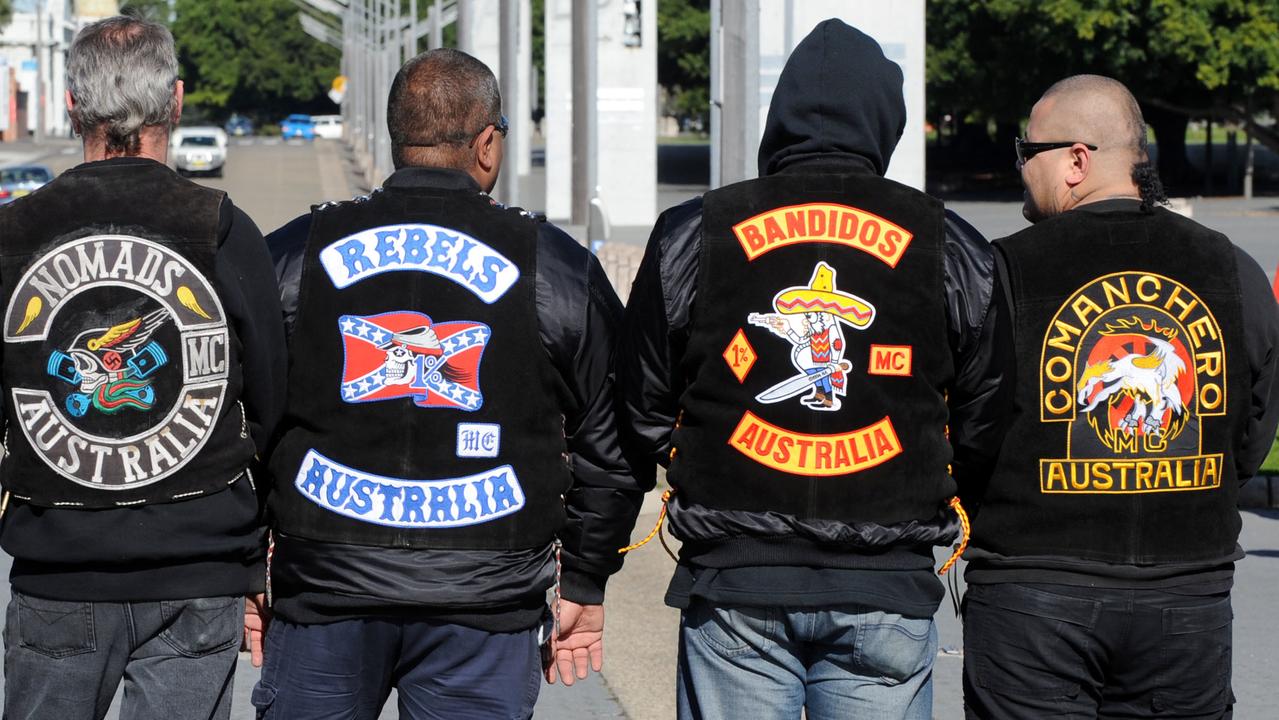
Identity is crucial to OMCGs. Many motorcycle clubs, both mainstream clubs and OMCGs, display unique club patches (symbols or club logos attached to the back of a motorcycle club member's vest) on the back of their members' vests. These patches feature the club's logo, name, and often the initials 'MC' (motorcycle club), together with the club's local branch or chapter (a local branch of a motorcycle club).
These patches form what is known as the club's colours (a motorcycle club's standard vest showing the club's patches on the back as a mark of identification). For OMCGs, the club's colours are very important to both the club and its members.
Note
Sometimes a member must earn the club's patch through:
- A club vote
- Swearing allegiance to the club
- Performance of tasks
A member losing his (or her) colours—for example, to the police or a rival gang—might result in some form of penalty or even expulsion from the club.
Some OMCGs even have an additional patch with ' per cent', to clearly distinguish themselves from the norms and values of mainstream clubs. Other patches include symbols such as skulls and crossbones.
The colours also act as a crucial identifier for law enforcement agencies seeking to prove OMCG involvement.
Organisational structure
The structure of an OMCG is often another important factor for the law in identifying the group and its levels of membership under the defined legal terms for such organisations.
OMCGs in Australia
New South Wales now has the greatest number of clubs and club chapters. The largest gang in Australia is believed to be the Rebels, with an estimated members.
The Hells Angels: a case study
The Hells Angels Motorcycle Club originated in Fontana, California, in 1948. Initially, it attracted soldiers returning from the Second World War, and later the Vietnam War. The name 'Hells Angels' had been used by several US air fighting squadrons during both World Wars.
Military influence on structure
Note
The fact that many of the club's founding members came from military backgrounds influenced the structure of the club and formed the basis of the military-style hierarchy and notions of territory or 'turf' that still exist today.
International expansion
Over time, the Hells Angels grew from a small club in California to an international organisation with approximately chapters in countries.
Organisational hierarchy
According to Sergeant Jacques Lemieux, an Ottawa-based expert on the Hells Angels, each chapter holds weekly meetings known as 'church'. The organisational structure includes:
Note
President: The absolute leader who makes key decisions about the chapter's activities. If absent, the President is replaced by a Vice-President.
Sergeant-at-Arms: Responsible for the behaviour of members at meetings and special events such as funerals.
Secretary-Treasurer: Controls finances, with duties such as collecting fees and paying club expenses. May sometimes act as intelligence gatherer if police operations are pending.
Road Captain: Organises and navigates mandatory bike rides, including rest stops for food and petrol.
Code of conduct
It is believed that there is a code of conduct governed by the Sergeant-at-Arms, which may differ slightly from chapter to chapter. Three major rules apply to all members:
- No sexual assault
- No use of heroin
- No 'burning' of drug deals (attempting to 'rip off' a buyer or seller)
Official presentation
In Australia, the official Hells Angels website displays a range of activities based around motorcycle riding, with prizes and giveaways. It features notices of events, email contacts, and a photo gallery. It does not list any rules for club members.
OMCGs and organised crime
The criminal threat
According to the Australian Crime Commission, OMCGs present a visible threat of complex and highly functional criminal networks. Although estimates vary, the cost of OMCG activities has been estimated at around $2.2 billion per annum.
Criminal activities
OMCGs are reputed to be involved in:
- Manufacture and distribution of illegal drugs
- Money laundering and extortion
- Trade in illegal firearms
- Trade in stolen goods
- Violent crimes and motor vehicle offences
OMCG claims
Note
OMCG members claim that their clubs are legitimate motorcycle organisations and not used as fronts for organised crime, as claimed by law enforcement agencies. Outwardly legitimate businesses, such as entertainment, private security, finance, transport, natural resources, and construction, may have involvement with outlaw motorcycle gangs.
The Milperra Massacre
One of the most important Australian cases in which OMCGs received widespread media exposure for violent criminal activity was also one of the largest criminal court cases in Australian history. The incidents occurred in a Sydney suburb in 1984, in what became known as the 'Milperra Massacre'.
The Milperra Massacre court case was one of the largest criminal trials held in Australia to that time. A total of people were charged with seven counts of murder.
The incident
The Milperra Massacre took place on Father's Day 1984 in the Sydney suburb of Milperra. It involved two rival gangs, the Bandidos and the Comancheros, and a number of other motorcycle gangs. The chief conflict was between Anthony 'Snoddy' Spencer, who left the Comancheros to become a Bandido leader, and William 'Jock' Ross, the President of the Comancheros. The Comancheros, Bandidos, and other outlaw gangs were competing to control the manufacture and supply of amphetamines (speed), as well as the cocaine trade.
Important
The heavily armed gangs clashed in the car park of the Viking Tavern in Milperra during a motorcycle swap meet. In the resulting violence, a murderous shoot-out occurred that saw:
- Four Comancheros killed
- Two Bandidos killed
- A -year-old girl caught in the crossfire while she sold raffle tickets
- More than others wounded
Legal consequences
The judge in the case, Justice Adrian Roden of the Supreme Court of New South Wales, named Ross as the 'supreme commander' of the Comancheros. He stated that Ross had instigated the violence by deciding that his club members would go in force and armed to Milperra.
Ross received a life sentence for his part in the violence but served only five years and seven months. Life sentences were also given to seven other Comancheros, while manslaughter verdicts saw members of the Bandidos serving years. No 'biker' testified in the cases, and many details of the event remain unknown to this day.
Legislative impact
Note
The massacre resulted in amendments to the Firearms and Dangerous Weapons Act 1973 (NSW), with the introduction of a new licensing regime for the control of firearms. (The legislation currently in force in NSW is the Firearms Act 1996.)
Recent violent incidents
Since the Milperra Massacre, there have been many public and violent incidents involving OMCGs across Australia. Some of the most shocking recent examples include:
Note
1999 - Geelong, Victoria: Two public bombings within hours resulted from violence. A member of the Comancheros was tortured and murdered by the Bandidos, and the rival gang's Sydney clubhouse was firebombed.
2001 - Perth: Former WA Chief Detective Don Hancock and his companion were killed by a car bomb planted by the Gypsy Jokers, following an incident where one of the Gypsy Jokers' members was shot and killed in a pub.
2006 - Sydney: A drive-by shooting occurred at a Sydney nightclub named 'Gas', in which shots were fired into the doors by three men in balaclavas. About people were inside when the shooting broke out. It was alleged the shootings were OMCG-related and a warning to the club's owners that they should use their security guards to further the club's drug operations.
2007 - Parramatta and Granville: More than members of the Nomads abandoned their affiliation with the Comancheros to join the Bandidos. This led to violent clashes between the Comancheros and Bandidos, including drive-by shootings and firebombings, resulting in approximately arrests and charges. NSW Police established Operation Ranmore to break the escalation of violence.
2015 - NSW Central Coast: A -year-old man was shot dead in his vehicle outside his smash repair business. Police believe the victim was unknown to OMCGs and that his death may have been a case of mistaken identity.
Drive-by shooting statistics
A 2012 report by the NSW Bureau of Crime Statistics found a per cent increase in the rate of 'drive-by shootings' from 2010 ( shootings) to 2011 ( shootings). The Bureau director, Don Weatherburn, said this was one of the state's most serious crime trends and a matter of concern. By 2015, the number of drive-by shootings had remained static. These are now referred to as either 'discharge weapon into premises' or 'discharge a firearm illegally'.
Hidden criminal activities
The above statistics illustrate only the public, violent face of some OMCG activities. The black market criminal activities of OMCG-related business—such as the trade in illegal drugs or firearms, or illegal financial activities like money laundering and extortion—are often not as well known to the public.
Evolving threats
Important
However, reports from Australia's intelligence agencies suggest that crime associated with OMCGs is on the rise, and that OMCGs are moving into the maritime and security industries. OMCGs are becoming more sophisticated. As with legitimate business, the competition for profit and territory can result in friction and rivalry. The reports suggest that there may be a consolidation of smaller groups into larger and more powerful organisations controlling criminal operations in Australia.
Legislative challenges
As an issue of public and political concern in all Australian jurisdictions, OMCGs have received much attention from law-makers. The legislative responses to violent OMCG-related incidents have been unprecedented, largely because of the amount of media attention and public concern the incidents raised.
One of the main difficulties is that OMCG activities are a nationwide problem, but the problems often vary between jurisdictions, requiring coordinated responses across state and territory boundaries.
Remember!
Summary
Key Points to Remember:
-
OMCGs are organisations whose members use the structure of a motorcycle club as a front for criminal activity—they represent only a small percentage of motorcycle groups, but pose significant threats to public safety
-
The Australian Crime Commission estimates that approximately active OMCGs operate in Australia with around 'patched' members, involved in drug manufacture/distribution, money laundering, extortion, firearms trafficking, and violent crimes
-
The ' per cent' identity originated from the 1947 Hollister riots when the AMA stated only per cent of riders caused trouble—this term is now used by OMCGs to distinguish themselves from law-abiding motorcycle clubs
-
Club colours and patches are crucial identifiers for both OMCG members and law enforcement—they show club logos, names, chapters, and sometimes the ' per cent' patch to mark outlaw status
-
The Milperra Massacre (1984) was one of Australia's largest criminal trials with people charged with seven counts of murder—it resulted in significant firearms legislation reform and demonstrated the deadly violence of OMCG conflicts
-
Not all motorcycle club members are criminals—belonging to a motorcycle club does not necessarily mean involvement in crime, and there is danger of unfairly stereotyping all members based on the actions of a few
-
OMCG activities cost Australia an estimated ``40$ per cent between 2010-2011
Key terms: outlaw motorcycle gangs (OMCGs), organised crime, money laundering, extortion, digital piracy, bookmaking, chapter, patch, colours