What Are Rights and Responsibilities? (HSC SSCE Legal Studies): Revision Notes
📚Revision Notes
What Are Rights and Responsibilities?
Understanding rights
Rights are legal or moral entitlements that every person possesses. They define how individuals should be treated in society – fairly, respectfully and equally. When you have a right, other people and the government are prohibited from taking it away from you. Rights exist simply because we are human, which is why we refer to human rights.
For instance, under the Disability Discrimination Act 1992 (Cth), students with disabilities have the right to attend their local public school. The school must treat these students equally and provide the same opportunities as other students.
Note
Rights can be both legal (protected by law) and moral (based on ethical principles). Understanding this distinction is fundamental to comprehending how rights function in society.
Understanding responsibilities
Responsibilities are legal or moral obligations that individuals, groups, organisations or governments owe to others. These can be positive duties (things you must do) or negative duties (things you must not do).
Examples include:
- Parents have a legal and moral responsibility to care for their children
- All individuals have a responsibility not to commit criminal acts
- Businesses have responsibilities to their customers and employees
Note
The term tortious refers to wrongful conduct that constitutes a tort (a civil wrong that causes harm to another person). This is an important concept in understanding legal responsibilities.
The relationship between rights and responsibilities
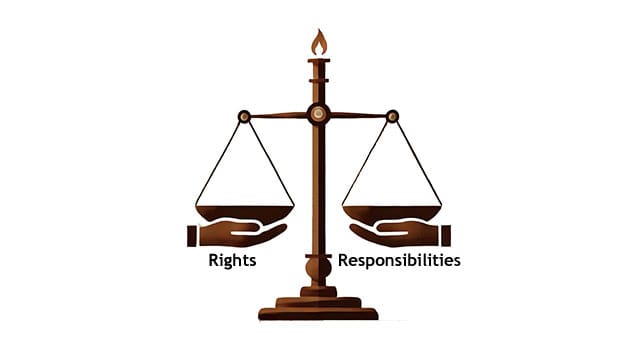
Rights and responsibilities are interconnected. When citizens possess certain rights, the state has a corresponding responsibility to protect those rights from violation. Similarly, when individuals have responsibilities, others have the right to expect those responsibilities to be fulfilled.
Example
Practical Application: School Accessibility
School principals have a responsibility to ensure disabled students can attend their local school. This might involve providing:
- Wheelchair access to all facilities
- Teacher support and specialized assistance
- Appropriate training for staff
This responsibility corresponds directly to the student's right to equal education under the Disability Discrimination Act 1992 (Cth).
Legal basis of rights
For a right to be legally enforceable, it must be protected by Australian law. There are three main sources of legal rights in Australia:
Constitution
The Australian Constitution establishes two categories of rights:
Express rights are clearly and explicitly written into the Constitution. These are absolute protections that cannot be easily removed.
Example
Express Right: Freedom of Religion
Section 116 guarantees freedom of religion. This prevents future governments from:
- Banning specific religions
- Forcing citizens to follow a particular faith
- Establishing a state religion
This is an absolute constitutional protection that safeguards religious freedom for all Australians.
Implied rights are not explicitly stated but can be inferred by reading the Constitution as a whole. Courts must "read between the lines" to identify these rights.
Example
Implied Right: Freedom of Political Communication
The right to freedom of political communication is an implied right derived from constitutional provisions about representative government. Although not explicitly written in the Constitution, courts have recognized this right as essential for democratic governance.
Important
Exam Tip: When discussing constitutional rights, always distinguish between express (explicitly stated) and implied (inferred) rights. This demonstrates analytical understanding and will earn you higher marks.
Statute
Statutory rights are created by legislation passed by Parliament. These laws protect individuals from discrimination and unfair treatment.
Key legislation includes:
- Racial Discrimination Act 1975 (Cth) – protects against exclusion or restriction based on race or ethnic origin
- Disability Discrimination Act 1992 (Cth) – protects against discrimination based on physical or mental disability
Example
Application of Statutory Rights
An employer cannot dismiss an employee because of their racial background. A political party cannot refuse membership based on ethnic origin. These actions would breach statutory rights and expose the discriminating party to legal consequences.
These protections are legally enforceable, meaning victims can seek remedies through the courts.
Common law
Common law rights develop through court decisions and judicial interpretation. When judges make rulings, they create legal precedents that establish rights.
Landmark case: Dietrich v R [1992] HCA 57; (1992) 177 CLR 292
The High Court ruled that individuals have the right to a fair trial. In serious criminal cases, this includes the right to legal representation funded by the state if the accused cannot afford a lawyer.
Important
Exam Tip: When citing cases, include the case name, year, and court. Explain the legal principle established, not just the facts. This shows you understand the significance of the case beyond its narrative.
Legal basis of responsibilities
Responsibilities (also called obligations or duties) correspond to rights. When someone has a right, another party has a responsibility to respect or fulfil that right.
Statutory responsibilities
Legislation creates specific legal duties that individuals and organisations must fulfil.
Example
Statutory Duties: Education Act 1990 (NSW)
The Education Act 1990 (NSW) creates reciprocal duties:
Parental duties:
- Parents have a duty to send their children to school or arrange home schooling
- This ensures children receive proper education
State duties:
- The state has a duty to provide public schools
- The state must ensure every child receives the best possible education
These duties are based on section 4 of the Act, which establishes that every child has the right to education. The duties exist to protect and fulfil this fundamental right.
Common law responsibilities
The courts have established important common law duties through case decisions.
Duty of care
The landmark case Donoghue v Stevenson [1932] AC 562 established the modern concept of duty of care. This case determined that individuals and organisations owe a duty of care to all persons who are likely to be closely and directly affected by their actions or behaviour.
Note
Application of Duty of Care
The duty of care principle extends to many situations:
- A soft drink manufacturer must take reasonable care to ensure their products do not injure consumers
- Doctors owe a duty of care to their patients
- Drivers owe a duty of care to other road users
- Property owners owe a duty of care to visitors
Negligence occurs when someone breaches their duty of care, causing foreseeable harm to another person. Victims can bring legal action for damages.
Example
Case Study: Medical Negligence
Hanssen v Peninsula Private Hospital 2012 Vic
Facts: A boy was severely handicapped during childbirth due to hospital negligence.
Action: The parents sued the hospital for breach of duty of care.
Outcome: The case was settled, with the family receiving millions of dollars in damages.
Legal principle: Medical professionals and hospitals owe a duty of care to patients. When this duty is breached and causes harm, victims are entitled to compensation.
Important
Exam Tip: Negligence Framework
When discussing duty of care, use this four-step formula:
- Duty exists – establish that a duty of care was owed
- Duty was breached – show how the duty was violated
- Breach caused foreseeable harm – demonstrate causation and foreseeability
- Damages awarded – explain the legal remedy
This structured approach demonstrates thorough legal analysis.
The distinction between moral and legal rights
Legal rights are enforceable through the legal system. They are protected by the Constitution, statutes or common law. If someone violates your legal rights, you can seek legal remedies.
Moral rights are based on ethical principles and social expectations. They may not be legally enforceable, even though most people believe they should be respected.
Example
Distinguishing Legal and Moral Rights: Fidelity in Relationships
Most people expect fidelity (faithfulness) in romantic relationships – this is a moral right based on ethical expectations and social norms.
However, engaging in extra-marital affairs is not a breach of statutory, common or constitutional law. While morally wrong to many people, it is not legally prohibited.
The distinction: Legal rights have legal consequences when violated (court action, penalties, damages). Moral rights may only have social or ethical consequences (damaged relationships, social disapproval), but cannot be enforced through the legal system.
Important
Key Distinction
Legal rights → Enforceable by law → Legal consequences when violated
Moral rights → Based on ethics → Social/ethical consequences only
Summary
Key Points to Remember:
Core Concepts:
- Rights are legal or moral entitlements; responsibilities are legal or moral obligations
- Rights and responsibilities are interconnected – rights create corresponding responsibilities
- Legal rights in Australia come from three sources: Constitution (express and implied), statute, and common law
- Legal responsibilities are also called obligations or duties
Important Principles:
- Duty of care requires individuals and organisations to avoid causing foreseeable harm to others
- Legal rights are enforceable by law; moral rights are based on ethics but may not be legally enforceable
- Negligence occurs when duty of care is breached, causing foreseeable harm
Key Terms:
- Express rights: Clearly stated in the Constitution
- Implied rights: Inferred from the Constitution
- Tortious: Wrongful conduct constituting a civil wrong
- Negligence: Breach of duty of care causing foreseeable harm
Essential Legislation:
- Disability Discrimination Act 1992 (Cth)
- Racial Discrimination Act 1975 (Cth)
- Education Act 1990 (NSW)
Critical Cases:
- Dietrich v R [1992] – Right to fair trial and legal representation
- Donoghue v Stevenson [1932] – Duty of care principle
- Hanssen v Peninsula Private Hospital 2012 – Medical negligence