Compound Interest (HSC SSCE Mathematics Standard): Revision Notes
📚Revision Notes
Compound Interest
What is compound interest?
Compound interest is a method of calculating interest where you earn interest not just on your original investment (the principal), but also on any interest you've already earned. This creates a "snowball effect" where your money grows faster over time.
Think of it as "interest on interest" – each time period, the interest is calculated on a larger and larger amount.
Note
How is this different from simple interest?
With simple interest, you only ever earn interest on the original amount. With compound interest, your interest earns interest too, leading to much faster growth over time.
How compound interest grows
Let's look at an example to see how this works. If you invest $100 at a compound interest rate of 10% per annum (p.a.), here's what happens:
Notice how the interest amount increases each year:
- Year 1: $10 interest
- Year 2: $11 interest
- Year 3: $12.10 interest
This happens because each year's interest is calculated on the growing balance, not just the original $100.
Future value formula
To calculate how much an investment will be worth in the future, we use the future value formula:
Where:
- = Future value (the final amount you'll have)
- = Present value (the initial amount you invest or borrow)
- = Interest rate per compounding period (as a decimal)
- = Number of compounding periods
Important
Converting Percentages to Decimals
Always convert percentage rates to decimals by dividing by 100. For example, 6.5% becomes 0.065. This is one of the most common mistakes in compound interest calculations!
Example
Worked Example: Finding Future Value
Question: Paige invests $5000 over 5 years at a compound interest rate of 6.5% p.a. Calculate:
a) The amount of the investment after 5 years
b) The interest earned after 5 years
Solution:
Part a) Finding the future value
Write the formula:
Substitute the values (, , ):
Answer: The investment will be worth $6850.43 after 5 years.
Part b) Finding the interest earned
To find the interest earned, we subtract the original investment from the future value:
Answer: The interest earned is $1850.43.

Calculating compound interest
The compound interest formula helps you find just the interest portion (not the total amount):
Where:
- = Interest earned or owed
- = Future value (final balance)
- = Present value (initial amount)
Example
Worked Example: Monthly Compounding
Question: James borrowed $50000 for 4 years at 11% p.a. interest compounding monthly. Calculate:
a) The amount owed after 4 years
b) The interest paid after 4 years
Solution:
Part a) Finding the amount owed
When interest compounds monthly, we need to adjust both the rate and the time period:
- The monthly interest rate is (annual rate divided by 12)
- The number of months is
Write the formula:
Substitute the values:
Answer: The amount owed after 4 years is $77479.90.
Part b) Finding the interest paid
Answer: The interest paid is $27479.90.
Important
When Interest Compounds More Frequently
When interest compounds more frequently than yearly (like monthly or quarterly), remember to:
- Divide the annual rate by the number of compounding periods per year
- Multiply the number of years by the same number of compounding periods
For example, monthly compounding over 4 years means: and
Present value formula
Sometimes you know how much you want to have in the future, and need to work out how much to invest now. This is called finding the present value.
The future value formula can be rearranged to give:
Where:
- = Present value (amount to invest now)
- = Future value (target amount)
- = Interest rate per compounding period (as a decimal)
- = Number of compounding periods
Note
Understanding Present Value
Present value answers the question: "How much do I need to invest today to reach my financial goal in the future?" It's essentially working backwards from your future goal to find your starting point.
Example
Worked Example: Calculating Present Value
Question: Calculate the present value needed if you want to have $8723.27 in 5 years, with a compound interest rate of 4.5% p.a.
Solution:
Write the present value formula:
Substitute the values (, , ):
Answer: You would need to invest $7000 now.
Example
Worked Example: Monthly Compounding with Present Value
Question: Calculate the present value needed to have $500000 in 8 years with an interest rate of 8.5% p.a. compounding monthly.
Solution:
For monthly compounding:
- Monthly rate:
- Number of months:
Write the formula:
Substitute the values:
Answer: You would need to invest $253916.41 now.
Graphing compound interest
Compound interest creates an exponential curve when graphed. This means the interest grows faster and faster over time, creating a curve that gets steeper.
Steps to create a compound interest graph
1. Create a table of values
Use the compound interest formula to calculate the future value and interest for different time periods.
2. Set up your axes
- Horizontal axis (): Time periods (years)
- Vertical axis (): Interest earned
3. Plot the points and draw the curve
Plot your calculated points and join them with a smooth exponential curve (not straight lines).
Example
Worked Example: Constructing a Graph
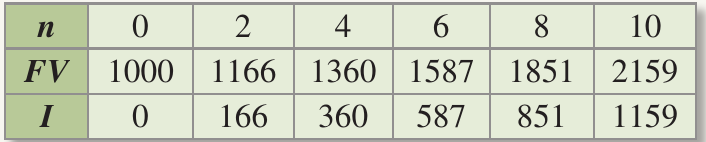
Question: Draw a graph showing the interest earned over 10 years if $1000 is invested at 8% p.a. compound interest. Use the graph to estimate the interest earned after 7.5 years.
Solution:
First, set up the formulas:
Create a table of values by calculating and for different values of :
Now plot these points on a graph with on the horizontal axis and on the vertical axis:
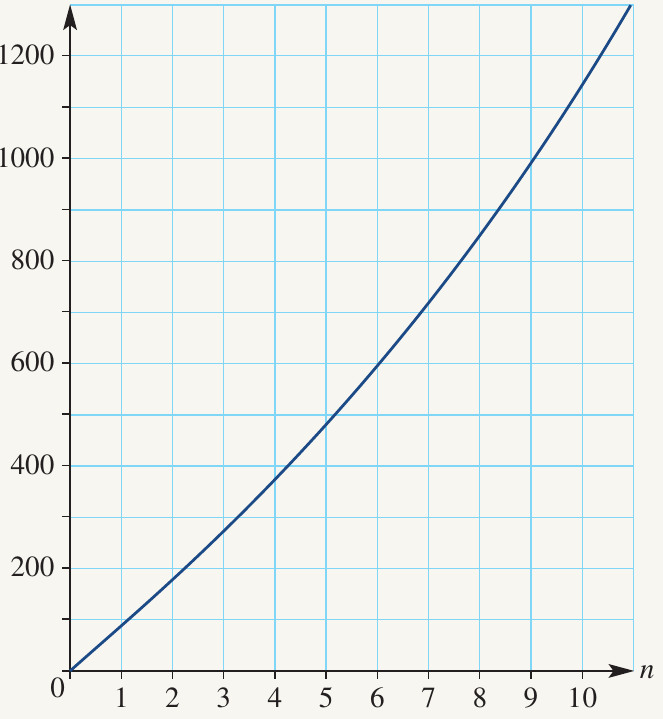
To estimate the interest after 7.5 years:
- Find on the horizontal axis
- Draw a vertical line up to the curve
- Draw a horizontal line across to the vertical axis
- Read the value
From the graph, the interest after 7.5 years is approximately $780.
Note
Why the Curve Gets Steeper
The curve gets steeper as time goes on – this shows how compound interest accelerates over time. This is why starting to invest early makes such a big difference! Even a few extra years at the beginning can result in significantly more money at the end.
Summary
Key Points to Remember:
-
Compound interest means "interest on interest" – you earn interest on both your original investment and on interest you've already earned
-
The future value formula is:
-
To find interest earned:
-
The present value formula is:
-
When compounding occurs more than once per year (like monthly), divide the annual rate by the number of periods and multiply the years by the same number
-
Always convert percentages to decimals before using them in formulas (divide by 100)
-
Compound interest creates an exponential curve that gets steeper over time – this is why starting early with investments is so powerful!