Simple Interest (HSC SSCE Mathematics Standard): Revision Notes
📚Revision Notes
Simple Interest
What is interest?
Interest is money that is either paid for borrowing funds or earned for lending funds. When you borrow money from a bank or financial institution, you pay interest. When you invest money or deposit it in a savings account, you earn interest.
There are several methods for calculating interest. This note focuses on simple interest, which is also known as flat interest.
Understanding simple interest
Simple interest is calculated as a fixed percentage of the original amount invested or borrowed. The key feature of simple interest is that it is always calculated on the initial sum, called the principal, and remains constant throughout the investment or loan period.
For instance, if you deposit $100 in a bank account that pays interest per annum (per year), you will receive $5 in interest each year:
Note
This $5 payment stays the same every year because simple interest does not compound. The calculation is always based on the original $100, not on the growing total.
Simple interest formula
The formula for calculating simple interest is:
Where:
- = Interest (simple or flat) earned for the use of money
- = Principal, which is the initial amount of money borrowed or invested
- = Rate of simple interest per period, expressed as a decimal
- = Number of time periods
Important
Remember to convert percentage rates to decimals before using the formula. For example, becomes .
Calculating simple interest
Let's look at how to use the simple interest formula in practice.
Example
Worked Example 1: Finding simple interest
Question: Calculate the amount of simple interest paid on an investment of $16000 at simple interest per annum for years.

Solution:
- Write the simple interest formula:
- Substitute , and into the formula:
- Evaluate:
- Therefore, the simple interest is $3840.
Amount owed or future value
When dealing with loans or investments, we often need to find the total amount at the end of the period. This is called the amount owed (for loans) or the future value (for investments). To find this, we add the interest earned to the original principal.
Formula for amount owed or future value
Where:
- = Amount or final balance
- = Interest (simple or flat) earned
- = Principal, which is the initial quantity of money
Example
Worked Example 2: Calculating the amount owed
Question: Find the amount owed on a loan of $50000 at per annum simple interest at the end of two years and six months.
Solution:
- Write the simple interest formula:
- Substitute , and into the formula:
- Evaluate:
- Write the amount owed formula:
- Substitute and into the formula:
- Evaluate:
- Therefore, the amount owed is $58750.
Example
Worked Example 3: Calculating value of an investment
Question: Joel plans to make an investment of $200000 at p.a. simple interest for years. What is the total value of his investment at the end of years?
Solution:
- Write the simple interest formula:
- Substitute , and into the formula:
- Evaluate:
- Write the amount owed formula:
- Substitute and into the formula:
- Evaluate:
- Therefore, the total value is $230000.
Simple interest graphs
When we represent simple interest visually on a graph, we can see an important characteristic: simple interest creates a straight-line graph. This is because the interest increases by a constant amount for each time period.
How to construct a simple interest graph
To draw a simple interest graph:
- Construct a table of values for and using the simple interest formula
- Draw a number plane with as the horizontal axis and as the vertical axis, then plot the points
- Join the points to create a straight line
Note
The linear nature of the graph shows that simple interest grows at a constant rate over time.
Example
Worked Example 4: Constructing a simple interest graph
Question: Draw a graph showing the amount of simple interest earned over a period of years if $1000 is invested at p.a. Use the graph to estimate the interest earned after years.
Solution:
- Write the simple interest formula:
- Substitute , and into the formula:
- Draw a table of values for and :
- Let and find the interest using :
- Draw a number plane with as the horizontal axis and as the vertical axis
- Plot the points , , , , and
- Draw a straight line between the points (simple interest graphs are always linear)
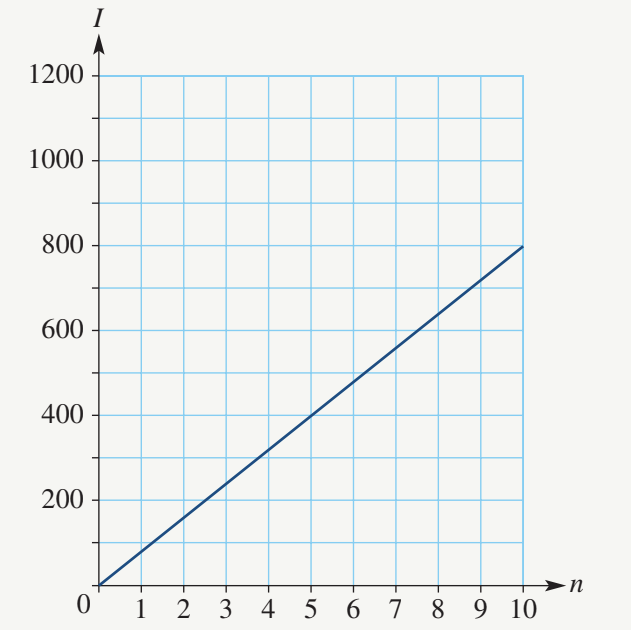
- Read the graph to estimate when :
- Therefore, the interest after years is approximately $600.
Important
Exam tip: When drawing simple interest graphs, always remember that they will be straight lines. If your graph is curved, check your calculations.
Summary
Key Points to Remember:
- Simple interest is calculated as a fixed percentage of the principal and does not change over time
- The simple interest formula is , where you must convert percentage rates to decimals
- To find the total amount or future value, use
- Simple interest graphs are always straight lines because interest increases by a constant amount each period
- Always check your units: if time is given in months, convert to years by dividing by
- When calculating with percentages like , remember to write it as in the formula