Pythagoras’ Theorem (HSC SSCE Mathematics Standard): Revision Notes
📚Revision Notes
Pythagoras' Theorem
What is Pythagoras' theorem?
Pythagoras' theorem is a fundamental relationship in geometry that connects the three sides of any right-angled triangle. Understanding this theorem is essential for solving many practical problems involving distances and measurements.
In a right-angled triangle, the side directly across from the right angle is called the hypotenuse. This is always the longest side of the triangle.

Note
The term "hypotenuse" comes from the Greek words meaning "stretching under" - it's the side that stretches under (opposite to) the right angle. Recognizing the hypotenuse is the first step in applying Pythagoras' theorem correctly.
The theorem statement
Pythagoras' theorem tells us that the square of the hypotenuse equals the sum of the squares of the other two sides.
We can write this mathematically as:
Where:
- is the length of the hypotenuse
- and are the lengths of the other two sides
You can also express this as:
When to use Pythagoras' theorem
This theorem helps you find a missing side length in a right-angled triangle when you know the lengths of the other two sides. You can use it to:
- Calculate the hypotenuse when you know both shorter sides
- Find one of the shorter sides when you know the hypotenuse and the other short side
- Check whether a triangle contains a right angle
Note
Pythagoras' theorem ONLY works for right-angled triangles. If you try to use it on a triangle without a right angle, your answer will be incorrect. Always check that your triangle has a right angle before applying the theorem.
Finding the length of the hypotenuse
When you need to find the hypotenuse and you know the two shorter sides, you'll be adding the squares of the known sides together and then taking the square root.
Example
Worked Example: Finding the hypotenuse
Find the length of the hypotenuse, correct to two decimal places.
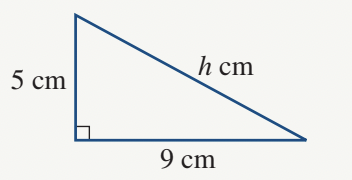
Solution:
Step 1: Write down Pythagoras' theorem.
Step 2: Substitute the known side lengths into the formula.
Step 3: Take the square root of both sides to find .
Step 4: Calculate the answer and round to two decimal places.
The hypotenuse is approximately 10.30 cm long.
Finding the length of a shorter side
When you know the hypotenuse and one of the shorter sides, you need to rearrange the formula to find the unknown shorter side. This time, you'll be subtracting rather than adding.
Example
Worked Example: Finding a shorter side
What is the value of , correct to one decimal place?
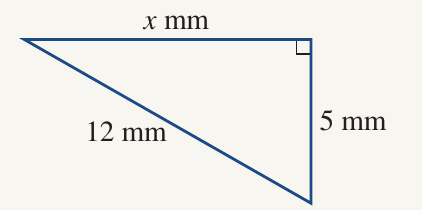
Solution:
Step 1: Write down Pythagoras' theorem.
Step 2: Substitute the known values. Here, the hypotenuse is mm and one side is mm.
Step 3: Rearrange the equation to make the subject.
Step 4: Take the square root to find .
Step 5: Calculate the answer and round to one decimal place.
The unknown side is approximately 10.9 mm long.
Important
Exam tip: When finding a shorter side, remember to subtract the known side squared from the hypotenuse squared BEFORE taking the square root. A common mistake is to take the square root first, which will give you an incorrect answer.
Applying Pythagoras' theorem to real-world problems
Pythagoras' theorem is incredibly useful for solving practical problems involving distances, heights, and measurements. Many real-life situations - from construction and navigation to sports and engineering - can be represented as right-angled triangles.
Note
Problem-solving steps
When tackling word problems using Pythagoras' theorem:
- Read the question carefully and identify the key information
- Draw a clear diagram showing the right-angled triangle
- Label all known measurements on your diagram
- Determine whether you need to find the hypotenuse or a shorter side
- Apply Pythagoras' theorem and calculate your answer
- Check that your answer is reasonable and includes the correct units
- Write your final answer in words, clearly answering the question asked
Example
Worked Example: Real-world application
A helicopter is at a height of m above the ground and is a horizontal distance of m from a landing pad. Find the direct distance of the helicopter from the landing pad, correct to two decimal places.
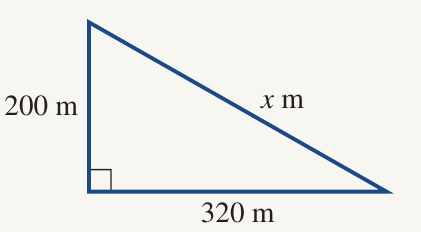
Solution:
Step 1: Draw a diagram showing the situation as a right-angled triangle.
The vertical height is m, the horizontal distance is m, and we need to find the direct distance (the hypotenuse).
Step 2: Label the hypotenuse with , which represents the direct distance from the helicopter to the landing pad.
Step 3: Write down Pythagoras' theorem.
Step 4: Substitute the known side lengths.
Step 5: Take the square root to find .
Step 6: Calculate the answer correct to two decimal places.
Step 7: Write the answer in words.
Therefore, the helicopter is 377.36 metres from the landing pad.
Important
Exam tip: Always draw a diagram for word problems. This helps you visualise the situation and identify which measurement is the hypotenuse. Remember that the hypotenuse is always opposite the right angle and is the longest side.
Summary
Key Points to Remember:
- Pythagoras' theorem relates the three sides of a right-angled triangle:
- The hypotenuse is the longest side and sits opposite the right angle
- To find the hypotenuse: square both shorter sides, add them together, then take the square root
- To find a shorter side: square the hypotenuse, subtract the square of the known side, then take the square root
- Always draw a diagram for word problems and check that your final answer makes sense in the context of the question
- The theorem ONLY works for right-angled triangles - check for that right angle first!