Solving Practical Problems (HSC SSCE Mathematics Standard): Revision Notes
📚Revision Notes
Solving Practical Problems
Introduction to practical trigonometry
Trigonometry helps us solve real-world measurement problems that would be difficult or impossible to measure directly. Common applications include:
- Calculating the height of tall objects like trees or buildings
- Determining the height of mountains
- Finding the width of rivers
- Measuring angles in construction projects
Important
When solving trigonometric problems in practical situations, always read questions thoroughly and create a clear diagram showing all the given information.
Step-by-step problem-solving approach
Follow these five essential steps when solving any trigonometric word problem:
Note
The Five-Step Approach:
Step 1: Read carefully
- Read the question and underline key information
- Identify what you need to find
Step 2: Draw a diagram
- Sketch a right-angled triangle
- Label all given measurements
- Mark the unknown value with a symbol (like or )
Step 3: Use trigonometry
- Choose the appropriate trigonometric ratio
- Set up and solve the equation
Step 4: Check your work
- Verify the answer is reasonable
- Ensure units are correct
Step 5: Write a complete answer
- Express your answer in words
- Confirm you have answered the question asked
Finding the length of a side
When you need to find an unknown side length in a right-angled triangle, use the appropriate trigonometric ratio based on what information you have.
Worked example: Tent pole height
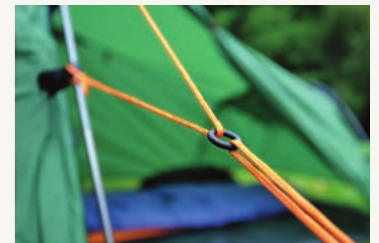
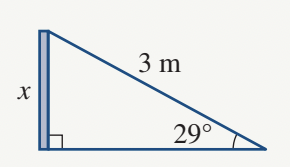
A vertical tent pole is supported by a rope tied to the top of the pole and to a peg on the ground. The rope is m in length and makes an angle of to the horizontal. What is the height of the tent pole? Answer correct to two decimal places.
Example
Worked Example: Finding the Height of a Tent Pole
1. Draw and label the diagram
Let the height of the tent pole be metres.
2. Name the sides
From the angle of :
- Adjacent side: base (along the ground)
- Opposite side: (the height we need)
- Hypotenuse: m (the rope length)
3. Determine the ratio
Since we know the hypotenuse and need the opposite side, use the sine ratio (SOH):
4. Substitute known values
5. Solve for
Multiply both sides by :
6. Calculate
Using a calculator:
7. Round to two decimal places
8. Write the answer in words
Therefore, the height of the tent pole is m.
Note
Exam tip: Always check your answer makes sense. Here, the height ( m) is less than the rope length ( m), which is correct for a angle.
Finding an angle
When you need to find an unknown angle in a right-angled triangle, use inverse trigonometric functions.
Trigonometry has many practical applications in building and construction. Vertical parts of structures make right angles with horizontal parts. Sloping lines complete right-angled triangles, allowing us to calculate angles and side lengths.
Worked example: Roof angle
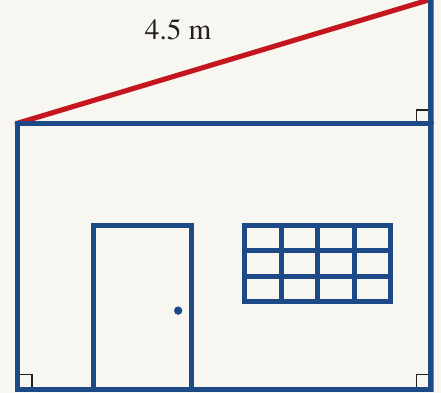

The sloping roof of a shed uses sheets of Colorbond steel m long on a shed m wide. There is no overlap of the roof past the sides of the walls. Find the angle the roof makes with the horizontal. Answer correct to the nearest degree.
Example
Worked Example: Finding the Roof Angle
1. Draw and label the diagram
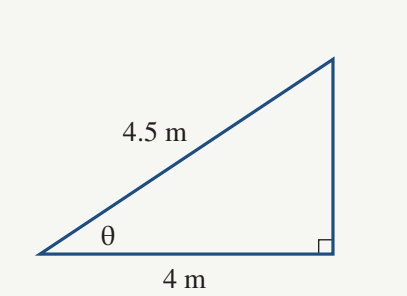
Let the required angle be .
2. Name the sides
From the angle :
- Adjacent side: m (width of shed)
- Opposite side: height (unknown)
- Hypotenuse: m (length of roof sheet)
3. Determine the ratio
Since we know the adjacent side and hypotenuse, use the cosine ratio (CAH):
4. Substitute known values
5. Make the subject
Use the inverse cosine function:
6. Calculate
Using a calculator: SHIFT = or exe
7. Round to the nearest degree
8. Write the answer in words
Therefore, the roof makes an angle of with the horizontal.
Note
Exam tip: To find an angle, you must use an inverse trigonometric function (, , or ). Make sure you know how to access these on your calculator.
Choosing the correct ratio
To select the appropriate trigonometric ratio:
Important
Selecting the Right Ratio:
-
Identify which sides you know or need to find
-
Match these to the ratio:
- SOH: Use when you have opposite and hypotenuse
- CAH: Use when you have adjacent and hypotenuse
- TOA: Use when you have opposite and adjacent
-
To find a side: substitute values and solve
-
To find an angle: use the inverse function (, , or )
Remember!
Summary
Key Points to Remember:
- Always draw a clear, labelled diagram for practical trigonometry problems
- Follow the five-step problem-solving approach: read, draw, calculate, check, answer
- Use SOH CAH TOA to choose the correct trigonometric ratio based on which sides you know
- To find a side length, use the trigonometric ratio directly
- To find an angle, use inverse trigonometric functions (, , or )
- Check your answer is reasonable and includes the correct units
- Always write your final answer in words to ensure you've answered the question