Trigonometric Ratios (HSC SSCE Mathematics Standard): Revision Notes
📚Revision Notes
Trigonometric Ratios
Introduction to trigonometric ratios
Trigonometric ratios are mathematical relationships that connect the angles and sides of right-angled triangles. We use three main trigonometric ratios: sine (), cosine (), and tangent (). These ratios help us solve problems involving right-angled triangles and are fundamental tools in mathematics.
Note
Understanding trigonometric ratios is essential for solving a wide range of mathematical problems, from finding unknown sides and angles in triangles to applications in physics, engineering, and navigation.
Naming the sides of a right-angled triangle
Before working with trigonometric ratios, you need to identify the three sides of a right-angled triangle correctly. Each side has a specific name depending on its position relative to the angle you're working with.
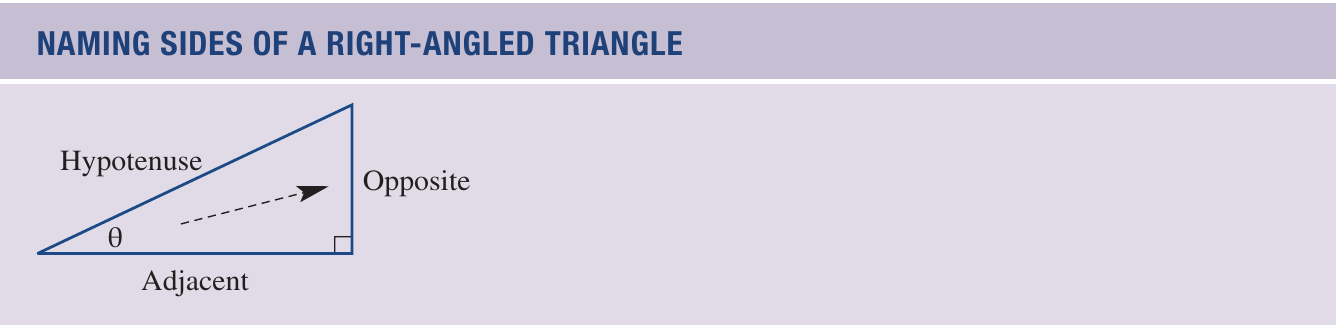
The three sides are:
- Hypotenuse: This is always the longest side of the triangle. It sits directly opposite the right angle (the 90° angle).
- Opposite side: This side is opposite to the angle (theta) that you're considering. The angle theta is the Greek letter commonly used to represent an angle in mathematics.
- Adjacent side: This is the side next to the angle , but it's not the hypotenuse. Think of it as the side that forms part of the angle along with the hypotenuse.
Important
Critical Concept: The opposite and adjacent sides can change depending on which angle you're using. If you consider the other acute angle in the triangle instead of , the labels for opposite and adjacent would swap positions. However, the hypotenuse always stays the same because it's always opposite the right angle.
Example
Worked Example: Identifying triangle sides
Let's say you have a right-angled triangle with sides measuring 3, 4, and 5, where is at one of the acute angles.
- Hypotenuse = 5 (the longest side, opposite the right angle)
- Opposite side = 4 (the side across from angle )
- Adjacent side = 3 (the side next to angle , excluding the hypotenuse)
Remember: Always identify which angle you're working with first, then label the sides accordingly.
The three trigonometric ratios
Once you've correctly named the sides of your triangle, you can calculate the three trigonometric ratios. Each ratio compares two specific sides of the triangle.
Sine ratio
The sine of an angle is the ratio of the opposite side to the hypotenuse:
Cosine ratio
The cosine of an angle is the ratio of the adjacent side to the hypotenuse:
Tangent ratio
The tangent of an angle is the ratio of the opposite side to the adjacent side:
The SOH CAH TOA mnemonic
To help you remember which ratio uses which sides, use the mnemonic SOH CAH TOA (pronounced as one word, like "so-ka-toe-ah").
- SOH: Sine - Opposite - Hypotenuse
- CAH: Cosine - Adjacent - Hypotenuse
- TOA: Tangent - Opposite - Adjacent
The order of the letters in each part matches the order in the ratio. For example, SOH tells you that sine equals opposite divided by hypotenuse.
Note
Exam tip: Write "SOH CAH TOA" at the top of your working when solving trigonometry problems. This simple step can help prevent mistakes and remind you of the correct ratios to use.
Understanding why trigonometric ratios are constant
A key property of trigonometric ratios is that they remain constant for a specific angle, regardless of the size of the triangle. Let's explore what this means.
Triangles with 30° angles

Consider three different-sized right-angled triangles, all containing a 30° angle. Although the triangles are different sizes, they all have the same sine ratio:
- Small triangle:
- Medium triangle:
- Large triangle:
This demonstrates that any right-angled triangle with a 30° angle will have a sine ratio of 0.5. If you change the angle, the ratio changes, but all triangles with the same angle share the same trigonometric ratios.
Triangles with 45° angles
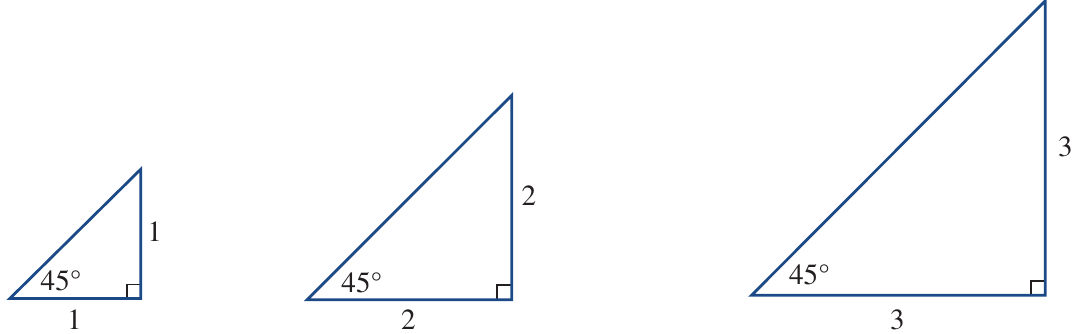
Similarly, let's examine three right-angled triangles with 45° angles. For these triangles, the tangent ratio is always 1:
- Small triangle:
- Medium triangle:
- Large triangle:
Important
This consistency applies to all three trigonometric ratios (sine, cosine, and tangent). The size of the triangle doesn't matter; only the angle affects the ratio values.
Worked example: Finding all three trigonometric ratios
Example
Worked Example: Finding all three trigonometric ratios
Let's find the sine, cosine, and tangent ratios for angle in a triangle with sides 8, 15, and 17.
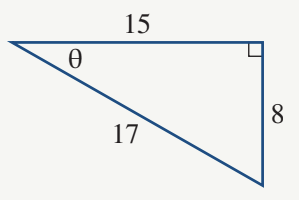
Step 1: Name the sides of the triangle
- Adjacent side:
- Opposite side:
- Hypotenuse:
Step 2: Calculate the sine ratio using SOH
Step 3: Calculate the cosine ratio using CAH
Step 4: Calculate the tangent ratio using TOA
Therefore, for this triangle: , , and .
Worked example: Finding a trigonometric ratio using Pythagoras' theorem
Sometimes you'll know one trigonometric ratio and need to find another. In these cases, you might need to use Pythagoras' theorem to find a missing side first.
Example
Worked Example: Finding a trigonometric ratio using Pythagoras' theorem
Question: Find in simplest form given .
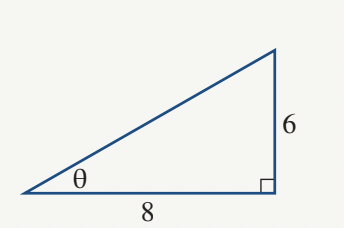
Step 1: Draw a triangle and label the known sides
Since , we know:
- Opposite side = 6
- Adjacent side = 8
Step 2: Use Pythagoras' theorem to find the hypotenuse
Pythagoras' theorem states:
Step 3: Substitute the known values
Step 4: Calculate the hypotenuse
Step 5: Find the sine ratio
Step 6: Simplify the ratio
Therefore, .
Note
Exam tip: Always simplify your trigonometric ratios to their simplest form unless the question specifies otherwise. Divide both the numerator and denominator by their highest common factor.
Remember!
Summary
Key Points to Remember:
-
Naming sides: The hypotenuse is always opposite the right angle. The opposite side is across from your angle , and the adjacent side is next to (but not the hypotenuse).
-
Three key ratios: , , and . Use SOH CAH TOA to remember these.
-
Constant ratios: Trigonometric ratios stay the same for a given angle, no matter how large or small the triangle is.
-
Pythagoras' theorem: When you need to find a missing side before calculating a trigonometric ratio, use .
-
Always simplify: Express your final answers as simplified fractions where possible.